

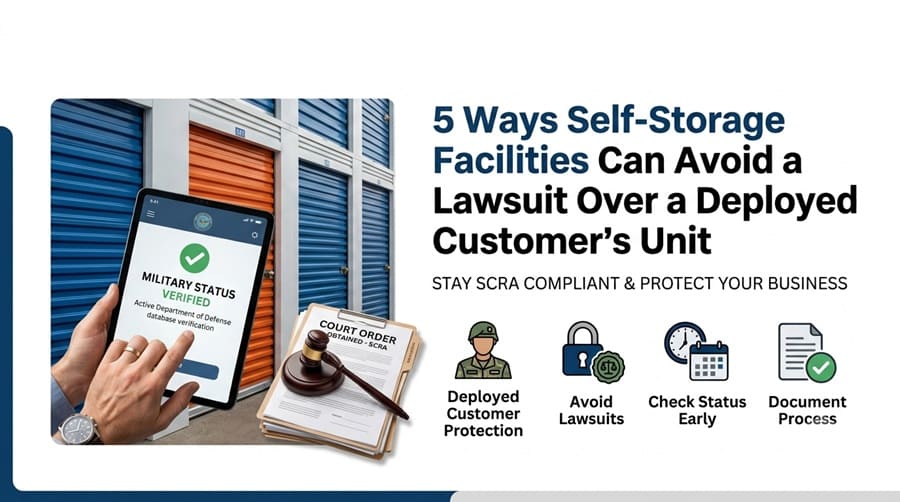
5 Ways Self-Storage Facilities Can Avoid a Lawsuit Over a Deployed Customer’s Unit
An Air Force staff sergeant told her storage facility she was on active duty before deploying to Jordan. The facility auctioned her belongings anyway, including her military awards and her children’s keepsakes. That single unit cost the operator $130,000 in a Justice Department settlement. The mistake wasn’t cruelty. It was a missed step most facilities assume they’ve covered.
TL;DR: The Servicemembers Civil Relief Act (SCRA) requires storage operators to verify military status and get a court order before selling a delinquent unit’s contents. Skip either step, and you risk federal penalties and tenant damages, regardless of whether the customer mentioned they were deployed. The fix: check status early, get court approval, drop waiver language, train staff, and document the process.
Check Military Status Before the Account Goes to Lien
Run a status check the moment an account hits 60 days late, not after you’ve scheduled the sale. The SCRA treats this as a strict liability rule. It doesn’t matter whether the tenant mentioned deployment or never said a word.
The fastest way to get a clear answer is to verify military status through the Department of Defense’s database before any unit moves toward auction. A same-day check costs far less than a lawsuit, and it leaves a record showing you checked first.
Get a Court Order Before You Sell Anything
Even when a tenant is confirmed active duty, most states still let you enforce a lien. What you can’t do is skip the courthouse. Federal law requires a judge’s order before you auction or dispose of a servicemember’s property, and that requirement extends 90 days past their service.
Massachusetts mover Father & Son Moving & Storage learned this after auctioning an Air Force sergeant’s two units, which held his late cousin’s combat mementos and his grandfather’s service medals. The Justice Department made the company pay damages and a civil penalty for skipping the court order. A court order isn’t a formality. It’s what separates a lien sale from a federal case.
Drop Waiver Language From Your Lease
Some rental agreements try to get tenants to sign away SCRA protections upfront, often buried in the fine print. Courts push back hard on this. A waiver signed before a dispute exists generally won’t hold up, and relying on one gives you false confidence while the risk stays the same. Rewrite your lease so it acknowledges SCRA rights instead of routing around them.
Train Every Employee Who Handles Delinquent Accounts
Front desk staff usually notice a stalled account first, and they’re rarely the ones who understand federal military protections. Build status checks and court order steps into your standard collections workflow, not a manual nobody reads after onboarding. A short refresher twice a year catches more problems than a binder on a shelf.
Keep Records From the First Missed Payment to the Sale
Document every contact attempt, status check, and court filing tied to a delinquent unit. If a case reaches a judge, your paperwork proves you followed the process instead of skipping it. Facilities that lose these cases usually can’t produce a clean timeline, not because they broke the law on purpose but because nobody wrote anything down.
Why This Process Protects Your Business, Not Just Your Tenants
The Justice Department has recovered over $474 million for more than 120,000 service members through SCRA enforcement since 2011, and self-storage cases keep showing up on that list. That reflects a pattern, not an occasional slip by a careless operator. The facilities that treat verification as optional usually learn about the law from a subpoena instead of a training session.
FAQs
Do I have to check military status on every delinquent account, or only when a tenant mentions deployment?
Check every account before moving toward a lien sale. The SCRA doesn’t require disclosure, and courts hold facilities responsible for verifying status regardless of what was said at move-in.
Can a servicemember waive their SCRA protections in the storage contract?
Rarely, and not through boilerplate signed before a dispute exists. Waivers get scrutinized closely and often thrown out, so don’t treat one as a substitute for verification and a court order.
What happens if I already sold a unit without knowing the tenant was deployed?
Contact an attorney familiar with SCRA compliance right away. Reporting the issue and remedying it quickly reduces your exposure compared to waiting for the servicemember or the Justice Department to act first.