
6 Things Ohio Bar Owners Should Know About Dram Shop Liability
You poured a drink. Hours later, the person who drank it caused a wreck three miles down the road. Now a lawyer wants to know what you knew and when you knew it. That scenario keeps Ohio bar owners up at night, and most of them misjudge how exposed, or how protected, they actually are. A liquor license attorney in Ohio will tell you the law is narrower than people assume, but the gaps that remain can still end a business.
TL;DR: Ohio’s dram shop law, found in Ohio Revised Code 4399.18, generally shields bar owners from lawsuits over what happens after a patron leaves. That shield disappears fast if you serve someone who is already visibly drunk or underage. Know the six points below, and you will understand exactly where your liability starts and stops.
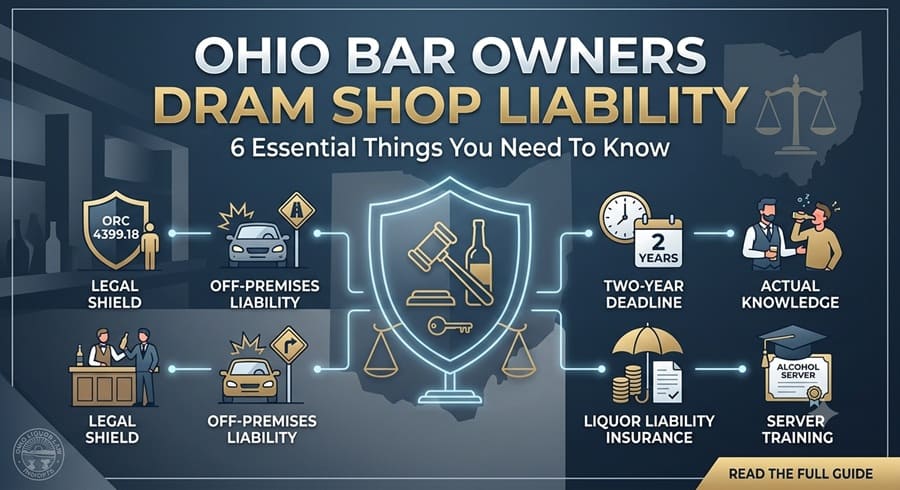
1. The Dram Shop Act Is Your Main Legal Shield, Not a Loophole
Ohio Revised Code 4399.18 is the only law that governs whether an injured party can sue you over a customer’s drinking. Under the statute, someone hurt by an intoxicated patron generally has no case against you unless the injury happened on your property or in a parking lot you control, and your negligence caused it. That single rule protects most bars from claims tied to accidents that happen well after last call.
2. Off-Premises Claims Require Proof You Knew Better
The protection weakens once alcohol leaves your building. Someone hurt off-site can still sue you if you knowingly served a noticeably intoxicated customer or sold to someone underage, and that intoxication caused the harm. The word “knowingly” carries the whole case. Plaintiffs’ attorneys have to show you were aware of the person’s condition, not just that a reasonable bartender should have noticed.
3. A 2025 Ruling Raised the Bar for Plaintiffs, and for You
Ohio courts sharpened this standard recently. In W. Res. Group v. Shingler (2025-Ohio-726), the Fifth District Court of Appeals held that a plaintiff must prove actual knowledge of intoxication, not circumstantial or constructive knowledge. That’s good news for bar owners in one sense: vague accusations no longer carry a claim. It also means your staff’s documented observations matter more than ever if a case reaches a courtroom.
4. You Have Roughly Two Years Before a Claim Can Be Filed
Personal injury claims in Ohio, including those brought under the dram shop statute, generally fall under a two-year statute of limitations set by Ohio Revised Code 2305.10. That clock starts on the date of the injury, not the date someone decides to sue. Keep incident reports, security footage, and receipts for at least that long. A claim filed in year one can hinge entirely on records you didn’t think to save.
5. Liquor Liability Insurance Isn’t Mandated, but Skipping It Is a Gamble
Ohio doesn’t legally require liquor liability coverage the way some states do. What it does require, indirectly, is general liability insurance as a practical condition of holding a liquor permit. Liquor liability sits on top of that, covering the specific scenario where a served patron causes harm. Annual premiums for bars typically run several hundred to a couple of thousand dollars, which is modest next to a single lawsuit.
6. Server Training Isn’t Required by Law, but It Changes Everything Else
Ohio has no statewide mandate forcing bartenders to complete alcohol server certification. That said, most insurers now expect it before they’ll write a policy at a reasonable rate, and trained staff are simply better at spotting the signs that create liability in the first place. Programs built around Ohio’s own Alcohol Server Knowledge guidelines give your team a shared, defensible standard for cutting someone off.
Building a Liability Strategy That Actually Holds Up
Knowing the statute is one thing. Building daily habits around it is another. The bars that stay out of court aren’t the ones that never serve a drunk patron, since that’s not realistic on a busy Friday night. They’re the ones with trained staff, documented incident procedures, adequate coverage, and a clear record of what happened and when. Treat the six points above as a checklist, not trivia, and dram shop exposure stops being a mystery and starts being a manageable part of running the business.
FAQs
Can a bar in Ohio be sued if a customer gets drunk and causes a car accident after leaving?
Generally not, unless the bar knowingly served a noticeably intoxicated or underage patron and that intoxication caused the crash. Ohio’s dram shop law makes this the narrow exception rather than the rule.
Is liquor liability insurance required to get a liquor permit in Ohio?
No. Ohio doesn’t mandate liquor liability insurance specifically, though general liability coverage is commonly required to secure and keep a permit, and most bars carry liquor liability voluntarily.
How long does someone have to sue a bar under Ohio’s dram shop law?
Roughly two years from the date of the injury, under Ohio’s personal injury statute of limitations.
What does “noticeably intoxicated” mean under Ohio law?
Visible signs of impairment, such as slurred speech, stumbling, or erratic behavior, that a server actually perceived. Since the 2025 Shingler ruling, the server’s actual awareness matters more than whether the signs were merely present.