
If you’ve been injured due to someone else’s carelessness, you may have come across the phrase “4 elements of personal injury” when reading about filing a claim.
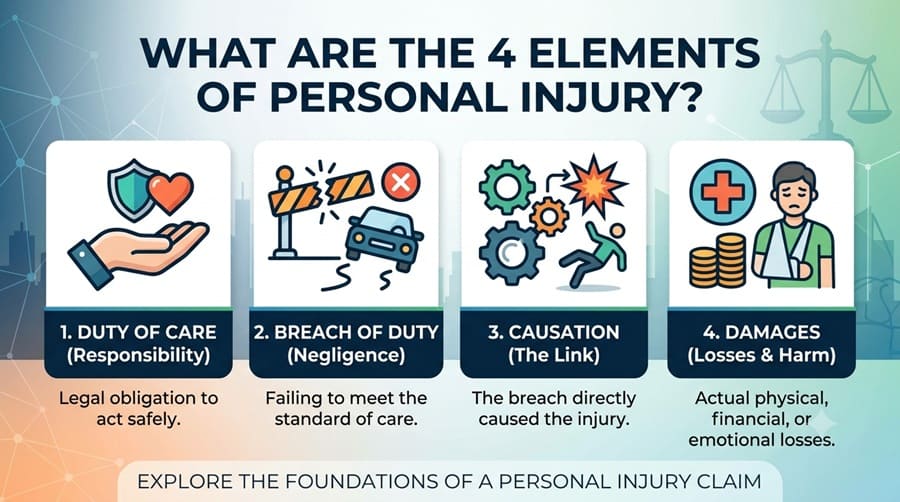
The 4 elements of personal injury are:
- Duty of care
- Breach of duty
- Causation
- Injury/Damages
The 4 elements of personal injury are the things you must prove before you can be granted the compensation you demand.
In simple terms, you must be able to prove that:
- The at-fault party owed you a duty of care
- They failed to uphold that duty of care, therefore putting you in harm’s way
- Their action caused an accident
- The accident led to your injury
In personal injury claims, it is usually not enough to show that you were injured. You must be able to prove that the other party caused it by acting in a way that is unexpected under normal circumstances.
The 4 Elements of Personal Injury Explained
1. Duty of Care
The first thing you must establish in personal injury is that the person owed you a duty of care. This means they have a legal obligation to act in a way that does not put you in harm’s way.
For example, it is expected of drivers to focus on the road, to not overspeed, and to adhere to traffic signs. These obligations do not only protect the drivers — they also serve to prevent them from hurting other road users.
Say, for example, a driver was over speeding and therefore was unable to brake in time before slamming into the car in front.
Doctors owe a duty of care to their patients to warn them of risks and to use safe tools and techniques. Shop owners owe customers a duty of care to keep the floors dry.
2. Breach of Duty
Establishing a breach of duty involves proving that the other party failed to uphold their duty of care to you.
In the example given above, the driver breached their duty of care by going above a safe speed, thereby putting you at risk. Of course, over speeding is dangerous to both the driver and other law-abiding road users.
A doctor who failed to warn you of potential complications of a treatment has breached a duty of care. A pet owner who lets their wild dog loose on the street has breached their duty of care. A manufacturer who knowingly sells a defective product without warning customers is liable for the same.
To determine a breach, the question the court asks is this: “Would a reasonable person have acted differently in the same situation?”
A breach can come from an action (doing something dangerous) or inaction (failing to do what they should have done).
3. Causation
Even after proving the other party owed you a duty of care and breached it, it is still not enough to validate your claim. No compensation would be granted if you cannot also prove that their breach caused your injuries, directly or indirectly.
There are two parts to causation:
- Cause-in-fact. To establish this, the court asks: But for the defendant’s actions, would you have been injured? If the answer is no, then direct causation has been established.
- Proximate cause. The question here is, are your injuries a reasonably foreseeable outcome of the defendant’s actions? If the answer is yes, indirect causation has been established.
The reason is that it’s quite possible for the defendant to have breached a duty of care, while the accident resulted from something entirely different, which unfortunately coincided with when that duty was breached. So it would be unfair for the defendant to pay for something that happened independent of their actions.
Causation is where defendants push back the most, as there is often room for contest. And this is why medical records and witness testimonies immediately after the accident carry so much weight. Witness testimonies can verify that the accident in fact resulted from a lapse on the defendant’s part, while medical records date connect the injuries to the accident. The longer you wait before seeking treatment, the bigger room you give the defendant to dissociate your injuries from the event.
4. Damages
You can prove duty of care, breach of duty, and causation, but if the accident did not lead to actual harm (damages) to you, you may not be entitled to a personal injury claim.
Damages can be tangible or not. Tangible damages are known as economic damages.
- Economic damages: this includes the harm you suffered, resulting in medical bills, property repair (e.g., in a car crash), and lost wages. For every dollar that you lost due to the accident, personal injury law entitles you to reimbursement.
- Non-economic damages: If you can prove that the injury has caused you suffering, loss of enjoyment of life, and emotional distress, you may be entitled to financial compensation, even though these things have no actual dollar value.
In wrongful death cases, the deceased’s family is usually compensated for funeral expenses and loss of consortium. These are easy to prove, as long as it can be proven that the death was a result of someone’s negligence.
At the End of the Day
All four elements must be proven. Three are not enough. And expect the defendant to push back. No one enjoys losing money. Not you. And certainly not the defendant. Insurance companies have ample resources to hire attorneys to defend them. This is why you must equally hire a reputable Tucker personal injury lawyer to protect your rights.
The good part is, personal injury lawyers usually work on a contingency basis. That is, you don’t have to pay upfront. They only take a cut from your compensation, and only after it comes through.
Having strong legal representation is key to establishing the 4 elements of personal injury.