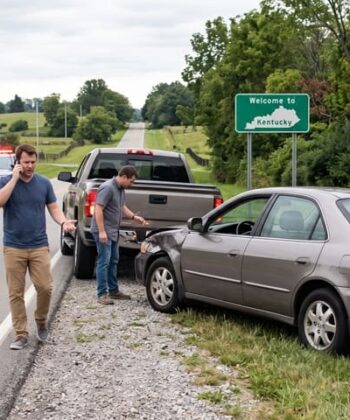

Car, Motorcycle, and Commercial Trucking Accidents in Oklahoma: A Complete Guide to the Legal and Medical Process
Every year, tens of thousands of Oklahomans are hurt in vehicle collisions on the state’s interstates, highways, and city streets. According to research compiled by the national nonprofit transportation group TRIP, an average of 692 people died in Oklahoma traffic crashes each year between 2019 and 2023 — nearly two fatalities a day. Federal data from the National Highway Traffic Safety Administration (NHTSA) later recorded 645 Oklahoma traffic deaths in 2024, a decline from 711 the year before, though alcohol-impaired-driving fatalities actually rose during that same period. Behind every one of those numbers is a person whose life changed in an instant, along with a family that suddenly has to navigate medical bills, lost income, insurance adjusters, and unfamiliar legal deadlines all at once.
This guide breaks down what Oklahomans need to understand about car accidents, motorcycle accidents, and commercial trucking accidents — the three categories of vehicle collisions that most often produce catastrophic injuries and complicated claims. It also walks through how the legal and medical processes intersect after a crash, and what role insurance companies actually play once a claim is opened.
Car Accidents in Oklahoma: Common Causes and Injury Patterns
Passenger vehicle collisions remain the most frequent type of crash on Oklahoma roads. State crash data and federal safety summaries consistently point to a handful of recurring causes:
- Distracted driving. Texting, phone use, and general inattention remain a persistent factor in Oklahoma crash reports, despite the state’s texting-while-driving ban.
- Speeding. Nationally, speeding was a factor in roughly 29 percent of all traffic fatalities in 2023. Oklahoma’s rural highways, many with speed limits of 70 mph or higher, tend to produce more severe outcomes when a speeding-related crash occurs.
- Impaired driving. Alcohol- and drug-related crashes continue to be a leading contributor to serious and fatal collisions statewide.
- Failure to wear a seat belt. Oklahoma’s seat belt use rate climbed to about 86.4 percent in 2024, but that still trails the national average of roughly 91 percent, and unbelted occupants make up a disproportionate share of crash fatalities.
- Weather and road conditions. Sudden storms, ice, and construction zones add another layer of risk, particularly on high-traffic corridors like I-35 and I-44, which consistently rank among the state’s most dangerous stretches of road.
Injuries from car accidents range widely in severity. Soft-tissue injuries such as whiplash are common in lower-speed collisions, while higher-speed or T-bone and rear-end crashes frequently produce herniated discs, fractures, traumatic brain injuries, and spinal cord damage. One of the most important things for any injured driver or passenger to understand is that injury severity is not always apparent immediately. Adrenaline can mask pain at the scene, and some injuries — particularly concussions and soft-tissue damage — may not fully present for days.
Location also plays a role in how these crashes unfold. Oklahoma County and Tulsa County typically lead the state in overall crash volume simply due to population density and traffic congestion, while rural counties tend to see fewer total crashes but a disproportionately higher share of fatalities. That pattern is largely explained by higher rural speed limits combined with longer emergency response times — a driver injured on a two-lane rural highway may wait significantly longer for medical help than someone injured in a dense urban corridor. Intersections remain another high-risk setting statewide, particularly where left-turn and red-light-running collisions occur, both of which tend to produce more severe T-bone-style impacts than typical rear-end crashes.
Motorcycle Accidents: A Higher-Stakes Category of Injury
Motorcyclists face a fundamentally different risk profile than passenger vehicle occupants. Without the structural protection of a vehicle frame, airbags, or a seatbelt, riders absorb the force of a collision directly. Statewide data has shown roughly 990 injury-causing motorcycle crashes in a single recent year, and the injuries involved are disproportionately severe relative to the number of crashes.
Common motorcycle accident injuries include:
- Traumatic brain injuries, even in riders wearing helmets
- Road rash and severe abrasions from sliding across pavement
- Compound fractures, particularly in the legs, arms, and pelvis
- Spinal cord injuries and resulting paralysis
- Internal organ damage from blunt-force impact
Motorcycle crashes also present unique legal challenges. Riders often face an uphill battle with insurance adjusters and even juries, who may carry unconscious bias against motorcyclists regardless of who was actually at fault. Left-hand turn collisions, where a passenger vehicle turns directly into an oncoming motorcycle’s path, remain one of the most common and most preventable causes of serious motorcycle crashes. Lane-change collisions caused by a driver failing to check blind spots for a motorcycle are another recurring pattern. Because these cases frequently turn on eyewitness accounts, event data recorders, and reconstruction analysis, prompt evidence-gathering matters more in motorcycle claims than in almost any other vehicle accident category.
Commercial Trucking Accidents: A Different Legal Landscape Entirely
Collisions involving commercial trucks — tractor-trailers, delivery trucks, tanker trucks, and other large commercial vehicles — occupy their own category, both medically and legally. The sheer size and weight disparity between a loaded semi-truck and a passenger vehicle means that even a moderate-speed impact can produce catastrophic or fatal injuries. A fully loaded tractor-trailer can weigh up to 80,000 pounds, roughly 20 times the weight of an average passenger car, and requires significantly longer stopping distances, especially at highway speeds.
Truck accidents differ from ordinary car accidents in several important ways:
Multiple potentially liable parties. Unlike a typical two-car collision, a trucking accident claim may involve the truck driver, the trucking company that employed or contracted the driver, the company that owns the trailer, a cargo-loading company, a maintenance contractor, or even the truck’s manufacturer if a mechanical defect contributed to the crash. Identifying every liable party is often the difference between a claim that fully compensates an injured person and one that leaves significant damages uncollected.
Federal regulation. Commercial trucking is governed by an extensive body of federal rules through the Federal Motor Carrier Safety Administration (FMCSA), covering driver hours-of-service limits, vehicle maintenance and inspection requirements, drug and alcohol testing, and driver qualification standards. Violations of these regulations — such as a driver exceeding legal hours-of-service limits, aka “driving fatigued,” or a carrier failing to maintain proper vehicle inspection records — can become central evidence of negligence in a truck accident case.
Specialized evidence. Commercial trucks are typically equipped with electronic logging devices (ELDs), which record driving hours, speed, and braking data. Many carriers also use dash cameras and GPS tracking. This data is enormously valuable in reconstructing what happened in the moments before a crash — but trucking companies are not always inclined to preserve it voluntarily, which is why sending an early spoliation or evidence-preservation letter is a standard step for attorneys handling these cases.
Higher insurance policy limits, met with more aggressive defense. Federal law requires interstate commercial carriers to maintain much higher minimum liability insurance than an individual driver — often $750,000 or more, and $1 million or higher for carriers hauling hazardous materials. Because more money is potentially at stake, trucking companies and their insurers frequently deploy rapid-response investigation teams to the scene of serious crashes, sometimes within hours, to begin building a defense before an injured party has even left the hospital.
Injuries in commercial trucking accidents tend to be severe: crush injuries, amputations, multiple fractures, traumatic brain injuries, and fatalities are all disproportionately common compared to standard passenger vehicle crashes, given the size and force differential involved.
What Happens Medically After a Crash
Regardless of the type of vehicle accident, the medical process typically unfolds in stages, and each stage matters for both health and any later legal claim.
Emergency evaluation. Whether treated at the scene, transported by ambulance, or self-presenting to an emergency room, the initial evaluation establishes a baseline medical record. This record becomes one of the most important pieces of evidence in any injury claim, because it links the crash date directly to documented injuries.
Diagnostic imaging and specialist referrals. X-rays, CT scans, and MRIs are used to identify fractures, soft-tissue damage, and internal injuries that may not be visible externally. Depending on the injury, patients are often referred to orthopedic specialists, neurologists, or spine specialists for further evaluation.
Ongoing treatment. This may include physical therapy, chiropractic care, pain management, or in more serious cases, surgery and inpatient rehabilitation. For catastrophic injuries such as spinal cord damage or traumatic brain injury, treatment can extend for months or years, and may involve long-term or permanent care needs.
Documentation. Every visit, every diagnosis, and every treatment recommendation becomes part of the medical record that supports a personal injury claim. Gaps in treatment — skipping follow-up appointments or stopping physical therapy early — can be used by insurance companies to argue that an injury wasn’t as serious as claimed, or that a person failed to mitigate their damages. This is one of the most common and most damaging mistakes injured people make, often without realizing the consequence until much later in the claims process.
It’s worth noting that following a doctor’s treatment plan isn’t just important for legal reasons — it’s important for actual recovery. But because the medical and legal processes are so closely linked after a crash, consistent treatment serves both purposes at once.
Future medical needs. For catastrophic injuries — spinal cord damage, amputation, severe traumatic brain injury, or serious burns — the medical process doesn’t end when acute treatment concludes. Life care planners and medical experts are often brought in to project future surgeries, long-term therapy, assistive equipment, home modifications, and in-home care needs over a person’s lifetime. These projections become a critical component of any claim involving permanent or life-altering injury, since a settlement or verdict that only accounts for past medical bills will almost certainly fall short of covering a lifetime of ongoing care.
What Happens Legally After a Crash
Reporting and preserving evidence. Oklahoma law requires drivers to report accidents involving injury, death, or significant property damage to law enforcement. That police report becomes a key document in any subsequent claim. Photographs of the scene, vehicle damage, and visible injuries, along with contact information for any witnesses, should be gathered as soon as safely possible.
Understanding fault in Oklahoma. Oklahoma follows a modified comparative negligence rule. An injured person can recover damages as long as they are found to be less than 51 percent at fault for the accident; their compensation is reduced by their own percentage of fault. If a person is found 51 percent or more at fault, they are barred from recovery entirely. This makes early investigation and evidence-gathering critical, since insurance companies frequently attempt to shift blame onto the injured party to reduce or eliminate their payout obligation.
The statute of limitations. In Oklahoma, injured parties generally have two years from the date of the accident to file a personal injury lawsuit, under Title 12, Section 95 of the Oklahoma Statutes. Wrongful death claims are also generally subject to a two-year window, though it typically runs from the date of death rather than the date of the incident. Missing this deadline, absent narrow exceptions, generally bars an injured person from pursuing compensation through the courts entirely — which is why understanding this timeline early matters, even if a claim seems likely to settle out of court.
Demand and negotiation. Once treatment has progressed enough to understand the full scope of an injury (sometimes described as reaching “maximum medical improvement”), a demand package is typically prepared and sent to the at-fault party’s insurer. This package outlines liability, details medical treatment and costs, documents lost wages, and states a compensation demand. Negotiations often follow, and many claims resolve at this stage without a lawsuit ever being filed.
Litigation, if necessary. If a fair settlement can’t be reached, filing a lawsuit is the next step. This opens the door to formal discovery, depositions, expert witness testimony, and — if the case doesn’t settle along the way — trial.
The Role of Insurance Companies in the Claims Process
Understanding how insurance companies operate is one of the most important parts of navigating a claim, because their role is often misunderstood by injured people who assume an insurer is there to help them.
Insurance adjusters work for the insurance company, not the claimant. Even when dealing with a person’s own insurer — for example, in an uninsured/underinsured motorist claim — adjusters are trained to minimize payouts. Their job performance is often tied to how efficiently and inexpensively they resolve claims.
Recorded statements carry risk. Insurance companies frequently request recorded statements early in the claims process. While this can feel like a routine formality, statements given before an injured person fully understands the extent of their injuries can be used later to argue that the injuries were less serious than they turned out to be.
Early settlement offers are often lowball offers. Insurers sometimes extend a quick settlement offer before an injured person has completed treatment or understands the full scope of their damages. Accepting a settlement typically closes the claim permanently, even if new symptoms or complications emerge afterward.
Oklahoma’s minimum insurance requirements aren’t always enough. Oklahoma requires drivers to carry at least $25,000 in bodily injury liability coverage per person and $50,000 per accident. In a serious crash — particularly one involving a commercial truck — those minimums can be exhausted quickly, which is why underinsured motorist coverage and the pursuit of all available liable parties matters so much in significant injury cases.
Bad faith insurance practices are a real and regulated concern. Oklahoma law recognizes that insurers owe a duty of good faith and fair dealing to policyholders. When an insurer unreasonably delays, denies, or underpays a valid claim, that conduct can potentially give rise to a separate bad faith claim against the insurer itself.
Because of these dynamics, injured people are generally well served by understanding — before they ever sign anything or give a recorded statement — that the insurance company’s financial interests and their own recovery interests are not the same thing.
Practical Steps After Any Vehicle Accident in Oklahoma
While every crash is different, a few steps consistently protect both health and legal standing:
- Seek medical evaluation promptly, even if injuries seem minor at first.
- Report the accident to law enforcement and obtain a copy of the report.
- Document the scene with photos and gather witness contact information.
- Avoid giving recorded statements to any insurance company — including your own — without understanding your rights first.
- Keep records of all medical treatment, missed work, and accident-related expenses.
- Be cautious about early settlement offers, particularly before treatment is complete.
- Understand the applicable deadlines, including Oklahoma’s two-year statute of limitations.
About Greg Denney Law
Navigating a serious vehicle accident claim in Oklahoma — particularly one involving a motorcycle or commercial truck — often requires resources and legal knowledge that go well beyond what an injured person can reasonably handle alone while also trying to recover. Greg Denney Law, PLLC, a Tulsa-based personal injury and auto accident law firm, has represented injured Oklahomans for more than two decades, with the firm’s attorneys bringing a combined 40-plus years of legal experience to their cases.
Founded in 1998 by attorney Gregory J. Denney, the firm focuses heavily on vehicle accident and catastrophic injury claims, including car accidents, motorcycle accidents, and commercial trucking accidents, alongside related practice areas such as bad faith insurance claims, wrongful death, brain injury, and permanent paralysis cases. The firm operates on a contingency fee basis, meaning clients pay no upfront costs and owe an attorney’s fee only if their case results in a recovery — a structure designed to make experienced legal representation accessible regardless of a client’s financial situation immediately following a crash.
A defining feature of the firm’s approach is its trial readiness. Rather than building cases solely around the expectation of a settlement, Greg Denney Law prepares each case as though it may go before a jury. That preparation often changes the dynamic in settlement negotiations, since insurance companies generally have more incentive to offer fair value to a firm they know is prepared to litigate rather than one likely to accept whatever is offered.
Given the layered evidence, federal regulations, and multiple liable parties often involved in commercial trucking cases — and the unique challenges motorcyclists face when insurers or juries carry bias against riders — this kind of trial-focused, detail-driven representation is particularly relevant to the accident categories covered in this article.
Greg Denney Law serves clients throughout Tulsa and the surrounding Oklahoma counties from its office at 1204 S Cheyenne Ave, Tulsa, OK 74119, and offers free, no-obligation consultations for individuals evaluating a potential injury claim. More information is available at gregdenneylaw.com, or by phone at (918) 465-8733.
This article is provided for general informational purposes only and does not constitute legal or medical advice. Every accident and injury case involves unique facts, and readers should consult a licensed Oklahoma attorney and appropriate medical professionals regarding their specific circumstances.