

Written By Leo Kremenchuker, Esq. — Founder & Managing Partner, Kremenchuker Law Group, Fort Myers, FL | Last reviewed: August 2026
After a car accident in Fort Myers, drivers often remember the same event differently. One says the light was green; the other says it was red. Insurance companies and courts do not decide fault based on which version sounds more confident. They look at the evidence.
Florida’s modified comparative-fault rule makes that evidence especially important. A person’s recovery can be reduced by their share of fault, and in negligence actions covered by Florida law, a claimant found more than 50% at fault generally cannot recover damages.
Why fault matters in Florida
Florida still uses Personal Injury Protection, or PIP, for your first medical bills, but serious injury claims beyond PIP depend on proving liability. The state follows modified comparative negligence (Fla. Stat. § 768.81), so your compensation drops by your share of the blame, and if you are found more than 50 percent at fault, you recover nothing. That 50 percent line changed the stakes, and adjusters now look for any reason to push blame onto you.
Insurance companies work from facts, not opinions. The proof that carries the most weight usually includes:
- Police crash reports and any citations issued
- Photos of the scene, vehicle positions, and skid marks
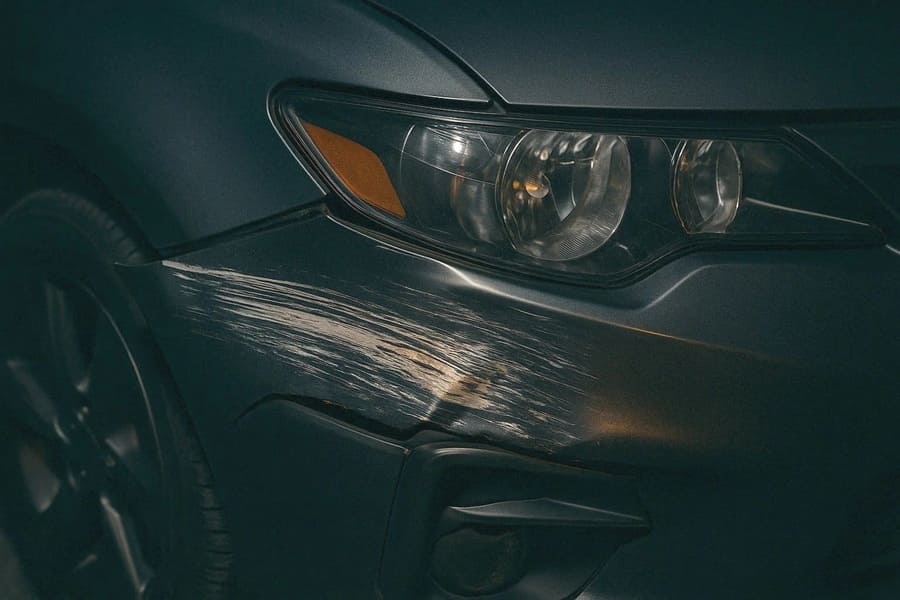
- Vehicle damage patterns that show the angle of impact
- Statements from independent witnesses
- Dashcam or nearby surveillance footage
- Event data recorder, or black box, data
The Police Report Is Important, but It Does Not Decide the Case
The police report is the usual starting point, since it records the scene, the drivers’ statements, any violations, and the officer’s preliminary read on the cause. You can request a copy of your crash report through the Florida Department of Highway Safety and Motor Vehicles. Photos capture details that vanish within hours, independent witnesses add credibility, and a car’s black box logs speed, braking, and steering in the seconds before impact, which a reconstruction expert can tie back to the crash.
How the Investigation Builds a Fault Picture
A thorough investigation may involve obtaining the crash report, preserving video before it is overwritten, locating witnesses, comparing vehicle damage, reviewing traffic-signal timing, and using a reconstruction expert when the mechanics of the crash are disputed. For readers who want a practitioner-oriented explanation of how Florida collision claims are investigated and presented, this car accident lawyer resource provides additional context. It should be treated as a law-firm resource rather than a substitute for Florida statutes, court rules, or the evidence in a specific crash.
Real Fort Myers case results
Here is what it looks like when the evidence is built the right way. These are real results from Kremenchuker Law Group’s Southwest Florida car accident cases, with names left out.
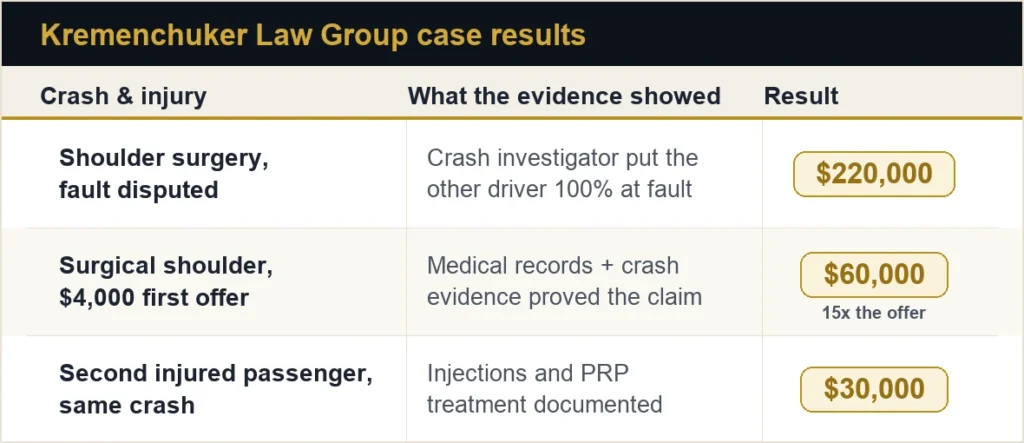
Case Study: When Contested Liability Became a $220,000 Settlement
In one recent Fort Myers case, the insurer disputed fault outright, leaving the injured client with no clear path to compensation. The client’s legal team pulled the crash report and brought in an accident reconstruction expert, whose testimony proved decisive — placing the other driver at 100 percent fault. That single finding reversed the insurer’s position, and the case settled for $220,000.
Kremenchuker Law Group builds every case this way, and an experienced personal injury lawyer knows that a well-documented fault picture is what turns an insurer’s lowball into a real number.
How Insurers May Dispute Fault
An insurer may compare statements, physical damage, witness accounts, video, and medical records before assigning fault. It may also argue that the injured person contributed to the crash through speeding, distraction, an unsafe lane change, failure to yield, or another act. That is why early statements should stay factual. Guessing about speed, distance, or timing can create inconsistencies later.
Protecting your claim after a crash
The first few minutes shape everything that follows. Call the police and let them document the scene, photograph the vehicles and signals before anything moves, get names and numbers from witnesses, stick to plain facts, and get medical attention promptly. Every strong case starts with building a clear picture of what actually happened, because strong evidence leads to stronger negotiations.
What to Do After the Crash
- Call law enforcement when required and obtain the report number.
- Photograph the vehicles, roadway, traffic controls, and visible injuries if it is safe to do so.
- Get contact information from independent witnesses.
- Seek appropriate medical care and keep records of treatment.
- Save dashcam footage and ask nearby businesses whether surveillance video exists.
Keep insurance correspondence and avoid guessing in recorded statements.
Frequently Asked Questions
Can the police report decide who was at fault?
Not on its own. A crash report is important evidence, but insurers and courts also weigh photos, witness statements, video, and expert analysis before settling liability. A strong report helps, but it can be challenged.
What if I think the insurer is blaming me unfairly?
You can push back with more evidence, including surveillance video, dashcam footage, black-box data, or a reconstruction expert. A well-documented case often changes the outcome even when the first fault call went against you.
How quickly should I gather evidence?
Right away. Footage can be erased within days, witnesses get harder to find, and physical evidence disappears fast. Florida also limits how long you have to file, so acting early protects the proof and your claim.
After a Fort Myers crash, fault is not about who argues hardest; it is about who can prove what happened. The police report, the photos, the witnesses, and the data in your own car decide who pays, and the driver who preserves that proof early ends up made whole.
Disclaimer
This article is for general informational purposes only and does not constitute legal advice.