
By Sean Quinn, Founder, Quinn Law Group | Updated October 2026 · 10 min read
Quick Note. A Pennsylvania car accident claim comes down to three things you can document: who caused the crash, what injuries it caused, and what it cost you. Evidence that was recorded early, does not depend on anyone’s memory, and tells the same story from several directions carries the most weight. Two Pennsylvania rules also shape what you keep and when. Most injury lawsuits must be filed within two years, and the tort option on your own auto policy, limited or full, decides whether you can seek pain and suffering damages.
After a crash, most people are not thinking about proof. They are sore, the car may be in a shop, and an adjuster is already asking for a recorded statement. But when a claim is disputed, it is the paper and the pictures, not anyone’s recollection, that insurers and juries rely on. This guide covers the evidence that tends to matter in Pennsylvania, why each piece matters, and a few traps that are specific to this state.
Evidence has to answer three questions: fault, injury and loss
Adjusters read a claim looking for gaps. No scene photos, and the position of the vehicles is open to argument. Treatment that started two weeks late, and the injury may be blamed on something else. No wage records, and lost income gets discounted. A complete file answers three questions in turn:
- Fault. The crash report, photos of the damage and scene, traffic or business camera footage, dashcam video, witness accounts and vehicle data.
- Injury. Emergency or urgent care records, imaging, follow-up visits, therapy notes, prescriptions and your doctors’ opinions about cause and outlook.
- Loss. Pay stubs and employer letters for missed work, repair or total-loss paperwork, out-of-pocket receipts, and a running journal of symptoms and limits.
The fault evidence cuts both ways. Pennsylvania uses a modified comparative negligence rule. Under 42 Pa.C.S. § 7102, your recovery is reduced by your share of the blame and barred if you are found more than 50% at fault, so insurers look hard at your speed, your phone and your seat belt as well as the other driver’s conduct.
The police report is useful, but it is not the last word
Crashes involving injury, a death, or a vehicle that cannot be driven away must be reported to police under 75 Pa.C.S. § 3746. If police do not investigate, section 3747 requires each driver to send PennDOT a written report within five days, using form AA-600. A missed filing can put your licence at risk, and it is easy to overlook when you are focused on medical care.
A police report records what the officer saw and was told: vehicle positions, weather, witness names, any citation. It is a strong starting point and often shapes the insurer’s first view of fault. It is not conclusive, though. The officer usually arrives after the impact and relies on what people say, and in court a report is generally treated as hearsay, so the opinions in it often cannot be put in front of a jury. Treat it as a map to better evidence rather than the evidence itself. If it contains an error, ask the department how to request a supplement, and make sure witness contact details are in it.
Physical evidence does not depend on memory
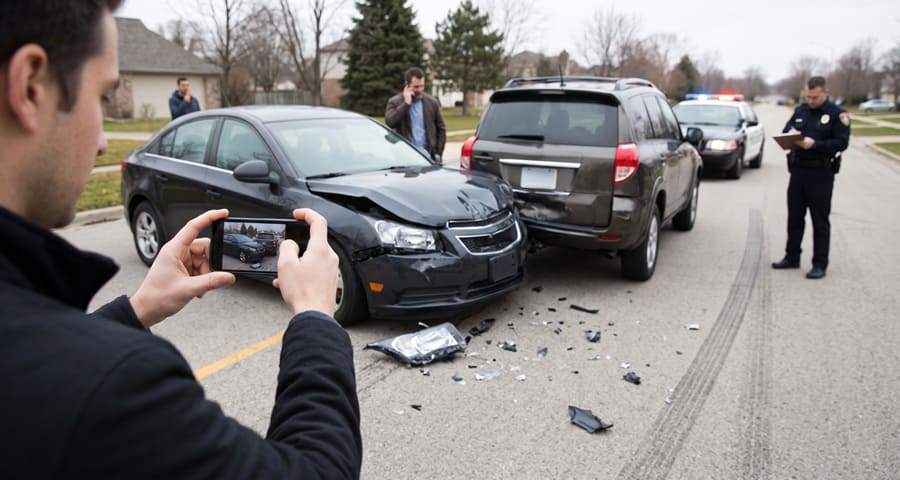
Photographs and video lose value fast, because vehicles move, debris is swept up and bruises fade. If you can, capture both vehicles from several angles, the debris field, skid marks, signals and signs, lighting, weather and any visible injuries, with close-ups and wide shots. Nearby businesses, doorbell cameras, buses and other drivers’ dashcams may have footage too. Many systems overwrite within days or weeks, so ask quickly and in writing.
The vehicle itself is evidence. Crush damage, airbag deployment and seat belt marks all help show how the crash happened. Many newer vehicles also carry an event data recorder. NHTSA describes these as logging pre-crash speed, brake status, throttle position and seat belt status in the seconds before an impact, and pulling the data takes specialised equipment. Under the Driver Privacy Act of 2015 (see Senate Report 114-147), that data generally belongs to the vehicle’s owner or lessee, with limited exceptions such as a court order. If liability is disputed, ask before the car is repaired, sold for salvage or scrapped, because once it is gone the proof cannot be recreated.
A Pennsylvania recording trap
Pennsylvania’s Wiretap Act, 18 Pa.C.S. § 5704, generally requires every participant’s consent to record a telephone call or conversation, as the Reporters Committee for Freedom of the Press explains in its state guide. A dashcam that captures only video is rarely a problem. Audio of a conversation with the other driver, a witness or an adjuster can be. If you want a witness’s account, ask for a short written statement or write down what was said and when. Check with a lawyer before recording anyone.
Medical records connect the crash to your injuries
You do not need an ambulance ride to have a valid claim, but you do need documented treatment. Some injuries show up late. The CDC notes that concussion symptoms may take hours or days to appear, and soft-tissue pain often builds over the first days. If you wait two weeks to see a doctor because you hoped the pain would pass, an insurer may use the gap against you.
Records should show symptoms, diagnosis, treatment plan and progress: urgent care and emergency notes, orthopedic visits, chiropractic care, physical therapy, imaging and medications. Tell your providers about the specific things you cannot do, such as lifting your child, sleeping through the night, driving or working a full shift. If it is not in the chart, insurers often treat it as if it did not happen.
There is also a Pennsylvania wrinkle. When you bought your policy you chose limited tort or full tort under 75 Pa.C.S. § 1705. Limited tort generally lets you recover medical bills and other economic losses, but not pain and suffering, unless the injury meets the “serious injury” threshold in section 1702: death, serious impairment of body function, or permanent serious disfigurement. Some exceptions apply. If you chose limited tort, your medical evidence has to show how the injury affects what your body can do, not only that you were treated. Your declarations page says which option you have.
How each type of evidence is used
| Type of evidence | What it helps prove | Common problem if it is missing |
| Police report or AA-600 | Initial fault findings, road conditions, witness names | The insurer disputes the basic facts of the crash |
| Scene photos and video | Vehicle positions, damage, weather, signs and signals | Damage is minimized or the sequence is challenged |
| Witness statements | An independent account of what happened | It becomes one driver’s word against the other’s |
| Vehicle and event data | Speed, braking, belt use, impact severity | A “low-speed” argument goes unanswered |
| Medical records | Diagnosis, treatment, and the link to the crash | The insurer argues you were not hurt, or were hurt before |
| Pay records and receipts | Lost income and out-of-pocket costs | Part of your loss goes undocumented and unpaid |
Small gaps that turn into bigger problems
A claim can weaken even when the other driver was clearly at fault. Social media posts get quoted back out of context. A missed appointment is framed as proof you recovered. A recorded statement given early locks you into guesses about injuries you do not yet understand. You generally have no obligation to give the other driver’s insurer a recorded statement, though your own policy usually requires cooperation with your own insurer, so read it and ask before agreeing to anything.
Early offers also tend to arrive before treatment is finished, and they rarely account for care you still need. This overview of how to tell whether an auto accident settlement is fair is a useful companion, and so is a look at how long a car accident settlement can take when treatment is ongoing.
Where a lawyer fits in
Some of this work is yours: photos, a symptom journal, keeping appointments. Some of it is hard to do alone. That includes formal preservation letters to the other driver, their insurer and nearby businesses, retrieving vehicle data, collecting records from several providers, and answering an insurer that cherry-picks facts.
People who search for a Philadelphia car accident lawyer after a crash are often looking for exactly that kind of help, and it makes sense to ask early, before footage is overwritten or the car is gone. Not every claim needs one. A minor crash with no injuries and clear fault may resolve through your own insurer.
What sits behind a $424,000 car accident result
This is an illustration, not a client account. Quinn Law Group’s case results page lists a $424,000 car accident result but publishes no facts about it, so the composite below shows how evidence typically supports a result in that range. It does not describe that case or any client.
A woman is rear-ended on a Philadelphia street while stopped at a light. The other driver tells the officer it was barely a tap. She feels sore but drives home. By day three, neck pain and numbness in her arm send her to urgent care, and an orthopedist later orders an MRI.
What answers the “barely a tap” argument is a stack of small things: her photos of the rear bumper before repair, an estimate showing structural damage, footage from a nearby shop that was requested in the first week, the day-three urgent care note that already lists her symptoms, the MRI report, months of therapy notes, and employer records of the shifts she missed. None of it is dramatic on its own. Together it leaves little room to argue about speed, cause or timing.
Results depend on the facts of each case. Past results do not guarantee a similar outcome.
What to do in the first week
- See a doctor, describe every symptom, and keep your follow-up appointments.
- Report the crash. If police did not investigate and someone was hurt or a vehicle could not be driven, file the AA-600 with PennDOT within five days.
- Photograph everything, save every document, and ask before repairing or disposing of the vehicle.
- Check your declarations page to see whether you have limited or full tort.
- Keep a short daily journal of pain, limits and missed activities.
- Hold off on recorded statements to the other driver’s insurer, and stay quiet about the crash on social media.
Frequently asked questions
How long do I have to file a car accident lawsuit in Pennsylvania?
Two years from the date of the crash for most injury and property damage claims, under 42 Pa.C.S. § 5524. Claims against a government unit, such as a city or transit vehicle, generally require written notice within six months under section 5522. Some exceptions exist, so do not wait to find out which deadline applies.
Do I need a police report to make a claim?
No, but it helps. If police did not investigate and the crash involved an injury or a vehicle that could not be driven, you must file the AA-600 with PennDOT yourself within five days.
Can I use my dashcam video?
Video is usually helpful. Audio of a conversation is where the Wiretap Act can become an issue, so ask a lawyer before recording the other driver or an adjuster.
What if I was partly at fault?
You can still recover as long as you are not found more than 50% responsible. Your award is reduced by your percentage of fault.
Do I need to see a doctor if I feel fine?
It is worth doing. Some symptoms appear hours or days later, and a prompt visit creates a record that ties them to the crash.
Does limited tort mean I cannot claim anything?
No. Economic losses such as medical bills and lost wages remain recoverable. Pain and suffering generally requires a serious injury under the statute, subject to exceptions.
Disclaimer. This article gives general information about Pennsylvania and federal law as of October 2026. It is not legal advice and does not create a lawyer-client relationship. Deadlines and rules depend on the facts of each case and can change. If you were hurt in a crash, speak with a licensed Pennsylvania attorney about your situation.