

By Justin B. May, Co-Founder and Managing Partner, Dixie Law Group · Louisville, Kentucky | Last reviewed: October 2026
A car accident can turn an ordinary day upside down in seconds. Beyond the damaged vehicle, there are medical appointments, missed work, insurance paperwork, and bills that arrive before anyone has decided who is responsible. The decisions made in the weeks after a Kentucky crash shape how the claim unfolds, and several of the most damaging mistakes come from misunderstanding how Kentucky’s no-fault system works.
Quick answer: In Kentucky, your own insurer usually pays the first $10,000 of medical bills and lost wages regardless of fault. You can sue the at-fault driver for pain and suffering only if your injury crosses a legal threshold, and you generally have two years to file. Waiting, guessing, or saying too much can put all of that at risk.
How Kentucky’s Choice No-Fault System Works
| Rule | What it means for your claim |
| Personal injury protection (basic reparation benefits) | Your own policy generally pays up to $10,000 for medical expenses, lost wages, and certain other losses, regardless of who caused the crash |
| Tort threshold (KRS 304.39-060) | You can sue the at-fault driver for pain and suffering only if medical expenses exceed $1,000 or the injury involves a fracture, permanent injury, permanent disfigurement, or death |
| Two-year deadline (KRS 304.39-230) | A motor vehicle injury lawsuit generally must be filed within two years of the injury or the last no-fault payment, whichever is later |
| Pure comparative fault (KRS 411.182) | You can recover even if partly at fault, but the award is reduced by your share |
Kentucky is a “choice” no-fault state because drivers can reject the no-fault limits on their right to sue by signing a written rejection with the state. Most drivers never do, so the threshold applies to them. Find Attorneys’ overview of Kentucky personal injury law and evidence covers the broader rules.
Mistake 1: Not Reporting the Crash or Leaving Too Soon
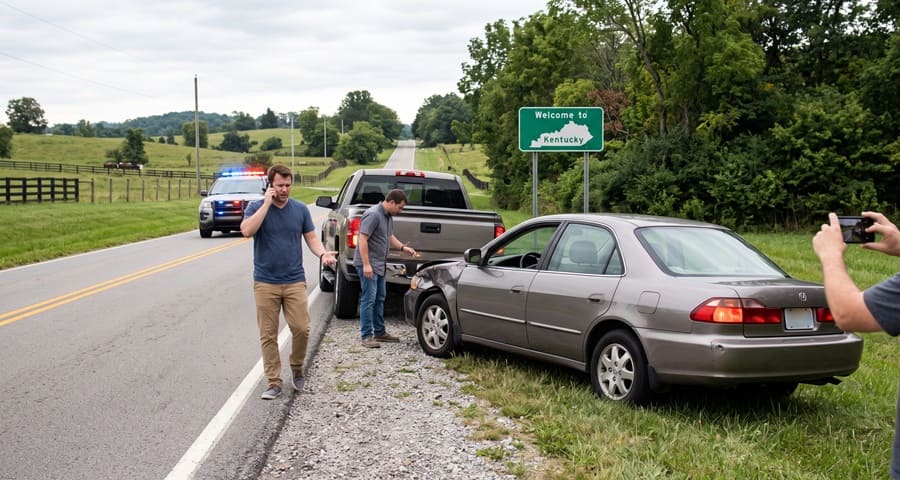
Under KRS 189.580, a driver involved in a crash must stop, give their name, address, and vehicle information, help anyone injured, and notify police when someone is hurt or killed. A police report also records the scene while it is fresh. If you can, photograph the vehicles, the intersection, traffic signals, skid marks, and any visible injuries before the cars are moved.
Mistake 2: Waiting Too Long to Document What Happened
Many people assume they will remember every detail later. Memories fade quickly when you are dealing with pain, repairs, and insurance calls. Write down what you remember as soon as you can: the direction each car was traveling, what the other driver said, the weather, and the names of witnesses. Keep photographs, repair estimates, and every letter or email from an insurer. Those records often matter most when the other driver’s account changes.
When the Police Report Gets It Wrong
Police reports are not always right, and an early record can help correct them. Among the results listed on the author’s firm’s case results page, a couple was blamed for running a red light, and the police report placed the wife at fault. A crash reconstruction expert showed that the couple was not responsible, and the claim settled for $220,000. Cases like this one turn on the physical evidence and timing, which is why photographs and witness names gathered at the scene are worth the effort.
Past results depend on the specific facts of each case and do not guarantee a similar outcome in any other matter.
Mistake 3: Ignoring Symptoms or Gaps in Treatment
Not every injury is obvious right away. Adrenaline can mask pain, and concussions, neck injuries, and back injuries often worsen over the following days. Delaying medical care creates uncertainty about when an injury developed. Gaps in treatment give insurers a reason to argue the injury was minor or caused by something else. In Kentucky, medical expenses also affect whether you cross the $1,000 threshold that allows a pain and suffering claim, so keep every bill and appointment record.
Mistake 4: Forgetting to File for No-Fault Benefits
Many people focus on the other driver’s insurer and never open a personal injury protection claim with their own. Those benefits can pay medical bills and part of lost wages while the liability claim is pending, and the date of the last payment can extend the two-year lawsuit deadline. Report the crash to your insurer promptly and ask how to apply for basic reparation benefits.
Mistake 5: Saying Too Much, to Insurers or Online
It is natural to talk about the crash with friends, coworkers, and insurance adjusters. Statements made while you are still processing what happened can be incomplete or misunderstood. You do not have to give a recorded statement to the other driver’s insurer, and you should not sign a medical authorization or release without understanding what it covers.
Social media creates similar problems. A photo from a family event or a comment that you are “doing fine” can be used to argue your injuries are minor. Find Attorneys explains how social media can affect an injury case.
Mistake 6: Losing Track of Expenses
An injury claim includes more than the first emergency room bill. Follow-up visits, prescriptions, physical therapy, mileage to appointments, missed work, a rental car, and household help can all be part of the loss. Keep a single folder, paper or digital, for receipts, invoices, pay stubs, insurance letters, and medical records.
Mistake 7: Relying on the Wrong Deadline
Kentucky has two different limitation periods that people confuse. Most personal injury claims must be filed within one year under KRS 413.140, but claims arising from a motor vehicle crash covered by the no-fault act generally get two years under KRS 304.39-230. Uninsured and underinsured motorist claims may have their own policy deadlines. Do not assume you have the longer period until someone has checked.
Moving Forward After a Kentucky Crash
The weeks after a car accident can feel overwhelming, especially when medical concerns, insurance questions, and repair bills arrive together. Careful documentation, prompt medical care, a timely no-fault claim, and cautious communication prevent most avoidable problems. People researching their options often review local resources such as Dixie Law Group to understand how these rules apply to their own situation. Every collision is different, so accurate records and unhurried decisions make it easier to evaluate the next step.
Disclaimer
This article provides general information about car accident claims in Kentucky. It is not legal advice, and reading it does not create an attorney-client relationship. Deadlines and insurance rules depend on the facts of each crash and the terms of each policy. Anyone injured in a collision should seek medical care and consult a licensed Kentucky attorney about their situation.