
By Elliot Singer, Esq. Founder & Managing Attorney | Conduit Law | Denver Personal Injury | Last reviewed: September 2026
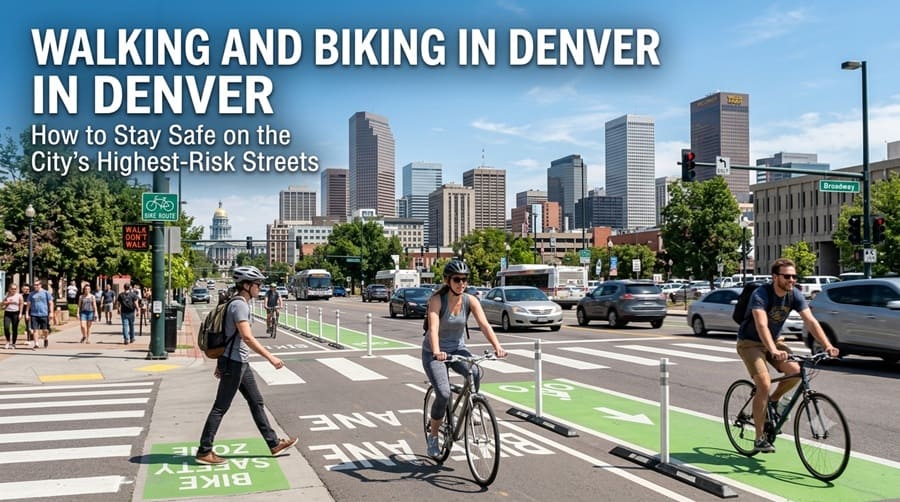
Denver is built for getting around on foot and by bike more than ever. Protected bike lanes, new crosswalks, and a growing trail network make it easy to leave the car at home. But crash risk in the city is not spread evenly. A relatively small set of streets carries a large share of the danger, and knowing where those streets are is one of the simplest ways to protect yourself.
This guide covers where Denver’s highest-risk streets and intersections are, and practical habits that make walking and riding safer.
Where the Risk Is Concentrated
Denver’s Department of Transportation and Infrastructure (DOTI) maps what it calls the High Injury Network: the streets where serious and fatal crashes happen most often. It is a street-level map, not a list of individual intersections, and it tells a clear story. Based on DOTI crash data from 2016 to 2021, Tier 1 and Tier 2 streets on the network together account for 56% of all crashes in the city.
Three corridors stand out. Colfax Ave, Federal Blvd, and Sheridan Blvd each have 37 High Injury Network segments, the most in Denver, according to this analysis of Colorado car accident statistics. These are wide, fast, multi-lane arterials with heavy traffic, frequent driveways, and long crossing distances. That combination is hard on anyone who is not inside a car.
The stakes are real statewide as well. Preliminary 2025 figures show 126 pedestrians and 18 bicyclists were killed on Colorado roads.
Intersections That Deserve Extra Care
Two Denver intersections lead the city’s open crash data for 2023 through 2025, and they lead in different ways:
- N Federal Blvd and W 6th Ave recorded the most crashes coded as happening at an intersection: 96 over those three years.
- N Speer Blvd and W Colfax Ave recorded the most crashes involving a death or serious injury: 5 over the same period.
The difference matters. An intersection with a high crash count may see mostly fender-benders between cars. An intersection with more severe crashes is often where speed, turning traffic, and people on foot or bikes meet. For pedestrians and cyclists, severity is the number to watch. A crash count is also only a location count; it does not say who was at fault in any given crash.
Safety Tips for Pedestrians
- Cross where drivers expect you. Use marked crosswalks and signals on arterials like Colfax and Federal, even if it means walking an extra half block. Mid-block crossings on multi-lane roads are especially risky, because drivers are less likely to expect someone there.
- Watch turning vehicles first. A common pedestrian crash at intersections involves a driver turning left or right while looking for a gap in traffic, not at the crosswalk. Make eye contact before stepping out.
- Use the head start when you get it. Some signals give pedestrians a few seconds of walk time before cars get a green light. Step off promptly so you are visible in the crosswalk before turning traffic moves.
- Beware the second lane. On multi-lane streets, one driver stopping for you can block the view of a driver in the next lane. Pause and check each lane as you cross.
- Be seen after dark. Wear light or reflective clothing and carry a small light when walking at dawn, dusk, or night.
- Put the phone away at the curb. A few seconds of attention at the crossing is worth more than any text.
Safety Tips for Cyclists
- Choose a parallel route. You can often avoid riding on Colfax, Federal, or Sheridan. Neighborhood bikeways and protected lanes run near parts of these corridors and carry far less fast traffic.
- Plan big crossings in advance. When you have to cross a major arterial, choose a signalized intersection and time your approach rather than darting through a gap.
- Watch for the right hook. At large intersections, drivers turning right often cut across a bike lane. Don’t pass a turning vehicle on its right, and hang back if a driver may not have seen you.
- Ride predictably. Hold a steady line, signal turns, and avoid weaving between parked cars and the travel lane.
- Light up, day and night. A white front light and a red rear light, including a flashing daytime light, make you visible from much farther away.
Fall and Winter Change the Picture
Shorter days put more walking and riding in low light, right as rush hour traffic peaks. The data reflects it: Colorado traffic deaths were on track for a 7% decline in 2025 until November and December, when deaths jumped 70% compared with the same months in 2024. As the clocks change, adjust your routes, lights, and clothing too.
If Something Happens
Even careful people get hurt. If you are struck while walking or riding:
- Get medical care. Some injuries, including head injuries, are not obvious right away.
- Report the crash. Call police so there is an official record.
- Document the scene. Take photos of the location, vehicles, signals, and road conditions, and write down witness contact information.
For a Colorado-specific example of why contemporaneous documentation matters, see Find Attorneys’ guide to documenting a road-rage crash in Colorado.
Case Example: A Colorado Crash Result
Firm-reported, anonymized result. Conduit Law reports a $397,908.58 recovery for a Colorado rear-end motor-vehicle case identified publicly only by the client’s initials. The firm’s public result listing does not provide enough detail to say the case involved a pedestrian, bicyclist, or any of the Denver corridors discussed above.
That limitation matters. The result is included only as an example of first-party case data from the author’s firm, not as evidence that a particular Denver street, injury, or crash type has a predictable case value.
Past results do not guarantee or predict a similar outcome.
The Bottom Line
Most of Denver’s serious crash risk sits on a short list of streets. Knowing which ones they are, and choosing when and how you cross or ride them, is one of the easiest safety tools you have. A few minutes of route planning can keep you off the most dangerous corridors entirely.
Authorities & Sources
- Denver DOTI – Denver Moves Everyone: State of the System / High Injury Network
- Colorado Department of Transportation – 2025 Traffic Fatality Data
- Colorado Department of Transportation – Pedestrian Safety and Laws
- Colorado Department of Transportation – Information for Bicyclists
- Colorado Department of Transportation – Commonly Misunderstood Traffic Laws (2026)
Disclaimer
This article provides general safety and legal information and is not legal advice. Traffic rules, crash data, infrastructure, and roadway conditions can change. A crash statistic does not establish fault in an individual case, and legal rights after a pedestrian or bicycle collision depend on the facts, insurance, injuries, and applicable Colorado law. Reading this article or following a link does not create an attorney-client relationship.