
By Julie K. Bracker, Esq. Partner | Bracker & Marcus LLC | False Claims Act & Whistleblower Litigation | Last reviewed: September 2026
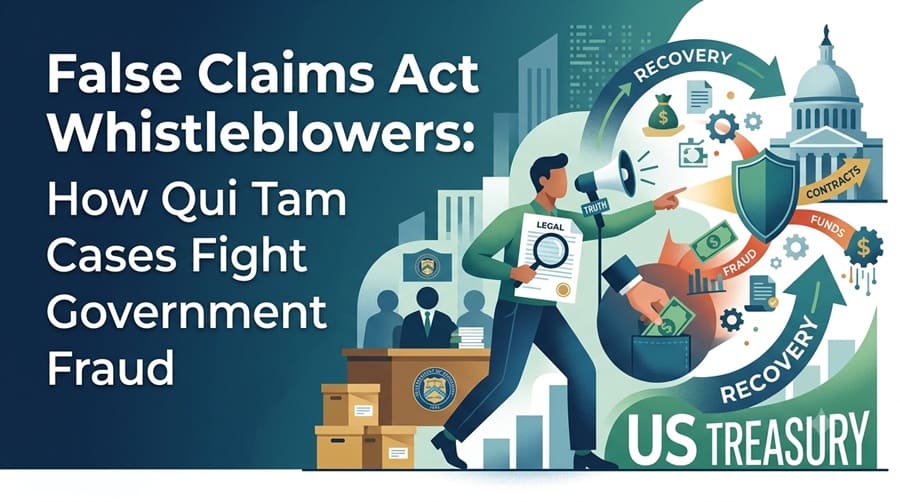
Government fraud is often difficult to detect from the outside. Billing staff, clinicians, contractors, compliance employees, and other insiders may see practices that never appear in an audit or public filing. The federal False Claims Act gives some of those insiders a way to bring evidence to the government through a qui tam lawsuit.
The law is powerful, but it is also technical. A suspicious invoice or regulatory violation is not automatically a False Claims Act case. The alleged falsehood must fit the statute, the defendant must have the required state of mind, and the misrepresentation must be material to the government’s payment decision.
Those distinctions matter because a qui tam case is filed on behalf of the United States, under seal, and subject to rules that can affect who may proceed, what evidence can be used, and when a case must be filed.
What the False Claims Act Covers
The False Claims Act, 31 U.S.C. §§ 3729-3733, can impose liability when a person knowingly presents a false or fraudulent claim for government payment, knowingly uses a false record or statement material to a false claim, conspires to violate the statute, or improperly avoids an obligation to pay money owed to the government.
The statute allows treble damages – three times the government’s loss – plus civil penalties that are adjusted for inflation. It is not limited to healthcare. Cases also arise from defense contracts, procurement, grants, loans, customs duties, cybersecurity requirements, and other federally funded programs.
Qui Tam Lets a Private Relator Sue on Behalf of the United States
A private person who brings a False Claims Act case is called a relator. The lawsuit is brought in the name of the United States, not simply as an ordinary private damages action.
If the government intervenes and the case succeeds, the relator generally receives 15% to 25% of the proceeds. If the government declines and the relator successfully pursues the case, the statutory range is generally 25% to 30%, subject to the limitations in the Act. 31 U.S.C. § 3730 – qui tam actions and relator awards
The Complaint Is Filed Under Seal
A federal qui tam complaint is filed under seal and is not initially served on the defendant. The relator must also provide the government with the complaint and a written disclosure of substantially all material evidence and information in the relator’s possession.
The statute gives the government an initial 60-day period to investigate and decide whether to intervene, but courts can extend the seal for good cause. In complex matters, that means the investigation may continue well beyond 60 days. U.S. Department of Justice – handling of qui tam suits
Because the complaint is sealed, potential relators should be cautious about public statements concerning the existence or contents of a filed case. The exact obligations depend on the court’s seal orders and the circumstances.
Not Every Billing Error or Regulatory Violation Is an FCA Case
The statute defines ‘knowingly’ to include actual knowledge, deliberate ignorance, and reckless disregard. It does not require proof of a specific intent to defraud.
The Supreme Court’s 2023 decision in United States ex rel. Schutte v. SuperValu Inc. emphasized that scienter focuses on the defendant’s knowledge and subjective beliefs when the claim was submitted. A facially ambiguous rule does not automatically defeat scienter if the defendant actually understood the requirement and believed the claim was false. United States ex rel. Schutte v. SuperValu Inc.
At the same time, the FCA’s materiality requirement is demanding. In Universal Health Services v. Escobar, the Supreme Court explained that a regulatory or contractual violation is not automatically material just because the government could have refused payment. The question is whether the misrepresentation was capable of influencing the government’s payment decision in a meaningful way. Universal Health Services, Inc. v. United States ex rel. Escobar
Where False Claims Act Cases Commonly Arise
Healthcare remains a major area of enforcement, but the statute reaches much further. Common fact patterns include:
- billing Medicare, Medicaid, TRICARE, or other government programs for services not provided or not medically necessary;
- kickbacks or referral arrangements that taint claims submitted for government payment;
- false certifications in government contracts or grant applications;
- overbilling for labor, materials, or equipment on federal contracts;
- falsifying eligibility or compliance information for federally backed loans or programs;
- knowingly failing to return money owed to the government; and
- misrepresenting compliance with material cybersecurity, customs, tariff, or procurement requirements.
The Department of Justice reported more than $6.8 billion in False Claims Act settlements and judgments for fiscal year 2025, including more than $5.7 billion involving the healthcare industry. Whistleblowers filed 1,297 qui tam suits that year, the highest annual number reported by DOJ. U.S. Department of Justice – FY2025 False Claims Act recoveries
Retaliation Protection Is Separate From the Qui Tam Claim
The FCA also protects employees, contractors, and agents from retaliation for lawful acts in furtherance of an FCA action or other lawful efforts to stop violations of the statute.
Available relief can include reinstatement, twice the amount of back pay, interest, special damages, litigation costs, and reasonable attorney’s fees. A retaliation action under § 3730(h) generally must be brought within three years after the retaliatory act. 31 U.S.C. § 3730(h) – retaliation remedies
Evidence Matters, but More Is Not Always Better
An insider may have emails, invoices, billing records, internal reports, or firsthand knowledge that helps explain what happened. Preserving lawfully available evidence can be important, but gathering documents without considering confidentiality, privacy, privilege, computer-access rules, or employment obligations can create separate problems.
A potential relator should not assume that copying every file available at work is helpful or lawful. The quality, source, and relevance of the evidence usually matter more than sheer volume.
Case Example: An Employee’s Evidence Supported a $14.3 Million Settlement
Firm-reported, anonymized result. Bracker & Marcus reports a False Claims Act case involving a former employee of a diagnostic laboratory who alleged that the company billed federal and state healthcare programs for medically unnecessary respiratory and genetic testing and conduct involving kickbacks.
According to the firm’s published account, the United States intervened and the defendants agreed to pay more than $14.3 million to resolve the allegations. The former employee, whose identity the firm limited in its public discussion at his request, received a 20% relator share. Bracker & Marcus – published $14.3 million FCA result
The result is useful as an example of how insider evidence can help government investigators connect billing practices to specific claims. It does not predict whether another matter will qualify under the FCA or produce a similar recovery.
Past results do not guarantee or predict a similar outcome.
A Neutral Resource for Understanding FCA Representation
Someone researching the filing process may also encounter Bracker & Marcus’s explanation of the role of a false claims act attorney. A private law-firm page can provide practical context about qui tam procedure, but the governing requirements should be checked against the False Claims Act, current federal cases, and Department of Justice guidance.
Deadlines Can Be Complicated
The general FCA limitations provision is not a simple one-date rule. Under 31 U.S.C. § 3731(b), an FCA action may not be brought more than six years after the violation or more than three years after the responsible government official knew or reasonably should have known the material facts, but never more than 10 years after the violation, whichever statutory period ends later.
Other rules can also affect whether a relator may proceed, including the first-to-file and public-disclosure provisions. Timing should therefore be evaluated before assuming that a potential case can wait.
Questions a Potential Whistleblower Should Clarify
- What government money, program, contract, loan, grant, or obligation is involved?
- What specific claim, statement, certification, or payment request is allegedly false?
- What evidence suggests the defendant knew, deliberately ignored, or recklessly disregarded the falsity?
- Why would the alleged falsehood matter to the government’s payment decision?
- Has the information already been publicly disclosed or reported by someone else?
- What evidence is lawfully available without taking privileged or restricted materials?
- Has any retaliation already occurred, and when?
- What filing deadline may apply?
For related reading, see Find Attorneys’ guide to how a whistleblower attorney can help with a claim.
You can also review Find Attorneys’ guide to choosing a whistleblower lawyer for questions about experience, confidentiality, and case process.
Authorities & Sources
- 31 U.S.C. § 3729 – False Claims Act liability
- 31 U.S.C. § 3730 – Qui Tam Actions, Relator Awards, and Retaliation
- 31 U.S.C. § 3731 – False Claims Act Limitations
- U.S. Department of Justice – The False Claims Act
- U.S. Department of Justice – FY2025 FCA Settlements and Judgments
- United States ex rel. Schutte v. SuperValu Inc. (2023)
- Universal Health Services, Inc. v. United States ex rel. Escobar (2016)
Disclaimer
This article provides general information about the federal False Claims Act and is not legal advice. Qui tam eligibility, public-disclosure issues, first-to-file rules, seal obligations, retaliation claims, evidence handling, relator shares, and filing deadlines are fact-specific and can change with new statutes or court decisions. Reading this article or following a link does not create an attorney-client relationship. A person considering a whistleblower claim should evaluate the specific facts, documents, and deadlines before acting.