
By David M. Van Sant, Owner and Attorney, Van Sant Law · Atlanta, Georgia | Last reviewed: October 2026
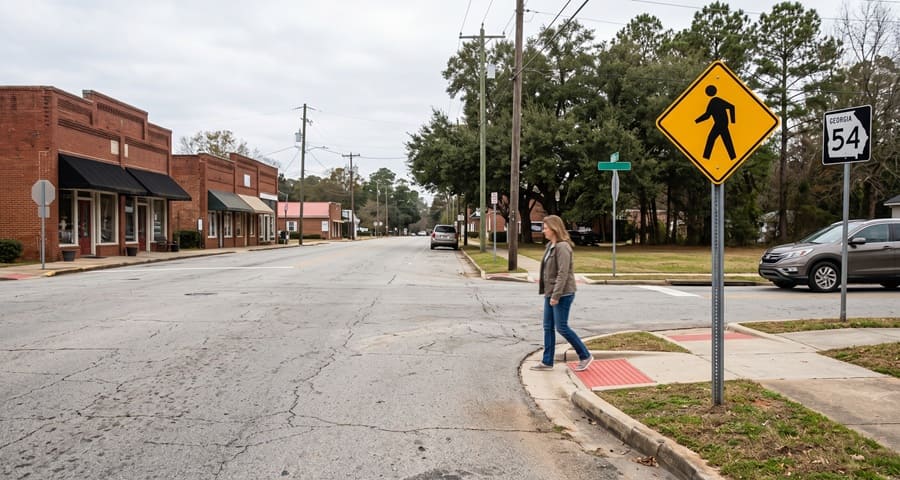
A pedestrian in an Atlanta neighborhood steps off the curb at a corner and heads for the sidewalk directly across the street. There are no white stripes and no crossing sign. A driver turning onto the street hits her and tells the responding officer she “wasn’t in a crosswalk.”
Under Georgia law, she may well have been. Georgia recognizes unmarked crosswalks at intersections, and the rules for who must yield depend on exactly where the person was crossing.
| Where the pedestrian crossed | Starting rule under Georgia law |
| Marked crosswalk (anywhere) | Driver must stop and remain stopped when the pedestrian is on, or within one lane of, the driver’s half of the road |
| Unmarked crosswalk at an intersection | Same as a marked crosswalk |
| Mid-block, no markings | Pedestrian must yield to vehicles unless already safely in the roadway |
| Between two adjacent signalized intersections | Pedestrian may cross only in a marked crosswalk |
| Diagonally across an intersection | Not allowed unless signals or signs authorize it |
In every situation, the driver still has a duty to exercise due care to avoid hitting a pedestrian.
What Counts as a Crosswalk in Georgia
O.C.G.A. § 40-1-1(10) defines a crosswalk in two ways:
- Unmarked: the part of a roadway at an intersection within the connections of the lateral lines of the sidewalks on opposite sides of the highway, measured from the curbs or, without curbs, from the edges of the traversable roadway.
- Marked: any portion of a roadway, at an intersection or elsewhere, distinctly indicated for pedestrian crossing by lines or other markings on the surface.
In plain terms, if sidewalks on opposite sides of a street line up at an intersection, the area between them can be a legal crosswalk even if no one ever painted it.
The definition also has limits. An unmarked crosswalk exists only at an intersection, and the sidewalk lines have to connect. Away from an intersection, a crossing must be marked to be a crosswalk; a path people use every day does not become one on its own. At odd-shaped intersections, such as some T-intersections or corners with a sidewalk on only one side, whether an unmarked crosswalk exists can be a real dispute that turns on measurements and photographs.
When a Driver Must Stop
Under O.C.G.A. § 40-6-91, a driver must stop and remain stopped to let a pedestrian cross within a crosswalk when the pedestrian is on the half of the roadway the vehicle is traveling on, or is approaching and within one lane of that half or of the half the vehicle is turning onto. “Half of the roadway” means all lanes carrying traffic in one direction.
That duty is stronger than a general instruction to yield. It applies before the pedestrian reaches the car’s lane, and it applies to turning drivers, who cause many intersection pedestrian crashes because they are watching for gaps in oncoming traffic rather than for people in the crosswalk.
At intersections with working traffic signals and pedestrian “Walk” signals, those signals also control who may go, so the signal phase at the moment of the crash becomes key evidence.
Do not pass a car stopped at a crosswalk
Section 40-6-91(d) adds a rule that matters on multilane roads. When a vehicle has stopped at a marked crosswalk, or an unmarked crosswalk at an intersection, to let someone cross, a driver approaching from behind may not overtake and pass it. The stopped car hides the pedestrian from the passing driver and hides the passing car from the pedestrian, which is why this crash pattern is so often serious.
Pedestrians Have Duties Too
Section 40-6-91(b) says no pedestrian may suddenly leave a curb or other place of safety and walk or run into the path of a vehicle so close that it is impractical for the driver to yield. Right of way in a crosswalk is not permission to step in front of a car that cannot stop.
Outside a crosswalk, O.C.G.A. § 40-6-92 makes the pedestrian yield to vehicles unless they have already safely entered the roadway. Between adjacent intersections that both have working traffic signals, pedestrians may cross only in a marked crosswalk. A pedestrian who ignores an available tunnel or overpass must also yield, and diagonal crossing is prohibited unless signals or signs allow it.
Drivers Must Use Due Care Everywhere
Even when a pedestrian is crossing in the wrong place, O.C.G.A. § 40-6-93 requires every driver to exercise due care to avoid colliding with a pedestrian, to sound the horn when necessary, and to take proper precautions when they see a child or a person who is obviously confused, incapacitated, or intoxicated.
That means both people can share fault. A pedestrian may have crossed mid-block, while a driver who was speeding, looking at a phone, or driving with dirty headlights may still have had time to avoid them. FindAttorneys.org’s overview of the causes of pedestrian accidents and who is liable in Georgia covers the most common driver and pedestrian behaviors behind these crashes.
How Fault Affects a Georgia Pedestrian Claim
Georgia uses modified comparative fault. An injured pedestrian found 50% or more responsible recovers nothing, and a lower percentage reduces the award proportionately. So the crosswalk question is rarely just academic. Whether the pedestrian was in an unmarked crosswalk can shift the starting rule from “pedestrian must yield” to “driver must stop,” and with it a large share of the fault.
Most Georgia personal injury claims must be filed within two years. Evidence that answers the crosswalk question, such as the exact point of impact, skid marks, debris, signal timing, and nearby business or traffic cameras, can disappear much sooner.
When right of way is disputed, an Atlanta pedestrian accident attorney or insurance investigator will usually start with the intersection itself: measuring where the sidewalk lines actually meet, pulling signal timing, and fixing the point of impact before arguing about who was careless.
A Person on Foot in Traffic: An Officer Struck While Directing Cars
Van Sant Law’s published case results include a $235,000 recovery for a law enforcement officer who was struck by a vehicle while directing traffic. The listing does not give the location or the facts in dispute, so it is not offered as a crosswalk case.
It does illustrate the due-care duty in § 40-6-93. A person standing in the roadway is not in a crosswalk, but drivers who can see them still have to slow, watch, and avoid them. Claims like this often turn on visibility, speed, and whether the driver was paying attention- the same questions that decide many mid-block pedestrian cases.
Past results do not guarantee a similar outcome. Each case depends on its own facts.
Frequently Asked Questions
Is it jaywalking to cross at a corner with no painted crosswalk in Georgia?
Not necessarily. If sidewalks on opposite sides of the street connect at an intersection, the area between them can be an unmarked crosswalk, with the same driver duties as a marked one.
Do drivers have to stop for pedestrians in Georgia crosswalks?
Yes. Drivers must stop and remain stopped when a pedestrian in a crosswalk is on their half of the road or within one lane of it, including when turning.
Can I recover if I was hit crossing mid-block?
Possibly. You generally had to yield, but drivers still owe a duty of due care. If your share of fault is less than 50%, you may recover reduced damages.
Who decides whether an unmarked crosswalk existed?
It depends on the intersection’s layout. Photos, measurements, and maps of the sidewalks and curbs are usually key, and a jury may decide if the facts are disputed.
Authorities & Sources
- O.C.G.A. § 40-1-1(10): Definition of crosswalk
- O.C.G.A. § 40-6-91: Right of way in crosswalks
- O.C.G.A. § 40-6-92: Crossing at other than crosswalks
- O.C.G.A. § 40-6-93: Drivers to exercise due care
Disclaimer
This article provides general information about Georgia pedestrian and traffic law. It is not legal advice, and reading it does not create an attorney-client relationship. Laws and court interpretations change, and every case depends on its own facts. Anyone injured as a pedestrian in Georgia should speak with a licensed Georgia attorney about their situation.