

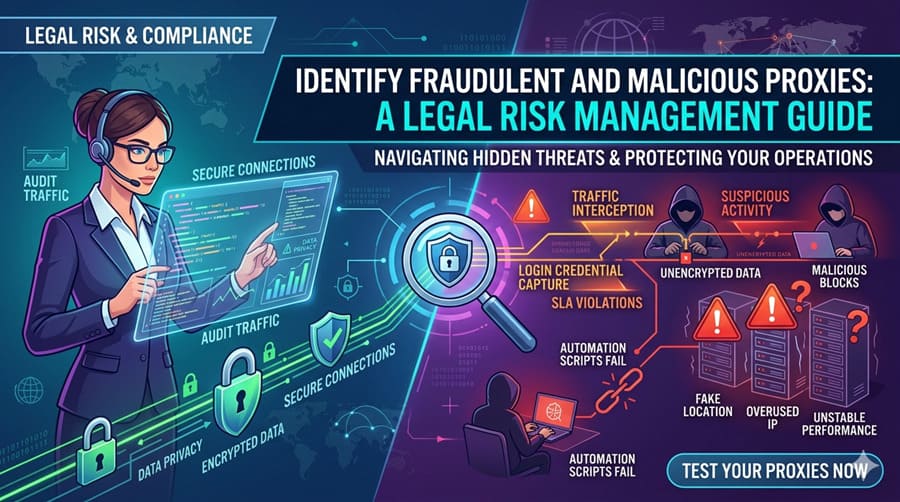
Purchasing a proxy service with the expectation of seamless performance can result in significant operational failures, such as degraded connection speeds and website inaccessibility. The commercial proxy market carries inherent risks of deception, where seemingly attractive service offers mask infrastructure that is ineffective and potentially injurious to business operations. Illicit proxies may intercept network traffic, unlawfully modify web content, or misappropriate sensitive login credentials. Furthermore, organizations may unknowingly inherit IP addresses already implicated in suspicious activities, exposing themselves to platform blacklisting and potential vicarious liability.
Categorizing Fraudulent and Malicious Proxies
- Fraudulent (“Fake”) Proxies: These services represent a fundamental breach of contract and misrepresentation by failing to meet advertised specifications.
- Examples include material misrepresentation of geolocation, such as paying for a German IP address that resolves to an alternate jurisdiction.
- Providers may commit false advertising by promising high bandwidth but delivering minimal speeds plagued by continuous interruptions.
- In instances of complete non-performance, the proxy service may fail to operate entirely from the point of purchase.
- Malicious (“Dangerous”) Proxies: These entities pose severe cybersecurity and legal threats by actively compromising user security architecture.
- Malicious actors may unlawfully log network traffic, capture protected data like financial details or passwords, inject malicious content (e.g., fraudulent authentication pages), or hijack connections to launch unauthorized cyberattacks.
- The deceptive nature of these services is exacerbated by their outward appearance of normal functionality.
- While page loading and speeds may appear acceptable, hidden unauthorized processes create substantial data privacy risks and regulatory exposure.
The Legal Imperative of Quality Assurance
- Executing due diligence to verify proxy quality is essential, as relying on non-compliant services can yield severe legal and operational consequences.
- Organizations configuring tools for precise requirements may suffer material deviations in expected outcomes.
- This results in the failure of automation scripts, the blocking of account registrations, and the corruption of collected data.
- Traffic interception by malicious proxies can facilitate unauthorized access to corporate accounts by threat actors.
- Such breaches incur significant financial damages, particularly when resulting in the loss of access to well-funded advertising accounts.
Evidentiary Signs of Non-Compliant Services
- SLA Violations: Unstable performance, characterized by temporary connectivity followed by drops, directly contradicts the consistent uptime expected of a reliable proxy.
- Jurisdictional Misrepresentation: Verification tools revealing a geolocation that diverges from contractual promises.
- Deceptive Trade Practices: Providers marketing “private” proxies that are actually shared among multiple users.
- This unauthorized resource sharing leads to overused IP addresses, resulting in throttled speeds and continuous CAPTCHA interventions.
- Advertised bandwidth capabilities that fail to materialize in practice often signify overloaded, substandard server infrastructure.
- Breach of Good Faith: A lack of technical support, evidenced by delayed or dismissive responses to reported issues.
- Reputable providers typically maintain policies for the prompt, uncomplicated replacement of defective proxies.
Tools and methods for checking proxies
- Jurisdictional Audits: Employing multiple verification services to conduct geolocation checks; contradictory findings regarding the advertised country indicate an unreliable proxy.
- Performance Testing: Assessing connection viability via automated checker tools or testing platforms to measure success rates, response times, and overall reliability.
- Security Compliance: Validating that the real IP address is safeguarded against WebRTC leaks and verifying the proper encryption of HTTPS connections.
- Stress Testing: Executing behavioral tests, such as routing 50 to 100 requests to a single domain.
- A proxy of high quality must process this volume without a noticeable degradation in operational performance.
Recommendations for choosing proxies
- Organizations should seek independent feedback beyond the provider’s proprietary website to circumvent manipulated on-site reviews.
- Independent forums and external platforms generally supply a more objective assessment of vendor reliability.
- Procurement teams should evaluate whether a provider manages criticism with professional accountability rather than defensiveness.
- Continuous monitoring of proxy infrastructure is legally prudent; periodic checks are mandatory as even reliable services can degrade, face blacklisting, or cease functioning.
- For enterprise-level deployment, integrating automated validation into operational workflows ensures failing proxies are removed and only active services are utilized prior to transmitting requests.
Vendors such as Belurk provide proxy networks that are subjected to pre-distribution testing. Their infrastructure portfolio includes both IPv4 and IPv6 protocols, fortified by HTTPS and SOCKS5 compatibility.
Belurk minimizes operational friction by providing technical support for configuration and troubleshooting, alongside a complimentary proxy verification tool accessible regardless of the original point of purchase.
Conclusion
The deployment of unreliable and malicious proxies introduces actionable risks to business operations, precipitating data breaches, the degradation of IP reputation, and the expenditure of wasted resources. Entities must enforce mandatory testing protocols prior to relying on proxy services for critical, high-stakes tasks. Organizations must rigorously audit performance, IP reputation, and geolocation accuracy, ensuring they contract exclusively with providers demonstrating transparency and accountability for the quality of their services.