

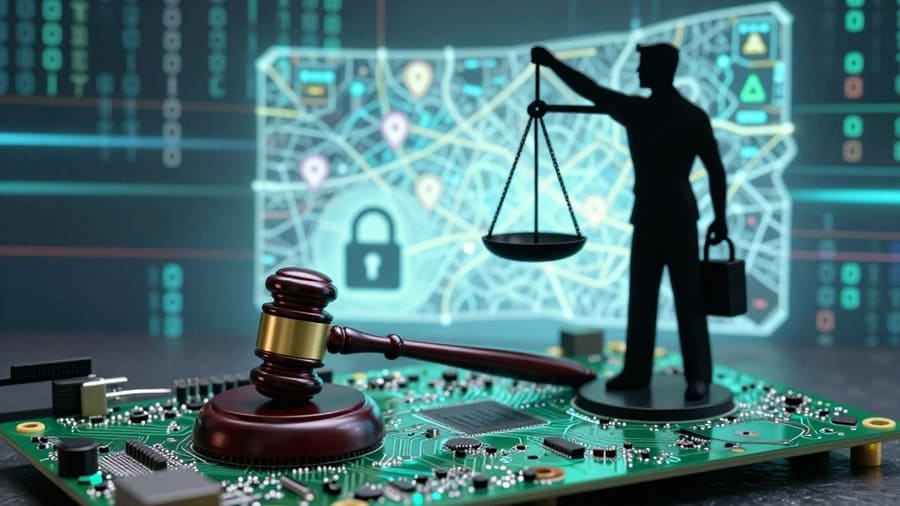
The Supreme Court is weighing the constitutionality of geofence warrants, a modern law enforcement tool that allows police to access vast amounts of location data from tech companies to identify potential suspects near a crime scene. The core question is whether this practice, which can sweep up data from millions of innocent individuals, violates the Fourth Amendment’s protection against unreasonable searches.
Key Takeaways
- Geofence warrants allow police to draw a virtual boundary around a crime scene and request location data from tech companies for all devices within that area.
- Critics argue this practice constitutes a dragnet search, infringing on the privacy of innocent individuals.
- Law enforcement contends it’s a crucial tool for solving crimes when traditional leads are exhausted.
- The Supreme Court’s decision could significantly impact digital privacy and law enforcement’s investigative capabilities.
The Geofence Warrant Explained
Geofence warrants enable law enforcement to request location data from tech giants like Google for a specific geographic area and time frame. This data, often collected through features like Google’s ‘Location History,’ can pinpoint the whereabouts of millions of users who have opted into such services. In cases where traditional investigative methods fail, police can use these warrants to identify individuals present at a crime scene, as seen in a 2019 bank robbery in Midlothian, Virginia.
Privacy Concerns and Constitutional Challenges
Privacy advocates and legal experts express significant concerns that geofence warrants can lead to the indiscriminate collection of data from innocent bystanders. This “dragnet” approach is likened to general warrants, which the Fourth Amendment was designed to prevent. The argument is that requiring tech companies to sift through millions of user accounts to find potential suspects is an unreasonable search, even if a warrant is obtained. Critics warn that such practices could be used to monitor lawful protests or political activities.
Law Enforcement’s Perspective
On the other hand, the government argues that individuals who voluntarily share their location data with tech companies have relinquished a reasonable expectation of privacy. They contend that geofence warrants are a necessary and effective tool for solving crimes, especially when suspects are unidentified. The Justice Department maintains that the search is directed at the tech company’s servers, not directly at individuals without probable cause.
Justices’ Deliberations and Potential Outcomes
During oral arguments, Supreme Court justices appeared divided, grappling with the tension between privacy rights and law enforcement needs. Chief Justice John Roberts questioned the potential for misuse, asking what would prevent the government from using geofence warrants to identify attendees of churches or political organizations. Some justices expressed concern about the broad implications of the government’s position, while others questioned the necessity of the case given changes in how tech companies store data. The court’s decision is expected by summer and could set a significant precedent for digital privacy in the digital age.
Sources
- Supreme Court weighs constitutionality of geofence warrants : NPR, NPR.
- Supreme Court wrestles with geofence search warrants, Politico.
- Supreme Court Wrangles With Police Use of Cell Location Data to Find Suspects, The New York Times.
- Supreme Court grapples with whether police may seek sweeping cellphone location data in investigations |
CNN Politics, CNN.