
By Scott L. Wiss, Founding Partner and Managing Attorney, Levine & Wiss, PLLC · Long Island, New York | Last reviewed: October 2026
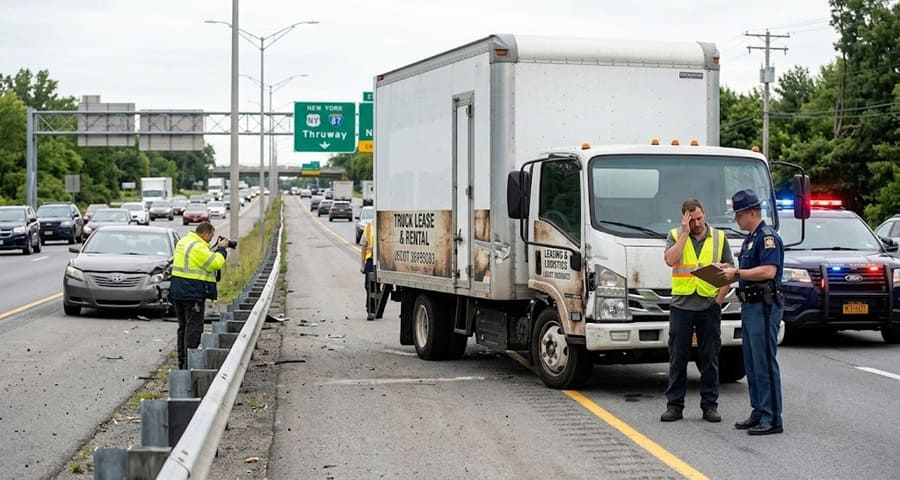
A box truck sideswipes a car on Sunrise Highway. The police report lists the driver, the company he works for, and a registered owner that turns out to be a national truck leasing company. The injured driver’s first question is usually simple: which of these companies is responsible?
In New York, the answer is less automatic than it is for an ordinary borrowed car. State law makes vehicle owners broadly liable for permissive drivers, but a federal law called the Graves Amendment carves out companies in the business of renting and leasing vehicles. Two 2026 decisions sharpened where that line falls.
| Who may be responsible | Usual basis for liability | Common defense |
| Truck driver | Own negligent driving | Disputed fault |
| Driver’s employer or motor carrier | Employer liability for an employee driver; federal lease rules for carriers | Driver was not an employee or was off duty |
| Owner that is not a rental or leasing business | VTL § 388 permissive-use liability | Driver lacked permission |
| Rental or leasing company | Only its own negligence, such as poor maintenance | Graves Amendment bars ownership-only liability |
New York’s Owner Liability Rule
Vehicle and Traffic Law § 388 makes the owner of a vehicle liable for injuries caused by anyone driving it with the owner’s express or implied permission. The owner does not have to be negligent. Owning the vehicle and allowing it to be used is enough.
That rule is favorable to injured people because it gives them access to the owner’s insurance. For a company that owns its own trucks and lets employees drive them, § 388 often adds the owner as a responsible party alongside the driver.
The Graves Amendment Exception
49 U.S.C. § 30106, known as the Graves Amendment, says an owner that rents or leases a vehicle is not liable under state law simply because it owns the vehicle, as long as two conditions are met:
- the owner, or an affiliate, is engaged in the trade or business of renting or leasing motor vehicles; and
- there is no negligence or criminal wrongdoing by the owner or its affiliate.
When both conditions are met, federal law preempts § 388’s ownership-based liability. A commercial lessor such as a truck fleet leasing company usually cannot be held responsible just because its name is on the title while a customer’s driver caused the crash.
The Exception Does Not Cover a Lessor’s Own Negligence
The Graves Amendment protects against liability “by reason of being the owner.” It does not shield a leasing company from its own conduct. In Alfonso v. Trucar Leasing Corp. (1st Dep’t 2024), the Appellate Division let claims proceed against owners and lessors that sought to hold them liable “for their own alleged negligence with respect to the vehicle,” rather than for the lessee’s driving.
In practice, that usually means looking at maintenance. Many full-service truck leases make the lessor responsible for inspections, brakes, tires, and repairs. If a crash involved a brake failure or a worn tire, and the lessor was responsible for maintaining them, the case against the lessor may not depend on ownership at all.
A Leasing Company Has to Prove It Qualifies
The words “loaner” or “rental” do not settle the issue. In O’Hare v. Eddo (4th Dep’t July 24, 2026), a dealership gave a customer a free courtesy car while his vehicle was being serviced. The customer later struck the plaintiff, and the dealership argued the Graves Amendment protected it.
The Fourth Department disagreed. It held that an owner “must receive payment for the use of the vehicle” for the arrangement to count as a rental under the statute. Because the customer paid nothing, the dealership remained exposed under § 388. Courts look at the actual transaction, not the label.
Who Controls the Truck Often Matters More Than Who Owns It
In most commercial truck cases, the defendant that matters most is the company operating the truck. An employer is generally responsible for an employee’s negligent driving within the scope of the job, and New York’s § 388 can still apply to an operator that owns its own equipment.
For interstate carriers that lease trucks to haul freight, federal leasing regulations add another layer. Under 49 C.F.R. § 376.12, the lease must provide that the authorized carrier has exclusive possession, control, and use of the equipment and assumes complete responsibility for its operation during the lease. That helps identify which company is answerable for the driver even when the truck, the driver, and the operating authority come from different businesses.
This is where the paperwork becomes evidence. The lease, maintenance records, driver qualification files, dispatch records, and electronic logging data usually show who controlled the truck and who was responsible for keeping it safe. FindAttorneys.org’s guide to evidence that strengthens a commercial vehicle accident claim covers many of those records. For a Long Island crash involving a leased truck, an attorney for an Amityville trucking accident would typically request the lease early, because it can decide whether the titled owner stays in the case.
2026: Insurance Is a Separate Question
In Second Child v. Edge Auto, Inc., decided April 23, 2026, the New York Court of Appeals took up a case in which a business rented a truck from Edge Auto and one of its employees sideswiped another car. The question was whether Edge Auto had to provide primary liability insurance to the renter under Vehicle and Traffic Law § 370, as earlier New York decisions had required.
In a 4-3 decision, the Court held that the Graves Amendment preempts § 370 to the extent it requires rental companies to provide primary liability coverage for accidents caused solely by the renter’s negligence. But it kept intact New York’s requirement that rental companies carry a specified minimum amount of insurance as a condition of registering and operating vehicles, and it confirmed that rental companies remain responsible for their own negligence.
The practical result for injured people is that the rental company’s policy may not be the primary source of coverage when the renter caused the crash. The renter’s own insurance and the employer’s commercial policy often matter more. FindAttorneys.org’s overview of legal options after a truck accident explains how drivers, carriers, maintenance companies, and manufacturers can each become part of the claim.
A Long Island Tractor-Trailer Recovery
Levine & Wiss’s published case results include a $1,000,000 recovery in a tractor-trailer accident case. The listing gives no details about the vehicles, ownership, or the defendants, so it is not offered as a Graves Amendment example.
It reflects the kind of case where these questions arise. Tractor-trailers are frequently leased, with the tractor, trailer, and driver coming from different companies. Identifying which of them owned, controlled, maintained, and insured the equipment is often what determines where a recovery comes from.
Past results are not indicative of future outcomes. Each case depends on its own facts and circumstances.
Other New York Rules That Apply
Most New York personal injury claims must be filed within three years of the crash. In motor vehicle cases, the no-fault law also limits claims for pain and suffering to people with a “serious injury” as defined in Insurance Law § 5102(d), such as a fracture, significant disfigurement, or a permanent or significant limitation of a body function. Fault is divided under New York’s pure comparative negligence rule, so a share of fault reduces but does not bar recovery.
Frequently Asked Questions
Can I sue the company that owns a leased truck in New York?
Only in limited situations. If the owner is a rental or leasing business, the Graves Amendment generally bars liability based on ownership alone. You may still have a claim if the owner was itself negligent, such as by failing to maintain the truck it was responsible for.
Does the Graves Amendment protect the trucking company that leased the truck?
No. It protects owners that rent or lease vehicles to others. The company operating the truck and employing the driver remains responsible under ordinary negligence and employer liability rules.
What did the 2026 Second Child decision change?
It held that New York cannot require rental companies to provide primary liability insurance for crashes caused solely by a renter, though they must still carry the state minimum insurance.
Is a free dealership loaner car covered by the Graves Amendment?
Not according to the Fourth Department’s 2026 O’Hare decision, which held that the owner must receive payment for the vehicle’s use for it to count as a rental.
Authorities & Sources
- N.Y. Vehicle and Traffic Law § 388: Owner liability for permissive use
- 49 U.S.C. § 30106: The Graves Amendment
- Alfonso v. Trucar Leasing Corp., 225 A.D.3d 401 (1st Dep’t 2024)
- O’Hare v. Eddo, 2026 NY Slip Op 04592 (4th Dep’t July 24, 2026)
- Second Child v. Edge Auto, Inc., 2026 NY Slip Op 02436 (N.Y. Apr. 23, 2026)
- 49 C.F.R. § 376.12: Required lease provisions for authorized carriers
Disclaimer
This article provides general information about New York vehicle and trucking liability law. It is not legal advice, and reading it does not create an attorney-client relationship. Court interpretations change, and every case depends on its own facts. Anyone injured in a crash in New York should speak with a licensed New York attorney about their situation.