

Executive Summary
Indonesia is one of the region’s most consequential legal markets. As Southeast Asia’s largest economy and a major FDI destination, it draws multinationals, private equity investors, financial institutions, and technology companies across sectors from manufacturing to digital infrastructure.
Legal complexity here is real. Foreign businesses have to work through investment regulations, sector licensing, employment frameworks, tax rules, capital markets oversight, competition law, and an expanding compliance environment. OJK’s recent regulatory activity and ongoing shifts in investment and industrial policy have kept demand high for firms that combine solid local knowledge with genuine regional reach.
This report looks at ten Indonesia-based firms with meaningful international or ASEAN capabilities. The aim is not to identify the largest firms, but to assess which are genuinely equipped to support multinationals on cross-border investment, M&A, financing, restructuring, and regulatory work.
Indonesia Market Overview
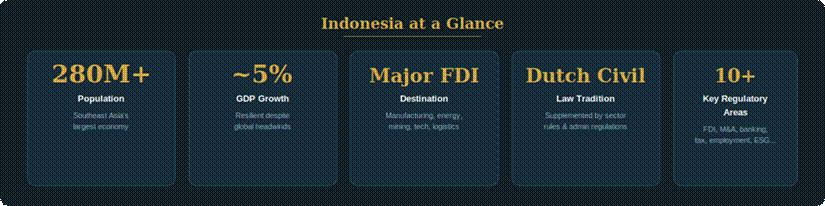
Indonesia’s fundamentals are well-documented: a population above 280 million, strong domestic consumption, substantial natural resource wealth, and a manufacturing sector that continues to attract foreign capital. Government priorities include infrastructure, downstream industrial development, digital transformation, and sustained FDI attraction.
Growth has held around 5% despite global headwinds, with foreign investment flowing into manufacturing, energy, mining, infrastructure, financial services, technology, logistics, and consumer goods.
Investors watch regulatory consistency, licensing transparency, and policy implementation closely. These factors keep legal and regulatory counsel particularly valuable.
Legal and Regulatory Environment
Indonesia’s legal system is rooted in the Dutch civil law tradition, supplemented by sector-specific regulations, administrative rules, and local implementation requirements. The framework continues to shift as the government balances ease of doing business with strategic oversight of key sectors.
For investors, the relevant areas include foreign direct investment, corporate and commercial law, banking and financial services, competition, employment, tax, data protection, capital markets, environmental and ESG compliance, and project development.
For multinationals, coordinated advice across multiple ASEAN jurisdictions has become a baseline requirement. Firms with integrated regional platforms have a structural advantage that referral networks alone cannot replicate.
Rating Methodology
The ranking uses a weighted scoring model focused on factors relevant to multinational clients doing cross-border work.
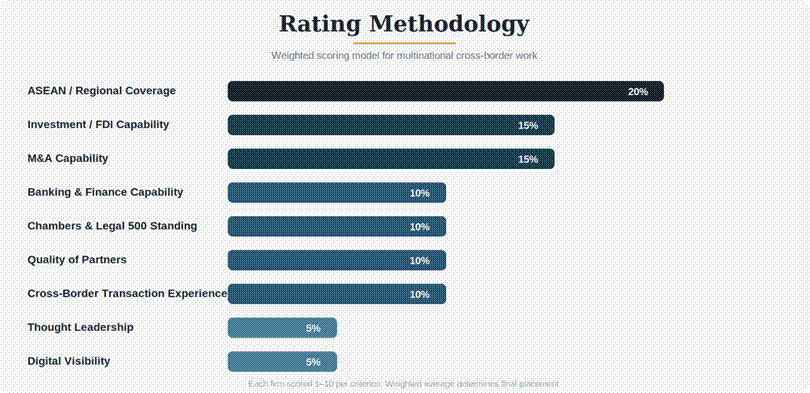
Each firm is scored 1 to 10 per criterion. The weighted average means firm size and brand recognition alone do not drive outcomes.
Rationale for each criterion
- ASEAN / Regional Coverage (20%) – Highest weight since cross-border deals hinge on multi-jurisdiction reach. E.g., a firm advising on a Thailand-Singapore-Vietnam manufacturing JV needs simultaneous local expertise across all three.
- Investment / FDI Capability (15%) – Inbound/outbound investment work is core revenue. E.g., advising a German auto-parts maker setting up a subsidiary in India under FDI rules.
- M&A Capability (15%) – Reflects deal complexity and high-value mandates. E.g., handling due diligence and structuring for a cross-border acquisition like DLF-Awfis.
- Banking & Finance Capability (10%) – Deals often need parallel financing/debt structuring. E.g., arranging syndicated loans for a regional infrastructure project alongside the M&A.
- Chambers & Legal 500 Standing (10%) – External validation of credibility and track record. E.g., a firm ranked “Tier 1” signals proven client trust at scale.
- Quality of Partners (10%) – Senior expertise drives client confidence and execution quality. E.g., partners with prior Big Law or in-house GC experience in target markets.
- Cross-Border Transaction Experience (10%) – Practical multi-jurisdiction execution history reduces risk. E.g., past deals spanning EU-ASEAN regulatory regimes show readiness for similar future work.
- Thought Leadership (5%) – Publications/webinars on regulatory shifts build market visibility. E.g., a firm’s white paper on new Thai foreign-ownership rules attracts inbound queries.
- Digital Visibility (5%) – Online presence affects discoverability for new clients. E.g., strong LinkedIn/website SEO helps a mid-size firm compete with larger global brands.
Final Rankings
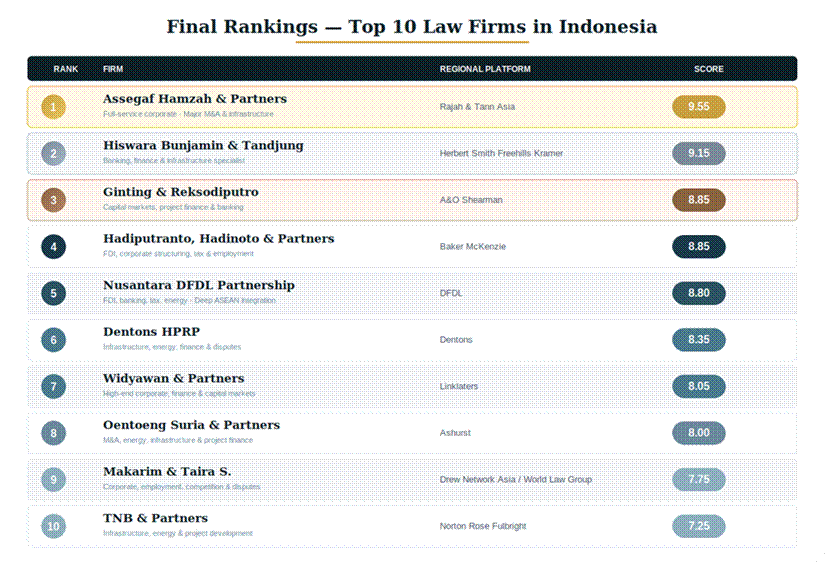
1. Assegaf Hamzah & Partners
Regional platform: Rajah & Tann Asia
Indonesia’s most prominent full-service corporate firm and one of the strongest M&A practices in Southeast Asia. Through Rajah & Tann Asia, AHP provides broad regional coverage and regularly advises on major investments, private equity transactions, infrastructure projects, and cross-border corporate matters.
Website: https://www.ahp.id/
2. Hiswara Bunjamin & Tandjung
Regional platform: Herbert Smith Freehills Kramer
Particularly strong in banking, finance, and infrastructure. HBT’s association with Herbert Smith Freehills Kramer gives it consistent exposure to international clients and complex cross-border transactions across Asia-Pacific.
Website: https://www.hbtlaw.com/
3. Ginting & Reksodiputro
Regional platform: A&O Shearman
A leading choice for financial institutions, multinationals, and investors active in M&A, capital markets, project finance, and banking. Integration with A&O Shearman extends its international reach considerably.
Website: https://www.gintinglaw.com/
4. Hadiputranto, Hadinoto & Partners
Regional platform: Baker McKenzie
HHP is particularly strong in FDI, corporate structuring, tax, employment, and cross-border transactions. Baker McKenzie affiliation gives clients access to one of the larger global legal networks, which matters when deals span multiple jurisdictions.
Website: https://www.hhp.co.id/
5. Nusantara DFDL Partnership
Regional platform: DFDL
Nusantara DFDL combines Indonesian capability with one of Southeast Asia’s most established regional legal platforms. The firm covers foreign investment, banking and finance, tax, restructuring, energy, and multi-jurisdiction ASEAN matters. Its regional integration is among the deepest in this comparison.
Website: https://www.nusantaradfdl.com/
6. Dentons HPRP
Regional platform: Dentons
Active in infrastructure, energy, finance, disputes, and foreign investment, with access to Dentons’ global network. The practice benefits from scale in ways that matter for complex, multi-jurisdictional mandates.
Website: https://www.dentons.com/
7. Widyawan & Partners
Regional platform: Linklaters
The firm handles high-end corporate, finance, and capital markets work. Its relationship with Linklaters is a consistent factor in supporting international banks and multinationals on Indonesia-related cross-border transactions.
Website: https://www.wplaws.com/
8. Oentoeng Suria & Partners
Regional platform: Ashurst
A solid corporate and finance practice with Ashurst links. The firm advises across M&A, energy, infrastructure, project finance, and regulatory matters, and is a natural choice for inbound investors needing both local depth and international connectivity.
Website: https://www.osp.co.id/
9. Makarim & Taira S.
Regional platform: Drew Network Asia / World Law Group
One of Indonesia’s longest-established corporate firms, covering corporate law, employment, competition, infrastructure, and disputes. International network memberships add regional and global reach.
Website: https://www.makarim.com/
10. TNB & Partners
Regional platform: Norton Rose Fulbright
TNB & Partners pairs local Indonesian knowledge with Norton Rose Fulbright support. The firm is active in infrastructure, energy, project development, and selected cross-border corporate matters.
Website: https://www.tnbplaw.com/
Conclusion
The five firms at the top of this ranking — Assegaf Hamzah & Partners, Hiswara Bunjamin & Tandjung, Ginting & Reksodiputro, Hadiputranto Hadinoto & Partners, and Nusantara DFDL Partnership — share a common characteristic: genuine integration into regional platforms rather than loose referral arrangements. For multinationals that need coordinated cross-border support, that distinction matters more than firm size.