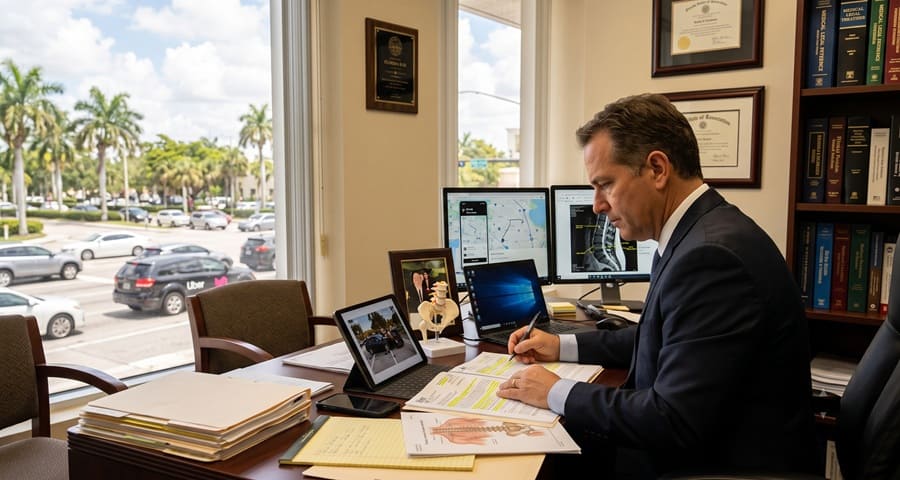
By Alan Siegel, Co-Founder and Equity Partner, Demand The Limits · Boca Raton, Florida | Last reviewed: October 2026
I did not plan to become a lawyer. I studied criminal justice at Florida Atlantic University with the goal of becoming a police officer, and I passed the required test and physical exams before one of my professors, who had become a mentor, encouraged me to go to law school instead. I followed that advice, attended St. Thomas University College of Law, and eventually co-founded a personal injury firm in Palm Beach County, where I am an equity partner today.
What drew me to injury work was the place where law meets medicine. Medical causation- the question of whether a specific event produced a specific injury, sits at the center of nearly every serious case, and it is the part of the work I find most interesting. The cases where it matters most are often the hardest ones a family will ever face: a fatal crash, or a collision involving a rideshare vehicle where several insurance policies point at one another.
Why Causation Decides So Many Cases
Our cases range from car and motorcycle crashes to train accidents and medical malpractice, and the same question keeps returning in every category. An insurer rarely disputes that a collision happened. It disputes what the collision did. A herniated disc can be blamed on age, a brain injury on a prior concussion, and a death on an underlying heart condition.
Florida law answers part of that argument. A defendant takes the injured person as it finds him, so an aggravation of a pre-existing condition is compensable. Proving the aggravation is another matter. It requires imaging taken before and after the crash, treating physicians willing to explain the difference in plain terms, and records that show when symptoms started and how they changed.
Florida’s 2023 tort reform made this work more demanding. House Bill 837 created § 768.0427, which limits evidence of past medical expenses to amounts actually paid, or the amounts needed to satisfy unpaid charges, and requires disclosure when treatment is provided under a letter of protection. The same law moved the state to modified comparative negligence under § 768.81(6), so an injured person found more than 50 percent at fault in most negligence cases recovers nothing. It also cut the deadline for most negligence lawsuits from four years to two under § 95.11. Together, these changes put more weight on precise medical records and less on estimates.
Terminology Matters in the Record
Every injury lawyer benefits from fluency in medical terminology. Radiology reports, operative notes, and neurology consults use language that jurors and adjusters do not read casually. When the record says “acute” instead of “chronic,” or when a physician documents a new finding instead of a degenerative one, that single word can change how the entire claim is valued.
When a Crash Becomes a Wrongful Death Claim
Florida’s Wrongful Death Act gives survivors a path to recovery when someone dies because of another person’s negligence. The claim is brought by the personal representative of the estate on behalf of the survivors, who under § 768.18 include a spouse, children, and parents, and in some circumstances other relatives who depended on the person for support. Under § 768.21, the estate itself can also recover certain losses, such as medical and funeral expenses it paid and the earnings the decedent would likely have accumulated.
The deadline is short. Most wrongful death claims in Florida must be filed within two years of the date of death under § 95.11, and waiting for a criminal case against a drunk or reckless driver to finish can use up much of that time. Families often want to understand how these claims work before they are ready to act, and a conversation with a Boca Raton wrongful death lawyer can focus on those timelines, the probate steps needed to appoint a personal representative, and which survivors hold which claims.
Causation carries into these cases as well. A defense team may argue that a person who died weeks after a crash died of a pre-existing illness or of a complication unrelated to the collision. Autopsy findings, hospital records, and testimony from treating physicians usually decide that question, which is why those records should be requested early. Physical evidence needs the same attention. Most modern vehicles carry an event data recorder that stores speed, braking, and seatbelt information from the seconds before a collision, and that data can be lost once a damaged car is sold for salvage or repaired.
Rideshare Crashes and Layered Insurance
Rideshare collisions raise insurance questions that ordinary car crashes do not. Florida’s transportation network company statute, § 627.748, ties required coverage to what the driver was doing at the moment of the crash:
| Driver status | Minimum required coverage |
| App off | Driver’s personal auto policy only |
| Logged in, waiting for a request | $50,000 bodily injury per person, $100,000 per incident, $25,000 property damage, plus PIP and uninsured motorist coverage |
| Engaged in a prearranged ride (from accepting the request through drop-off) | At least $1 million in liability coverage, plus PIP and uninsured motorist coverage |
That structure turns app data into evidence. Whether a driver had accepted a ride, was carrying a passenger, or had logged off can determine which policy applies and how much money is available. Passengers, other drivers, and pedestrians can all be affected, and each may look to a different layer of coverage. The trip records held by the rideshare company, along with the driver’s personal auto policy, are among the first records worth requesting.
Anyone hurt in one of these collisions should also keep Florida’s no-fault rules in mind. Under § 627.736, personal injury protection requires initial medical care within 14 days of the crash, and that deadline applies even when a much larger liability policy may eventually pay. People comparing their options often speak with a lawyer about how the coverage tiers apply to their facts, and the most useful thing they can bring is a screenshot of the trip or any message from the app about the ride. Find Attorneys has a general overview of what to know after an Uber accident, and a separate explainer on whether an injury qualifies for a claim in Florida.
A Case Where the Records Changed the Outcome
The gap between an insurer’s view of a case and its documented value can be large. One car crash case listed on our firm’s case results page began with a pre-litigation offer that was a small fraction of what the claim was ultimately worth. Cases like that one tend to turn on the details discussed above: before-and-after imaging, treating physicians who can explain what changed, and medical records that hold up under the 2023 rules on what can be shown to a jury.
Past results depend on the specific facts of each case and do not guarantee a similar outcome in any other matter.
The Question at the Center of Every Case
My path from a criminal justice classroom to injury law was not a straight one, and the interest that pulled me off it was a curiosity about how injuries happen and how they can be proven. That question still sits at the center of every case, from a disputed rideshare claim to a family trying to understand a sudden loss.
Disclaimer
This article provides general information about Florida injury and wrongful death law. It is not legal advice, and reading it does not create an attorney-client relationship. Florida law changed significantly in 2023, and outcomes depend on the facts of each case. Anyone injured in a crash, or who has lost a family member, should consult a licensed Florida attorney about their situation.