By Justin Peterson, Founding Attorney, Peterson Law Office · Lexington, Kentucky | Last reviewed: October 2026
A broken bone usually shows up clearly on an X-ray and heals on a fairly predictable schedule. Tendon and ligament injuries are different. They are often labeled “soft tissue” injuries, can be missed on a standard X-ray, and may heal slowly or incompletely. Months after a crash or fall, the swelling may be gone while the knee still gives way on stairs or the shoulder still cannot lift a grocery bag to a shelf.
This guide explains why these injuries can have lasting effects, what those effects tend to look like, and how they are treated. It also covers how long-term soft tissue damage is evaluated in a Kentucky injury claim, where a short filing deadline catches many people off guard.
Tendons and Ligaments: What Each One Does
Tendons connect muscle to bone. When a muscle contracts, the tendon transfers that force to the skeleton and the joint moves. Ligaments connect bone to bone and hold a joint together, limiting how far it can move in each direction.
Both are made of dense, fibrous tissue that is strong but has a relatively limited blood supply. That is one reason these injuries tend to heal more slowly than muscle, and why some complete tears do not heal well on their own.
| Injury | What happens | Common accident causes |
| Sprain (ligament) | Fibers stretch or tear; graded from mild stretching (grade 1) to a complete tear (grade 3) | Twisting a knee or ankle in a fall; bracing against impact |
| Strain or tendinopathy (tendon) | Tendon is overstretched, inflamed, or partially torn | Sudden overload, such as catching yourself during a fall |
| Tendon rupture | Tendon tears completely, disconnecting muscle from bone | Forceful contraction or direct impact |
Common Injuries From Crashes and Falls
A few injuries come up again and again in accident cases. The anterior cruciate ligament (ACL) in the knee is often torn by a sudden twist or a dashboard impact. According to the American Academy of Orthopaedic Surgeons’ guide to ACL injuries, complete ACL tears have a limited ability to heal on their own, and many active people need reconstruction followed by months of rehabilitation. Rotator cuff tendons in the shoulder are commonly injured when someone braces against a steering wheel or falls on an outstretched arm; the AAOS notes that torn rotator cuff tendons generally do not heal back to bone on their own and can get larger over time. Wrist ligaments, ankle ligaments, and the Achilles tendon are also frequently involved.
How the Effects Can Last
Persistent pain
Even after the initial injury settles, the area may hurt with particular movements. Someone with a knee ligament injury may feel it on stairs or after standing for long periods. Someone with a shoulder tendon injury may struggle to reach overhead or sleep on that side. Pain that continues beyond the expected recovery period is worth reporting, because it can signal incomplete healing, scar tissue, or a missed injury that needs imaging such as an MRI.
Joint instability
A stretched or torn ligament may no longer hold the joint firmly in place. People describe a knee that “gives way” when they change direction or an ankle that rolls repeatedly on uneven ground. Each new episode can damage the joint further. Instability in the knee is also linked to a higher long-term risk of cartilage damage and arthritis, which is one reason orthopedic surgeons consider reconstruction for some patients.
Weakness and lost range of motion
When a tendon cannot transfer force properly, the movement it powers becomes weak. Depending on the tendon, gripping, lifting, pushing off while walking, or raising the arm may become difficult. Immobilization during healing, along with scar tissue that forms around the repair, can leave the joint stiff. This is especially noticeable in the hand, wrist, and shoulder, where fine control and full range of motion matter most.
Problems that spread to other joints
People naturally protect an injured limb. Someone with a painful knee shifts weight to the other leg; someone with an injured shoulder uses the other arm or their back to compensate. Over months, those changes can create pain in the hip, lower back, or opposite joint, and the muscles around the original injury weaken from disuse.
Treatment and Recovery
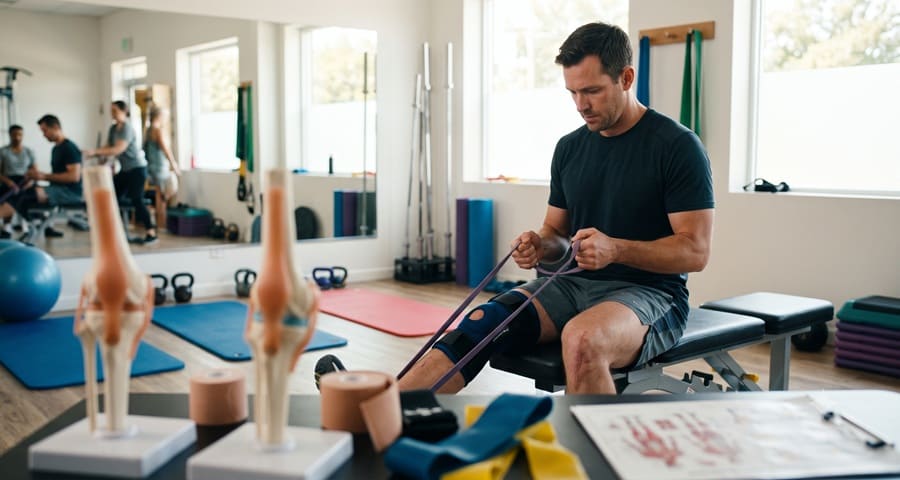
Treatment depends on the structure involved and the severity of the tear. Mild sprains and strains often improve with rest, bracing, and physical therapy. Complete tears of certain ligaments and tendons may require surgery, and recovery from repairs such as ACL reconstruction or rotator cuff repair commonly takes many months, with a structured rehabilitation program throughout.
Two practical points matter for long-term outcomes. First, returning to strenuous activity too early can reinjure tissue that has not regained its strength. Second, skipping physical therapy or stopping early often leaves stiffness and weakness that are harder to fix later. A rehabilitation program built around the specific injury, including flexibility work, controlled movement, and gradual strengthening, gives the best chance of a full recovery.
Work, Daily Life, and Financial Effects
A long recovery from soft tissue injury can mean time off work, light duty, or, for physically demanding jobs, a change of occupation. Household tasks, childcare, and hobbies may be limited for months. Medical costs accumulate through imaging, specialist visits, surgery, and therapy, and some people need future care such as injections or a later surgery.
When someone else’s negligence caused the injury, these losses are part of a personal injury claim: medical expenses, lost wages and lost earning capacity, and non-economic damages such as pain and the loss of activities a person used to enjoy. Because soft tissue injuries are sometimes dismissed by insurers as minor, records from treating physicians, imaging results, and physical therapy notes that document ongoing limitations are especially important.
Kentucky Rules That Affect These Claims
Kentucky law has several features that people injured in accidents should know:
- Short deadline for most injury claims. Under KRS 413.140(1)(a), most personal injury lawsuits must be filed within one year. Motor vehicle claims are different: they generally must be filed within two years of the injury or the last no-fault (PIP) payment, whichever is later, under KRS 304.39-230, as explained in Nolo’s summary of Kentucky car accident law.
- No-fault insurance and its threshold. Kentucky drivers carry personal injury protection that pays up to $10,000 in medical bills and lost wages regardless of fault. To sue the at-fault driver for pain and suffering, medical expenses generally must exceed $1,000, or the injury must involve a qualifying fracture, permanent injury, permanent disfigurement, or permanent loss of bodily function, according to this overview of Kentucky’s no-fault rules. Many ligament and tendon injuries that need imaging, specialist care, and therapy pass the $1,000 threshold quickly.
- Pure comparative fault. Under KRS 411.182, an injured person who shares some blame can still recover, with the award reduced by their percentage of fault.
Kentucky’s approach to evidence in injury claims is covered in more detail in this findattorneys.org article on Kentucky personal injury law, and readers new to the claims process may find this explanation of how personal injury settlements work helpful.
A Fall Case That Resolved Without Trial
Falls are among the most common causes of tendon and ligament damage, and they often produce claims where the long-term effects drive the outcome. Among the verdicts and settlements listed by Peterson Law Office on its results page is a $2.85 million settlement in a slip-and-fall case. The listing does not describe the specific injuries, but fall cases with lasting harm typically depend on the same evidence discussed above: imaging, surgical and therapy records, physician opinions about permanent limitations, and testimony about how daily life and work changed.
Past results depend on the specific facts of each case and do not guarantee a similar outcome in any other matter.
Common Questions
Can a torn ligament heal without surgery?
Partial tears and sprains often heal with rest and rehabilitation. Complete tears of some ligaments, including the ACL, have limited healing ability, and surgery may be recommended depending on activity level and joint stability.
Why did my doctor order an MRI when the X-ray was normal?
X-rays show bone, not soft tissue. An MRI or ultrasound is usually needed to see tears in tendons and ligaments.
Is a soft tissue injury worth pursuing in a claim?
It depends on the severity, the treatment needed, and whether the effects are lasting. Documented tears requiring surgery or extended therapy can involve high medical costs and lost income.
Disclaimer
This article provides general information about tendon and ligament injuries and Kentucky personal injury law. It is not medical or legal advice, and reading it does not create an attorney-client relationship. Anyone with an ongoing injury should follow the advice of their treating providers, and anyone considering a claim should speak with a licensed Kentucky attorney promptly, given the short filing deadlines.