
By Julie K. Bracker, Esq. Partner | Bracker & Marcus LLC | False Claims Act & Whistleblower Litigation | Last reviewed: September 2026
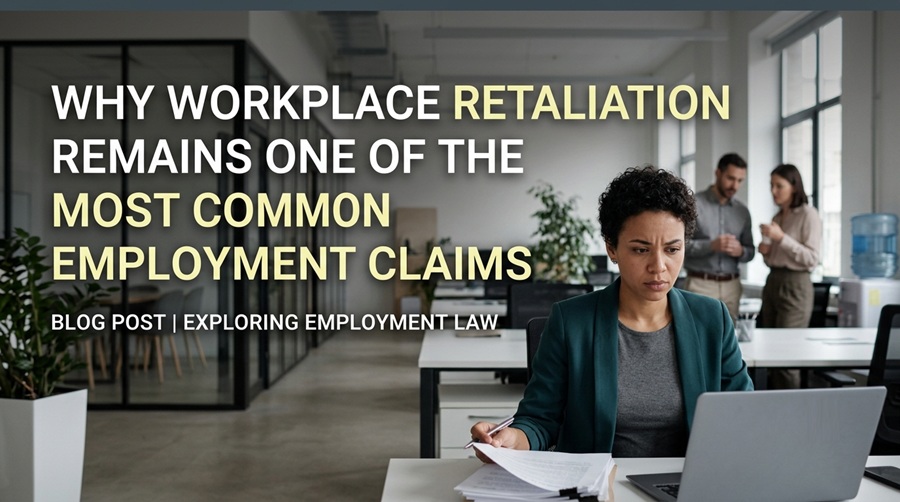
Retaliation claims are common because they often arise after an employee has already complained about another problem: discrimination, harassment, safety concerns, suspected fraud, or another protected issue. The dispute then shifts from what the employee reported to what happened afterward.
That does not mean every negative workplace event after a complaint is unlawful retaliation. The legal question depends on the statute involved, whether the employee engaged in protected activity, what the employer did, and whether the evidence connects the two.
Retaliation Is Common, but ‘Increasing’ Is Too Broad a Claim
The original article says workplace retaliation is continuing to increase across industries. That is too broad without a defined data set. A more accurate statement is that retaliation has remained one of the most frequently alleged forms of employment discrimination for years.
EEOC data show that retaliation became the most frequently alleged basis in private-sector discrimination charges in fiscal year 2010 and has remained a major part of the agency’s caseload. The EEOC now publishes retaliation charge data through fiscal year 2025. EEOC Enforcement and Litigation Statistics
What Counts as Workplace Retaliation?
Under federal EEO laws, retaliation generally requires three things: protected activity, a materially adverse action, and a causal connection between the two. EEOC guidance on retaliation and related issues
Protected activity can include filing a discrimination charge, participating in an investigation, serving as a witness, or reasonably opposing conduct believed to violate an employment-discrimination law.
A materially adverse action is broader than firing or demotion. It can include conduct that might deter a reasonable employee from reporting discrimination or participating in a protected process. Petty slights and ordinary workplace annoyances, by themselves, generally do not meet that standard.
Common Forms of Retaliation
- termination or suspension after protected activity;
- demotion or removal of meaningful responsibilities;
- a pay cut, denied promotion, or materially worse schedule;
- unjustified discipline or negative reviews;
- exclusion from training or opportunities that affect advancement;
- threats, harassment, or unusual scrutiny that could deter protected activity; and
- in some cases, harmful conduct after employment ends.
Context matters. The same scheduling change may be minor for one employee and materially harmful for another, depending on the circumstances.
Different Laws Protect Different Types of Reporting
There is no single federal workplace-retaliation law covering every complaint. The protection depends on what the employee reported.
Title VII, the ADA, the ADEA, the Equal Pay Act, and GINA contain anti-retaliation protections tied to discrimination rights. Other federal statutes protect certain reports involving workplace safety, securities, government fraud, and other regulated conduct.
That distinction matters because filing deadlines, remedies, causation standards, and administrative requirements can differ substantially from one statute to another.
False Claims Act Retaliation Has Its Own Rules
The federal False Claims Act protects employees, contractors, and agents from retaliation because of lawful acts in furtherance of an FCA case or other lawful efforts to stop an FCA violation.
Under 31 U.S.C. § 3730(h), relief can include reinstatement, twice the amount of back pay, interest, special damages, litigation costs, and reasonable attorney’s fees. A retaliation action under that subsection generally must be filed within three years after the retaliatory act.
A Real-World Example: Internal Reporting Followed by Retaliation
Firm-reported case example. Bracker & Marcus has published a False Claims Act matter involving two hospital employees who raised concerns about patient safety and suspected improper arrangements. According to the firm’s account, one employee was fired after raising the concerns and the other was isolated and required to work alone.
The underlying FCA matter later resolved for $520,000, and the two relators received an additional $47,000 to resolve their individual retaliation claims. The example shows why the retaliation analysis can be separate from the underlying fraud claim.
Past results do not guarantee or predict a similar outcome.
Timing Alone Usually Is Not Enough
A firing or demotion shortly after a complaint can be relevant evidence, but timing by itself does not automatically prove retaliation.
Other evidence can include statements showing retaliatory motive, inconsistent explanations, different treatment of comparable employees, sudden discipline after a strong performance history, or evidence that the employer’s stated reason is not credible.
Employers can still discipline or terminate employees for legitimate, non-retaliatory reasons. Protected activity does not excuse misconduct, poor performance, or failure to follow lawful workplace rules.
A Neutral Resource for Whistleblower Retaliation Questions
Employees dealing with suspected government fraud may also encounter Bracker & Marcus’s materials from a whistleblower lawyer. A private law-firm site can provide practical context, but the applicable retaliation standard should be checked against the statute involved, current agency guidance, and controlling court decisions.
What Employees Should Preserve
If retaliation may be developing, contemporaneous records are often more useful than a reconstructed timeline months later.
- the original complaint, report, or communication that may qualify as protected activity;
- emails, messages, performance reviews, and disciplinary notices;
- dates of schedule, pay, duty, or reporting-line changes;
- names of witnesses with firsthand knowledge;
- the employer’s stated reason for the action; and
- records showing how comparable employees were treated, when lawfully available.
Employees should not assume they may copy confidential, privileged, medical, customer, or restricted company records simply because they are considering a claim.
Why These Cases Remain Common
Retaliation disputes remain common partly because the underlying protected activity and the later employment decision often happen close together. Managers may also react defensively to complaints even when the employer has a written anti-retaliation policy.
The legal system therefore focuses less on whether the workplace relationship became strained and more on whether protected activity caused a materially adverse action under the law that applies.
For related reading, see Find Attorneys’ guide to how a whistleblower attorney can help with a claim.
Find Attorneys also has a guide to choosing the right whistleblower lawyer for questions about experience, confidentiality, and case handling.
Frequently Asked Questions
Is every firing after a workplace complaint retaliation?
No. The employee generally must show protected activity, a materially adverse action, and the required causal connection. An employer may still act for a legitimate reason unrelated to the complaint.
Does retaliation require termination?
No. Depending on the law and facts, retaliation can include demotion, suspension, reduced pay, undesirable reassignment, threats, exclusion from opportunities, or other materially adverse conduct.
Can an employee be protected if the original complaint turns out to be wrong?
Under federal EEO law, participation in an EEO process receives broad protection. Opposition complaints generally require a reasonable, good-faith belief that unlawful discrimination occurred. Other whistleblower statutes use different standards.
What remedies are available for False Claims Act retaliation?
Section 3730(h) provides relief that can include reinstatement, double back pay, interest, special damages, litigation costs, and reasonable attorney’s fees.
How long do you have to bring an FCA retaliation claim?
The FCA generally provides three years from the date the retaliation occurred. Other employment-retaliation laws can have much shorter administrative or filing deadlines.
Can retaliation happen after someone leaves a job?
Potentially. Some retaliation statutes and court decisions recognize certain post-employment conduct. The result depends on the law involved and the specific conduct.
Authorities & Sources
- EEOC – Enforcement and Litigation Statistics
- EEOC – Questions and Answers on Retaliation
- 31 U.S.C. § 3730(h) – False Claims Act Retaliation
Disclaimer
This article provides general information about workplace and whistleblower retaliation and is not legal advice. Retaliation standards, protected activity, causation rules, remedies, administrative requirements, and filing deadlines vary by statute and jurisdiction. An employee’s complaint does not automatically make every later workplace action unlawful. Reading this article or following a link does not create an attorney-client relationship.