

By Justin Sisemore, Founder, Sisemore Law Firm, P.C. | Reviewed for legal accuracy, September 2026
A Texas divorce can involve court forms, financial records, parenting information, notices, and deadlines that all need attention at the same time. Creating a reliable system early can make the process feel more manageable, whether the case is agreed, contested, or still uncertain. This guide to divorce paperwork in Texas focuses on practical organization rather than legal strategy.
From a busy Dallas County courthouse to a smaller district clerk’s office in West Texas, local procedures can differ. A well-kept file helps you find what you need, communicate clearly, and avoid preventable errors. Organization is useful, but it does not replace advice from a qualified Texas family-law professional.
Why Organization Matters in a Texas Divorce
Missing a notice, sending an incomplete form, or losing a bank statement can slow down a case and create unnecessary stress. A complete record is also useful when reviewing questions about the home, vehicles, retirement savings, debts, income, or a child’s schedule. For example, keep court-stamped filings in one folder, household bills in another, and personal notes in a separate, dated log. This approach prevents a proposed parenting schedule from being buried under credit-card statements.
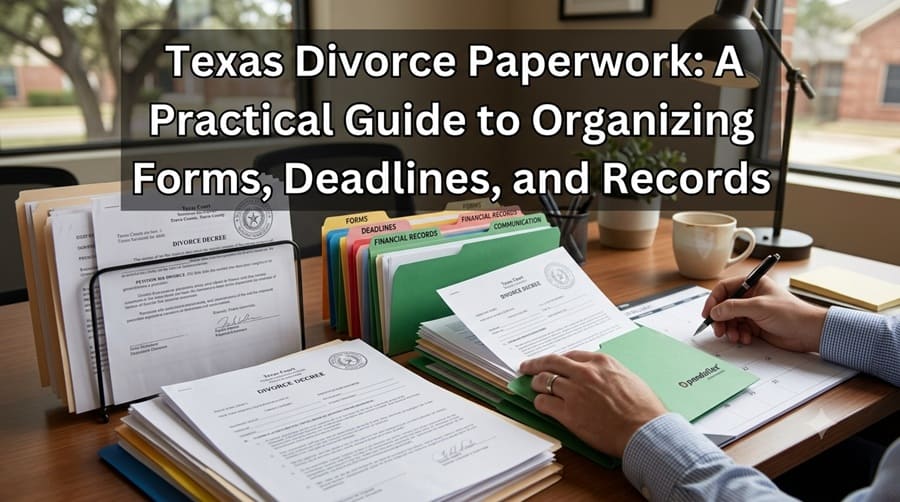
Build One Simple Paper and Digital System
Use one physical file container and one password-protected digital folder. Choose labels you will recognize quickly, then use the same names for paper and electronic copies. A file name such as “2026-09-03_Respondents-Answer_Filed” is easier to locate than “court paper final.”
• Court filings: Petitions, answers, notices, file-stamped copies, and signed orders.
• Financial records: Pay information, account statements, property records, loans, and recurring expenses.
• Parenting records: School calendars, medical details, childcare information, and proposed schedules.
• Communication: Important emails, messages, written agreements, and delivery confirmations.
• Deadlines: Hearing dates, response dates, filing tasks, and follow-up reminders.
What to Gather Before Filing
There is no universal packet for every Texas divorce, but early collection reduces the need for last-minute searching. Gather identity and marriage records, recent tax returns and pay records, bank and credit statements, retirement and investment information, mortgage and vehicle documents, insurance details, deeds, titles, and loan information. If children are involved, also collect information on school, medical, childcare, and activity.
Make readable copies and store them safely. Do not alter, hide, destroy, or remove records that could matter in the case. If you share devices or cloud accounts with your spouse, use a secure account and change passwords only in a way that does not interfere with access to jointly needed records or violate a court order.
Confirm the Correct County and Court
Before filing, confirm the appropriate district clerk and court for the county where the case belongs. Under Tex. Fam. Code § 6.301, either spouse generally must have been a Texas domiciliary for the preceding six months and a resident of the filing county for the preceding 90 days. Both requirements have to be met by at least one spouse at the time the petition is filed — it doesn’t matter which spouse actually files, as long as one of them satisfies both prongs.
Check the official county website for local rules, filing methods, hearing procedures, accepted payment options, and contact details. Filing in the wrong place or following an outdated local instruction can mean extra work, so verify before submitting documents.
Understanding What Actually Gets Divided
Records matter for a reason that isn’t always obvious upfront: Texas is a community property state, and the law starts from a presumption that everything either spouse holds at the time of divorce is community property, divisible between the two of you. Under Tex. Fam. Code § 3.003, overcoming that presumption — proving that a specific account, inheritance, or piece of property is actually separate property under § 3.001 rather than community property under § 3.002, requires clear and convincing evidence — a meaningfully higher bar than the ordinary standard used in most civil disputes. That’s precisely what a dated paper trail is for: a pre-marriage bank statement, an inheritance record, or a gift letter can be the difference between an asset staying yours and it being folded into the pot that gets divided. Community property itself is then divided under § 7.001, which requires a division the court considers “just and right” — not necessarily an even 50/50 split.
Create a Filing, Service, and Deadline Calendar
Put every date in one calendar as soon as it appears on a court notice. Start with the filing date, then add response deadlines, service attempts, hearings, mediation dates, and document due dates. Set reminders at least one week and two days in advance, and save proof of each filing, delivery, or electronic submission.
Filing a divorce starts the case, but it does not necessarily notify the other spouse. Keep copies of service returns, signed waivers, acknowledgments, and court-stamped documents. A person served with divorce papers should review the documents immediately and identify any response deadline. Under Tex. Fam. Code § 6.702, Texas generally imposes a minimum 60-day waiting period after filing before a divorce may be granted — an exception exists where the respondent has a final conviction for or an active protective order related to family violence against the petitioner or a household member — but the case does not finish automatically when that period ends.
If a notice is unclear, contact the clerk’s office for procedural information. The clerk cannot provide legal advice, but can often confirm practical details such as whether a document was received or where local filing instructions are posted.
Keep Parenting, Property, Debt, and Income Records Separate
Separate folders reduce the risk of overlooking important information. Use a parenting file for proposed possession schedules, school calendars, transportation notes, and medical records. Use a property file for real estate, vehicles, household items, appraisals, and business-related documents. Keep credit cards, personal loans, tax balances, and monthly obligations in a debt file, while pay stubs, benefits information, and business income belong in an income file.
Homes, businesses, retirement accounts, and shared debts can create long-term consequences even when spouses generally agree. Careful records help identify what exists, and whether it’s separate or community property, before an agreement is drafted or signed.
How Missing Records Change a Case in Practice
The value of a records system is easiest to see in a case where one wasn’t in place.
In one illustrative matter reflecting a pattern seen in Tarrant County-area cases, a spouse who received a sizable inheritance early in the marriage had deposited it into a joint account and used part of it for a down payment on the family home, without keeping records tracing the funds back to the inheritance. By the time the divorce was filed years later, no paper trail existed connecting the original inheritance to the current equity in the home. Because Texas presumes property held at divorce is community property absent clear and convincing evidence otherwise, the commingled funds were treated as community property subject to division — an outcome that a contemporaneous bank statement and a simple record of the transfer would likely have prevented. Identifying details have been changed, and this composite reflects a recurring pattern in property-division cases rather than a specific verified matter; individual outcomes depend on the facts and evidence in each case.
Use E-Filing Carefully and Protect Sensitive Information
Before uploading a document, check its filing type, page order, signatures, attachments, and scan quality. Save the submission receipt, then save the file-stamped version when it becomes available. Review documents for personal data, including Social Security numbers, bank-account numbers, children’s identifying information, and medical details, because court records may be accessible to the public.
The Texas judiciary’s self-represented litigant resources direct people without lawyers to court information, forms, and electronic-filing assistance. Use current forms that fit your situation rather than relying on an old file from a friend or an unverified online source.
Common Mistakes to Avoid and a Final File Review
• Leaving required fields blank instead of using “not applicable” when appropriate.
• Submitting unsigned documents or forgetting an attachment.
• Using inconsistent names, addresses, or case numbers across forms.
• Failing to retain file-stamped copies and proof of delivery.
• Assuming an informal agreement changes a court order.
• Missing a hearing notice or sharing sensitive records through an unsecured account.
Before the case ends, confirm that the required documents are filed and that you understand the final order. Keep the signed final decree in more than one secure location. Review any deadlines for property transfers, refinancing, account changes, support obligations, or parenting arrangements. Updating beneficiaries, insurance information, emergency contacts, and estate-planning documents may also be appropriate after the divorce is final.
When Additional Legal Help May Be Wise
Extra legal guidance can be especially important when there is family violence, a business, substantial retirement assets, real estate in another state, suspected hidden income, military service, international issues, special needs involving a child, or a spouse who will not cooperate. A carefully organized file gives a lawyer or legal aid provider a clearer starting point and helps you ask more focused questions.
Frequently Asked Questions
How long do I have to live in Texas before I can file for divorce?
Under Tex. Fam. Code § 6.301, at least one spouse must have been a Texas domiciliary for the preceding six months and a resident of the filing county for the preceding 90 days. Both requirements must be met by the time the petition is filed.
How long does a Texas divorce take once it’s filed?
There’s a mandatory minimum 60-day waiting period under Tex. Fam. Code § 6.702 before a divorce can be granted, with a narrow exception involving family violence. Meeting that minimum doesn’t mean the case is finished — contested issues can extend the timeline well beyond 60 days.
What’s the difference between separate and community property in Texas?
Separate property (owned before marriage, or received during marriage by gift, devise, or inheritance) generally isn’t divided in a divorce. Community property (most things acquired during the marriage) is presumed to exist and is divided in a manner the court considers just and right. Proving something is separate property requires clear and convincing evidence, which is why contemporaneous records matter.
Does organizing my paperwork replace the need for a lawyer?
No. Good organization makes a case easier to manage and gives an attorney a clearer starting point, but it doesn’t substitute for legal advice, especially in cases involving a business, significant assets, hidden income, or family violence.
What should I do if I’m not sure whether I’ve met Texas’s residency requirement?
Contact the district clerk’s office for procedural questions, and consult a Texas family-law attorney to confirm jurisdiction before filing — filing prematurely can result in dismissal and lost time.
Texas divorce paperwork is easier to manage when every document has a purpose, a storage location, and a deadline. A calm system cannot remove every challenge, but it can help Texas residents reduce avoidable filing problems and make informed decisions throughout the process.
Disclaimer
This article is for general informational purposes only and does not constitute legal advice. Texas family law changes, and the facts of every case are different; nothing here should be relied on as a substitute for consulting a licensed Texas family-law attorney about your specific situation. The case example above is a composite reflecting common patterns in property-division cases, with identifying details changed to protect privacy — it does not describe a specific verified matter, and past outcomes do not guarantee or predict similar results in any other case. This is attorney advertising.