
By Tad Thomas, Thomas Law Offices | Reviewed for Legal Accuracy | Updated September 2026 | 11 minutes read
Key Takeaways
- Federal nursing home regulations require facilities to provide residents with limited mobility appropriate equipment, services, and supervision to prevent accidents during transfers.
- Falls, fractures, skin breakdown, and pain are the most common consequences of improper lift equipment use, and older residents are especially vulnerable to lasting harm from any of them.
- OSHA has no single binding standard for safe patient handling, but it enforces serious ergonomic hazards in nursing homes under the General Duty Clause and publishes voluntary guidelines recommending that manual lifting be minimized or eliminated.
- A facility’s inspection history, including cited deficiencies related to falls or improper transfers, is publicly searchable through Medicare’s Care Compare tool.
- Improper lift equipment use also endangers caregivers, contributing to musculoskeletal injuries and staffing shortages that can compound the risk to residents.
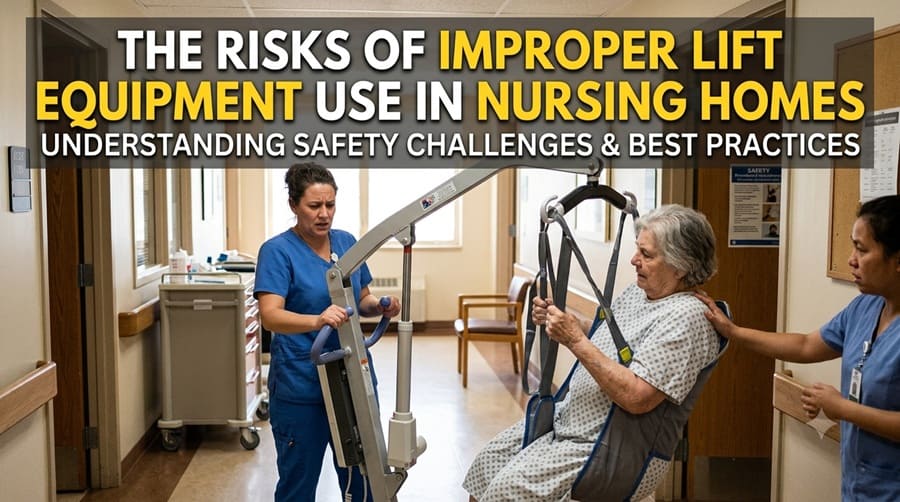
To help residents safely move between beds, chairs, wheelchairs, and other areas of the facility, nursing homes rely on lift equipment, sit-to-stand devices, transfer aids, mechanical lifts, and other equipment. These can reduce the physical strain placed on caregivers and help residents with limited mobility move more often. However, these devices must be used correctly to protect both staff and residents alike.
Improper lift equipment use can occur for several different reasons. Staff members may not have adequate training, or the equipment may not be properly maintained. Caregivers may use the wrong type of lift for a resident’s physical condition, rush through a transfer, or fail to follow the manufacturer’s instructions. When lift equipment is not used properly, residents can suffer serious physical and emotional consequences.
The Legal Framework Behind Safe Resident Transfers
Nursing homes that accept Medicare or Medicaid funding must comply with federal quality-of-care standards established by the Nursing Home Reform Act of 1987 (part of the Omnibus Budget Reconciliation Act, or “OBRA ‘87”) and implemented through 42 CFR § 483.25. Among other requirements, a facility must ensure that “the resident environment remains as free of accident hazards as is possible” and that “each resident receives adequate supervision and assistance devices to prevent accidents.” The same regulation requires that a resident with limited mobility receive “appropriate services, equipment, and assistance to maintain or improve mobility with the maximum practicable independence.” Improper lift equipment use can violate both of these obligations at once.
On the caregiver side, the Occupational Safety and Health Administration (OSHA) has no single mandatory standard specifically for patient handling, but it addresses serious ergonomic hazards in nursing homes under the General Duty Clause of the Occupational Safety and Health Act. OSHA’s voluntary Guidelines for Nursing Homes recommend that manual lifting of residents be minimized in all cases and eliminated when feasible — guidance that, while not independently enforceable, reflects the industry consensus that mechanical lift equipment should be the default, not a last resort.
Families can check a specific facility’s compliance history, including cited deficiencies related to falls, transfers, or accident prevention, through Medicare’s Care Compare tool, which publishes state survey results for every Medicare- and Medicaid-certified nursing home in the country.
Increased Risk of Falls
One of the most significant risks associated with improper lift equipment is falling. Residents who require mechanical assistance are typically unable to safely support their own weight. If a sling is incorrectly positioned or a strap is not properly secured, the resident can easily slip or fall during the transfer process.
Residents who fall due to a problem with lifting equipment can suffer serious injuries, including head injuries, bruising, broken bones, and other trauma. Older adults are particularly vulnerable to complications after a fall: reduced bone density, limited balance, or other physical problems can make recovery more difficult. A nursing home abuse attorney may be able to help families understand their options when improper equipment use contributes to a resident’s serious injury.
It’s vitally important that all caregivers follow the appropriate procedures every time they use lift equipment. This includes selecting the correct equipment, positioning the resident appropriately, checking the device before use, and ensuring all necessary safety features are adequately secured.
Fractures and Other Serious Injuries
A resident can suffer an injury if a lift is moved too quickly, the equipment is positioned incorrectly, or the caregiver transfers without following proper procedures. Improper transfers can also cause falls. Because older residents have fragile bones and existing physical limitations, they are especially vulnerable to injury during transfers.
Improper positioning can easily place excess pressure on a resident’s legs, arms, shoulders, hips, or back. Even movements that may appear minor can cause significant discomfort or injury for someone who already has limited mobility. It’s important for staff members to understand each resident’s limitations before performing a transfer. All resident care plans should provide guidance on the equipment needed for safe movement and the type of assistance the resident needs.
Skin Injuries and Pressure Damage
Another common result of improperly used lifting equipment is skin injury. Transfer devices and slings must be positioned correctly to evenly distribute weight and provide adequate support. If a sling is positioned incorrectly, twisted, or left in place longer than necessary, it can create friction or pressure against the resident’s skin. Older adults are more susceptible to skin damage because they have thinner, more fragile skin, and federal regulations specifically require facilities to prevent avoidable pressure ulcers and treat any that develop (42 CFR § 483.25(b)). Find Attorneys’ guide to documenting bedsores for legal action covers this in more depth.
It’s vital for caregivers to inspect equipment regularly and pay attention to a resident’s positioning during transfers. Any signs of irritation, redness, bruising, or skin breakdown should receive prompt care, since many residents with limited mobility are already at high risk for pressure injuries.
Pain and Physical Discomfort
Residents can experience significant pain when lifting equipment is used improperly. Improper positioning can place pressure on areas of the body that are already injured, affected by a chronic condition, or highly sensitive. A resident with a hip problem, for example, may experience increased discomfort if their body isn’t properly supported during a transfer.
Moving a resident without communicating what’s happening, or moving too quickly, can cause fear and physical tension, resulting in more discomfort throughout the process. Caregivers should always communicate with residents throughout a transfer and allow residents to ask questions.
Increased Risk to Caregivers
Improper use of lift equipment doesn’t just put residents at risk — it also puts nursing home employees at risk of serious injury. While mechanical lifts are designed to reduce the physical force caregivers need to use during transfers, caregivers can still be injured if they attempt to manually lift a resident. Improperly maneuvering equipment, or using a device that isn’t appropriate for the situation, can also demand more physical effort than the equipment was meant to require.
Musculoskeletal problems, shoulder injuries, muscle strains, and back injuries are among the most common injuries caregivers experience, often stemming from poor lifting technique or attempts to compensate for malfunctioning equipment. These injuries can affect an employee’s ability to work and contribute to the staffing shortages that, in turn, make safe transfers harder to guarantee facility-wide.
Equipment Malfunctions and Maintenance Problems
It’s vitally important that all lift equipment undergo regular inspection and maintenance to remain safe. Any device with damaged components, malfunctioning controls, worn straps, or other defects may not provide the support needed during a transfer. Nursing homes should have procedures in place for inspecting equipment and reporting problems.
Staff members should know how to identify signs that a sling or lift may not be safe to use. Any equipment that appears damaged should not be used until it is repaired — small defects can quickly become serious problems and contribute to unexpected accidents. Timely repairs and proper maintenance are imperative to preventing equipment-related injuries during patient transfers.
Inadequate Staff Training
Even properly functioning equipment can be highly dangerous when employees don’t know how to use it. Nursing homes should always provide appropriate training before letting staff operate mechanical lifts or other specialized transfer equipment. Training should cover proper operation, sling selection, safety procedures, weight limits, resident positioning, and emergency procedures.
Staff members should understand that different residents may require different types of assistance or equipment. Nursing homes should provide ongoing education rather than assuming a single training session is sufficient, using refresher training when new equipment is brought into the facility or when a resident’s mobility needs change.
When Equipment-Related Neglect Led to a Jury Verdict
The consequences of inadequate care around a resident’s basic physical needs aren’t hypothetical. In one case handled by Thomas Law Offices, a Cleveland jury awarded $2 million against a nursing home after a non-verbal resident lost roughly a quarter of her body weight while in the facility’s care, including $500,000 specifically for violations of the state’s Residents’ Rights Act. Details have been generalized here; the case involved general care neglect rather than a lift-equipment incident specifically, but it illustrates the scale of harm — and jury accountability — that can follow when a facility fails to meet a resident’s basic physical care needs. Case outcomes depend on each claim’s specific facts, and past results do not guarantee a similar outcome in any other case.
Frequently Asked Questions
What should I do if I suspect a loved one was hurt by improper lift equipment use?
Document what you observe — photos of any visible injury, dates and times, and the names of staff involved — and request the resident’s care plan and incident report from the facility. A prompt medical evaluation both protects the resident and creates a record connecting the injury to the incident. Reporting the concern to the facility’s administration and, if appropriate, the state long-term care ombudsman or licensing agency, creates an additional record.
Is there a specific law requiring nursing homes to use lift equipment safely?
There isn’t a single standalone “lift equipment law.” Instead, the obligation comes from federal quality-of-care regulations under 42 CFR § 483.25, which require facilities to prevent avoidable accidents and provide appropriate equipment and assistance for residents with limited mobility, combined with OSHA’s general duty to maintain a safe workplace for staff.
How can I check a nursing home’s safety record before or after placing a loved one there?
Medicare’s Care Compare tool publishes each certified facility’s star rating, staffing levels, and state survey deficiencies, including citations related to falls, accident prevention, and quality of care. It won’t capture every incident, but a pattern of related citations is worth discussing with the facility directly.
Can a caregiver’s own injury from improper lift equipment support a legal claim?
Caregiver injuries typically fall under workers’ compensation rather than a nursing home negligence claim, since the employer-employee relationship governs that harm. That said, a pattern of caregiver injuries tied to malfunctioning or insufficient lift equipment can be relevant evidence in a resident’s negligence claim, since it may show the facility knew about an equipment or staffing problem and failed to address it.
Conclusion
Lift equipment exists to protect both nursing home residents and the staff who care for them, but only when it’s properly maintained, appropriately selected, and used by trained staff who understand each resident’s specific needs. When any of those pieces fail, the consequences — falls, fractures, pressure injuries, pain, and caregiver injuries — can be serious and lasting. Families who notice signs of improper equipment use or unexplained injuries have the right to ask questions, request records, and, when necessary, seek legal guidance.
For more information about nursing home safety and legal options after suspected neglect, My Nursing Home Abuse Guide is a useful resource, as is Find Attorneys’ broader nursing home negligence coverage.
About the Author
Tad Thomas is the founder and managing partner of Thomas Law Offices, a plaintiffs’ civil litigation firm with offices across Kentucky, Ohio, Illinois, Missouri, and Iowa. A past president of the American Association for Justice and longtime chair of its Nursing Home Litigation Group, Thomas has tried nursing home neglect and wrongful death cases nationwide and regularly lectures other trial lawyers on litigating these claims, including combating arbitration clauses and presenting demonstrative evidence at trial.
Authorities & Sources
- 42 CFR § 483.25 — Quality of care, accident prevention, and mobility requirements
- OSHA — Nursing Homes and Personal Care Facilities: Standards / General Duty Clause
- OSHA — Guidelines for Nursing Homes: Ergonomics for the Prevention of Musculoskeletal Disorders
- Medicare.gov — Care Compare (nursing home inspection results)
Disclaimer
This article is provided for general informational purposes only and does not constitute legal or medical advice. Nursing home regulations and enforcement practices can vary and change over time. Reading this article does not create an attorney-client relationship with Find Attorneys, Thomas Law Offices, or any organization mentioned. The case example above is generalized for illustration; past results do not guarantee or predict a similar outcome in any future case. For guidance about a specific situation, consult a licensed attorney in your jurisdiction.