
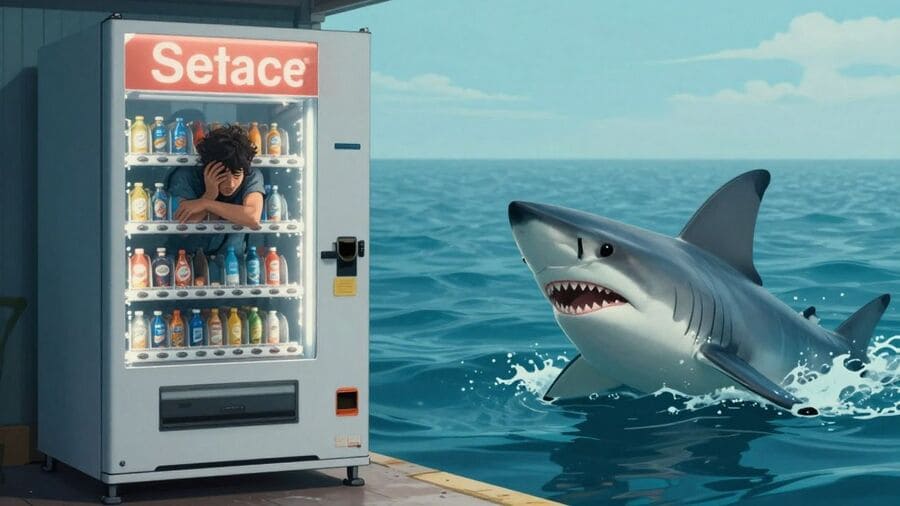
You’ve probably heard the wild claim that vending machines are more dangerous than sharks. It sounds crazy, right? Well, we decided to dig into this comparison, especially with a focus on Florida, to see if there’s any truth to it. We’ll look at the stats, how these incidents happen, and whether you should really be more worried about your snack break or your beach day.
Key Takeaways
- The idea that vending machines kill more people than sharks is a comparison that’s mostly based on older data, and current trends suggest this isn’t accurate anymore.
- Vending machine deaths typically occur when someone shakes or tips the machine, causing it to fall on them, often in an attempt to get free products or money.
- Shark attack fatalities are extremely rare, with global numbers consistently low, and the lifetime risk of a fatal encounter is minuscule.
- While vending machine deaths were more common in the past, safety measures and design changes have significantly reduced these incidents.
- In Florida, like elsewhere, the actual risk from sharks is very low, and legal issues surrounding vending machines are more about product safety and consumer rights than unusual fatalities.
Vending Machine Deaths Versus Shark Attack Statistics
It’s a comparison that pops up surprisingly often: are you more likely to die from a vending machine or a shark? For years, the common wisdom, often repeated in articles and casual conversation, suggested that vending machines were the more dangerous of the two. This idea was largely fueled by older statistics, particularly a 1995 report from the U.S. Consumer Product Safety Commission (CPSC). This report detailed incidents where people were injured or even killed after rocking or tilting vending machines, often in an attempt to get free snacks or money. The machines, some weighing over 1,000 pounds, could topple over, leading to serious harm.
Understanding the Comparison
The comparison between vending machine deaths vs shark attacks serves a specific purpose: to highlight how rare shark attacks actually are. By juxtaposing them with a seemingly mundane object like a vending machine, the point is made that sharks, despite their fearsome reputation, are not the constant killers depicted in movies. It’s a way to put the actual risk of a shark encounter into perspective. However, the data supporting this comparison needs a closer look to see if it still holds up today. Vending Machine Injuries Compensation
Historical Data on Vending Machine Incidents
Looking back, the numbers from the CPSC report are quite striking. Between 1978 and 1995, the commission recorded at least 37 deaths and 113 injuries linked to falling vending machines. This led to voluntary campaigns by manufacturers to add warning labels, advising against rocking or tilting the machines. Interestingly, the vast majority of these incidents involved men. These statistics painted a picture of vending machines as a low-key, but real, hazard.
Current Trends in Vending Machine Fatalities
So, what’s the situation now? According to the CPSC, reported vending machine deaths have become exceedingly rare. The last recorded fatality was in 2008, when a man died after a machine fell on his foot. Since then, there haven’t been any reported deaths. This significant drop suggests that safety measures and increased awareness have made these incidents far less common than they were in the past. The odds of winning the Powerball lottery, for instance, are astronomically lower than the historical odds of being killed by a vending machine, but the current risk is minimal.
The perception of risk doesn’t always align with statistical reality. We tend to fear things that are dramatic or sensationalized, like shark attacks, while overlooking more common or unusual dangers.
When we look at the numbers, the idea that vending machines kill more people than sharks annually is largely a relic of older data. While sharks are capable of inflicting harm, the actual number of fatalities globally is very low. For example, in 2021, there were only nine reported fatalities worldwide from shark attacks. The lifetime risk of a shark encounter is incredibly small, estimated at about 1 in 4.3 million. This starkly contrasts with the historical vending machine data, but the current reality shows a different picture. It’s important to remember that location plays a huge role in these kinds of comparisons; if you live far from the ocean, your risk of a shark attack is practically zero, whereas a vending machine is likely much closer. The comparison of vending machine deaths vs shark deaths is a fascinating way to explore risk perception, but the numbers have shifted over time.
The Reality of Shark Attack Risks
Global Shark Attack Fatality Numbers
When you hear about sharks, your mind probably jumps to those dramatic movie scenes, right? It’s easy to get caught up in the fear, but the actual numbers tell a different story. Globally, shark attacks that result in death are incredibly rare. We’re talking about a handful of incidents each year, on average. For instance, in a recent year, there were only about nine reported fatalities worldwide due to shark encounters. It’s a stark contrast to the sensationalized image often portrayed in media.
Lifetime Risk of Shark Encounters
Let’s put this into perspective. The chance of dying from a shark attack over your entire lifetime is astonishingly small. Some estimates place this risk at around 1 in 4.3 million. To put it even more simply, you are far, far more likely to encounter a shark and survive, or never encounter one at all, than to meet your end because of one. It’s a statistic that really makes you pause and consider the actual odds.
Misconceptions About Shark Danger
So why the widespread fear? A lot of it comes down to how sharks are presented to us. Think about popular movies and TV shows – they often paint sharks as relentless predators just waiting for a human to swim by. This portrayal, while entertaining, creates a huge disconnect from reality. Sharks are vital to ocean health, and most species don’t view humans as prey. In fact, many shark bites are cases of mistaken identity or curiosity, not predatory attacks. It’s a classic case of fear of the unknown, amplified by pop culture.
The narrative around sharks has been heavily influenced by media, leading to widespread misconceptions about their behavior and threat level to humans. This often overshadows their ecological importance and the actual rarity of fatal encounters.
Here are a few things that are statistically more likely to cause harm than a shark encounter:
- Accidental poisoning: This includes things like drug overdoses or chemical exposure, leading to hundreds of deaths daily in the US alone.
- Car accidents: Sadly, tens of thousands of people die in car crashes every year.
- Healthcare-acquired infections: These infections in hospitals account for a significant number of deaths annually.
- Even a champagne cork: Believe it or not, there are documented cases of fatalities from champagne cork incidents each year.
Investigating the Vending Machine Death Claim
How Vending Machine Deaths Occur
Most people are surprised to find out that vending machines can be dangerous. When injuries and deaths do happen, it’s almost always because someone tries to rock or tilt the machine:
- People might shake a machine to dislodge stuck snacks or get extra change
- Tilting a machine, especially the larger, heavier kind, can cause it to topple over
- These machines can weigh over 1,000 pounds, so if one falls, the result is often serious injury or even death
It’s not an electric shock or food poisoning—it’s usually the full weight of the unit crushing someone after improper use.
If you find your chips stuck inside the machine, don’t risk your life trying to shake them loose. It’s not worth it.
The Role of the Consumer Product Safety Commission
The U.S. Consumer Product Safety Commission (CPSC) plays a big role in tracking and preventing vending machine injuries and deaths.
- In 1995, the CPSC reported at least 37 deaths and 113 injuries from people rocking or tipping vending machines between 1978 and 1995.
- This led to a campaign by machine companies to add warning labels, telling users not to rock the machines.
- The CPSC continues to gather data on these incidents and issues safety guidance to prevent future accidents.
Here’s a simple breakdown of vending machine deaths, based on CPSC data:
| Year Range | Deaths Reported |
|---|---|
| 1978-1995 | 37 |
| 1996-2007 | Fewer cases, declining trend |
| 2008-present | Rare, nearly none reported |
Factors Contributing to Decreased Vending Machine Fatalities
So why does it seem like we hear about fewer vending machine accidents now?
- Warning labels have become standard on machines since the mid-1990s, reminding people not to tip or rock them
- Better machine designs and securing units to walls or floors in public areas
- The rise of credit card payments has reduced the frustration of lost coins, so fewer people take their chances shaking the machine
All these changes have made accidents far less common.
Today, vending machine deaths are very rare, but that doesn’t mean the danger is completely gone. Using machines as intended is still the safest bet.
Comparing Likelihoods: Vending Machines vs. Sharks
Statistical Analysis of Vending Machine vs. Shark Deaths
Okay, so let’s get down to the nitty-gritty. We’ve heard this comparison thrown around a lot: that vending machines are somehow more dangerous than sharks. It sounds wild, right? But when you dig into the numbers, it gets a little more interesting. For a long time, the statistic was that you were more likely to die from a vending machine incident than a shark attack. This often came from reports in the 1990s, where the U.S. Consumer Product Safety Commission noted deaths and injuries from people rocking or tilting machines to get free snacks or money. Back then, it was estimated to be around two vending machine deaths per year in the U.S.
Shark attack fatalities, on the other hand, are generally quite low globally. For instance, in 2021, there were only nine reported fatalities worldwide. The lifetime risk of dying from a shark attack is incredibly small, often cited as around 1 in 4.3 million. So, statistically, the old comparison had some basis.
However, things change. Recent information suggests that vending machine deaths have significantly decreased. The Consumer Product Safety Commission hasn’t reported a vending machine death since 2008. This means the old comparison might not hold up as well today. It seems the narrative has shifted, and in recent years, you might actually be more likely to encounter a fatal shark incident than a vending machine one, though both remain extremely rare.
The Influence of Location on Risk
Where you are definitely plays a huge role in your risk. If you live in Kansas and have zero plans to ever visit the coast, your chances of being attacked by a shark are, well, zero. You’re not going to bump into a Great White at the local grocery store, are you? Conversely, if you’re a regular surfer in waters known for shark activity, your potential for an encounter, however minuscule, is higher than someone who never sees the ocean.
Think about it this way:
- Beachgoers: Have a slightly elevated, though still tiny, risk of shark encounters.
- Vending Machine Users: Risk is tied to the presence of machines and the behavior of users (like trying to shake them).
- Inland Residents: Minimal to no risk from sharks.
This geographical factor is key. The old vending machine statistic might have been more relevant when machines were less stable or when people were more prone to trying to tip them. Today, with improved safety and perhaps a more informed public, the risk profile has likely changed, especially when you consider that shark populations and human activity in coastal areas are constant factors.
Expert Opinions on the Comparison
Shark experts often use the vending machine comparison, not because it’s perfectly accurate today, but as a way to illustrate a point. David Shiffman, a shark researcher, notes that these “funny examples” grab attention and help counter the monstrous image sharks often get from movies. He points out that while sharks can be dangerous, seemingly mundane things can also pose risks under the right circumstances.
The idea is to show that sharks aren’t the relentless killers portrayed in popular culture. It highlights that even everyday objects can become dangerous if mishandled or if circumstances align in a particular way. It’s about perspective and understanding actual risk versus perceived threat.
Toby Daly-Engel, another shark expert, also uses this comparison in her talks. She acknowledges that the statistic has been around for a while and was likely more accurate in the past. The goal is to make people think twice about their fears and to understand that sharks, while powerful, are not inherently malicious predators waiting for an opportunity to strike. It’s a tool to educate and demystify, rather than a precise, up-to-the-minute statistical comparison.
Florida’s Perspective on Vending Machine and Shark Incidents
When we talk about risks, especially in a state like Florida with its famous beaches and abundant marine life, sharks often come to mind. But what about those everyday machines we use without a second thought, like vending machines? It’s an interesting comparison, and Florida, being a hotspot for both beach activities and general population density, offers a unique lens through which to view these risks.
Florida Shark Attack Data
Florida’s coastline is well-known for shark activity, and unfortunately, it often leads the United States in reported shark bites. While most encounters are not fatal, the numbers are higher than in many other places. For instance, in recent years, Florida has consistently reported the most unprovoked shark bites nationally. These incidents, while scary, are statistically rare in terms of fatalities. The overall chance of a fatal shark encounter in the U.S. is incredibly low, often cited as being around 1 in 250 million annually. Even for frequent beachgoers, the odds remain minuscule.
Vending Machine Safety Regulations in Florida
When it comes to vending machines, the danger isn’t typically from the snacks inside, but from the machines themselves. Historically, the primary cause of vending machine-related injuries and fatalities has been people rocking or tilting the machines to get free products or their money back. The U.S. Consumer Product Safety Commission (CPSC) has tracked these incidents. While specific Florida-only data on vending machine fatalities is hard to pinpoint, national reports from the CPSC in the past indicated a number of deaths and injuries linked to these machines. Regulations and improved machine design have likely contributed to a decrease in such events over time, making them less of a concern than they might have been decades ago. It’s worth noting that the International Shark Attack File is a comprehensive database, but there isn’t a similar, widely recognized central database for vending machine incidents.
Legal Ramifications in Florida for Vending Machine Incidents
If a vending machine incident were to occur in Florida, the legal implications would likely fall under product liability or premises liability, depending on the circumstances. If a machine is found to be defectively designed or maintained, the manufacturer or the owner of the property where the machine is located could be held responsible. However, given the rarity of severe incidents today, especially compared to the historical data, legal cases are uncommon. The focus in Florida, as elsewhere, tends to be on preventing injuries through safer machine designs and user education, rather than dealing with frequent legal fallout. It’s a stark contrast to the ongoing discussions and safety measures surrounding marine activities and shark encounters along the state’s extensive coast.
The perception of risk often doesn’t align with statistical reality. While sharks capture our imagination and fear due to their predatory nature and media portrayal, everyday objects and activities can pose a greater, albeit less dramatic, threat. This disparity highlights how our emotional responses to danger can sometimes overshadow a rational assessment of actual probabilities.
Broader Context of Accidental Deaths
Everyday Risks Exceeding Shark Attacks
If you’re at all worried about your odds of dying from a shark encounter, take a look at how some common accidents compare:
| Cause of Accidental Death | Annual U.S. Deaths | Lifetime Odds |
|---|---|---|
| Car accident | 44,757 | 1 in 84 |
| Falls | 17,229 | 1 in 218 |
| Fireworks | 11 | 1 in 340,733 |
| Lightning | 47 | 1 in 79,746 |
| Shark attack | 1 | 1 in 3,748,067 |
You’re literally millions of times more likely to die falling off a ladder than being bitten by a shark. Everyday hazards like driving, walking down the stairs, or even stormy weather pose much higher risks for most of us than almost anything in the ocean.
Other Unusual Causes of Fatalities
Let’s be real—some risks are just strange (and unexpectedly deadly):
- Lawn mowers cause about 70 deaths in the U.S. each year.
- Around 1,000 Americans lose their lives annually in train accidents.
- Rip currents (not sharks!) are responsible for about 71 deaths a year.
- An estimated 1,200 annual deaths from skin cancer are linked to indoor tanning beds.
- Champagne corks actually cause a few deaths each year—cheers to that.
Sometimes, we fixate on wild or rare threats, but it’s actually the things right under our noses that deserve more caution.
The Psychology of Fear and Risk Perception
When we think about what’s dangerous, our brains don’t always do a great job.
- Media coverage makes rare events (like shark attacks) seem more common than they are.
- We naturally fear the unfamiliar. Most people don’t handle sharks, but almost everyone drives a car.
- Dramatic, unusual deaths get more attention—even though the odds are tiny.
If there’s a lesson here, it’s that everyday risks are far more pressing than the sensational ones. You might want to wear your seatbelt and watch your step, instead of worrying about what’s lurking in the waves.
So, About Those Vending Machines and Sharks…
Okay, so after all that, what’s the deal with vending machines versus shark attacks? It turns out that old saying about vending machines being way more dangerous? It’s not really holding up anymore. While there were definitely more than a few scary incidents with those heavy machines back in the day, especially when people tried to shake them for free stuff, the numbers have really dropped off. The last reported death from a vending machine was way back in 2008. Sharks, on the other hand, are still around, but the chances of running into one and having a bad outcome are incredibly slim. Experts even say we’re more likely to get hurt by other people than by sharks. So, while the vending machine comparison made for a catchy fact to show sharks aren’t the monsters of movie fame, the reality is that you’re probably safer from both than you think. Just don’t go shaking vending machines, and maybe enjoy the beach without too much worry.
Frequently Asked Questions
Are vending machines really more dangerous than sharks?
For many years, people have said that vending machines kill more people than sharks each year. This was mostly true in the past, but recent numbers show that shark attacks now cause about the same or even more deaths than vending machines. Both are very rare causes of death.
How do people get hurt or killed by vending machines?
Most vending machine deaths happen when someone tries to rock or tip the machine, usually to get a stuck snack or their money back. The machines are very heavy and can fall over, crushing the person. legal strategies personal injury
How many shark attacks happen in Florida each year?
Florida has the most shark attacks in the United States, but most of these are not deadly. On average, Florida sees about 20–30 shark bites each year, but deaths are very rare—often zero or just one.
What has been done to make vending machines safer?
After many injuries and deaths, warning labels were added to vending machines in the 1990s. These labels tell people not to rock or tip the machines. Newer machines are also designed to be harder to tip over.
Is it safe to swim in the ocean in Florida?
Yes, it is very safe to swim in the ocean in Florida. Shark attacks are extremely rare, and most people never see a shark while swimming. Lifeguards and warning signs help keep swimmers safe.
What are some other things more likely to cause accidental death than sharks or vending machines?
Many everyday things are more dangerous than sharks or vending machines. For example, car accidents, falling, lightning strikes, and even choking on food kill more people each year than either sharks or vending machines.