

Germany has firmly established itself as a global hub for innovation and industry, attracting talented Skilled workers from around the world. As the country faces a future where it needs to attract at least 400,000 skilled workers annually to sustain economic growth, the pathways to long-term residency are more important than ever. While many professionals begin their journey with a temporary residence title or an EU Blue Card, the ultimate goal for those building a life here is the Settlement Permit, the German settlement permit.
The permanent residence permit firm is the key to unlocking a stable and secure future in Europe’s largest economy. It signifies the end of renewal appointments at the Foreigners Authority and grants the freedom to navigate the German labour market without restrictions. However, transitioning from a temporary resident to a permanent one requires a clear understanding of German immigration law and a strategic approach to meeting the requirements. This guide serves as a comprehensive blueprint for skilled workers, outlining the pathways, requirements, and expert tips for successfully securing your permanent future in Germany.
Understanding the Settlement Permit in Germany
The German settlement permit is a permanent residence title that grants you the right to live and work in Germany indefinitely. Unlike a temporary residence permit, which is often tied to a specific purpose like a particular job, study, or family reunification and has an expiration date, the settlement permit is open-ended. It provides a secure legal status, essentially putting you on equal footing with German citizens in terms of employment and social rights, short of the right to vote or hold certain civil service positions. This permit is the foundation for truly Living in Germany long term.
Legal Basis under the German Residence Act
The legal framework for all residency matters, including the settlement permit, is the German Residence Act. This comprehensive piece of legislation outlines the conditions, pathways, and requirements for foreign nationals. For skilled workers, several sections are particularly relevant:
- Section 18c of the Residence Act (Sec 18c ResA): This is the central provision for skilled workers seeking a settlement permit. It details the various timelines and conditions for those holding a residence permit for qualified employment, including the accelerated pathways for EU Blue Card holders and graduates of German universities.
- Section 21 of the Residence Act: This section is crucial for entrepreneurs and self-employed individuals. It outlines a distinct set of criteria focused on the success of their business and their ability to secure their livelihood independently, which can also lead to permanent residency.
Settlement Permit vs. EU Long-Term Residence Permit
It’s crucial to distinguish the German settlement permit from the EU Long-Term Residence Permit. While both grant permanent residency in Germany, they serve different long term goals:
| Feature | German Settlement Permit | EU Long-Term Residence Permit |
| Primary Benefit | Secure, unrestricted permanent residency and work rights within Germany . | Grants residency rights in Germany plus simplified access to residency and work in other EU member states. |
| Residency Requirement | Shorter for many skilled workers (e.g., 21 months for Blue Card holders). | Generally requires a minimum of five years of continuous legal residence in Germany. |
| Mobility | Limited to Germany. Travel within Schengen states is for tourism (up to 90 days). | Allows you to move to another EU country and apply for a residence permit there under more favourable conditions. |
For most skilled workers, particularly EU Blue Card holders, the national settlement permit is the faster and more direct route to securing their future in Germany. The EU permit is a better option for those who anticipate future global mobility within the European Union.
Who Qualifies as a “Skilled Worker”?
Under German immigration law, the term “skilled worker” is clearly defined. You generally qualify if you meet one of two primary criteria:
- Skilled worker with vocational training: You have completed qualified vocational education or professional training in Germany or an equivalent foreign qualification.
- Skilled worker with academic qualifications: You hold a German university degree or a recognized foreign university degree.
A critical first step for many applicants from third countries is the recognition of foreign professional qualifications. The German authorities must officially acknowledge that your degree or training is equivalent to German standards. This process is often a prerequisite for obtaining the initial work permit that starts you on your journey to permanent residency.
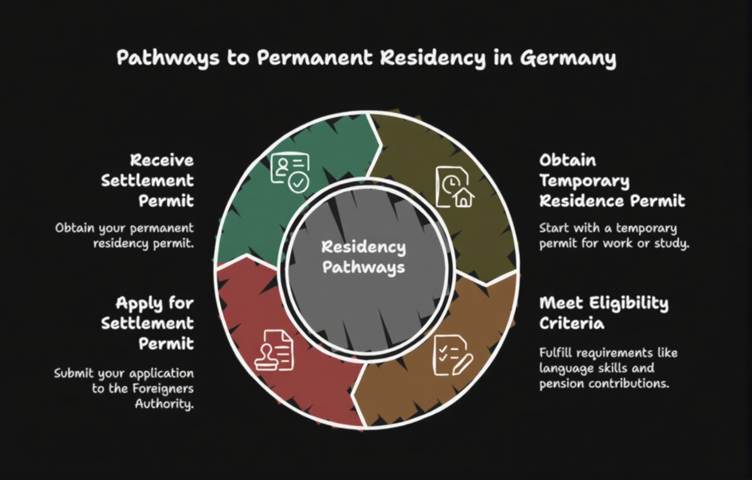
Pathways for Skilled Workers to Obtain a Settlement Permit
The journey from a temporary residence title to a permanent residence permit is not one-size-fits-all. German law provides several streamlined residency pathways for skilled workers, with eligibility timelines varying significantly based on your qualifications, language skills, and initial type of residence permit.
EU Blue Card Holders
Holders of the EU Blue Card enjoy the most accelerated route to permanent residency in Germany. This residence title, designed for highly qualified workers with academic degrees, offers two fast-track options under Sec 18b para 2 ResA:
- After 27 Months: You can apply for a settlement permit after just 27 months of qualified employment and making contributions to the pension insurance scheme, provided you can demonstrate basic German language skills at the A1-level German proficiency.
- After 21 Months: The waiting period is reduced to a mere 21 months if you can prove a higher level of integration by demonstrating sufficient German language skills at the B1-level German proficiency according to the Common European Framework of Reference for Languages.
Highly Qualified Professionals
For a very select group of top-tier international talent, a settlement permit can be granted almost immediately upon arrival. According to Section 18c subsection (3) of the Residence Act, this applies to “highly-qualified workers” such as researchers with exceptional technical knowledge or teaching staff in prominent positions (e.g., those supported by the Humboldt Foundation). This exception requires proof that their integration into Living in Germany and their financial self-sufficiency are guaranteed without a waiting period.
Graduates of German Universities and Vocational Training
Germany actively incentivizes international students to remain in the country after their studies. If you have successfully completed a degree from a German university or finished a qualified vocational education program in Germany, you are eligible for a settlement permit after only two years (24 months). During this time, you must have held a residence permit for employment as a skilled worker and made 24 months of contributions to the statutory pension insurance scheme.
Skilled Workers with Recognized Foreign Qualifications
If you entered Germany as a skilled worker with a recognized foreign qualification but do not hold an EU Blue Card, you fall under the standard pathway. Under recent updates to the German Residence Act, you can apply for a settlement permit after holding a residence permit for skilled employment for three years (36 months). This requires 36 months of pension contributions and proof of B1-level German language skills.
Self-Employed Professionals and Entrepreneurs
Freelancers and entrepreneurs follow a different set of criteria under Section 21 subsection (4) of the Residence Act. They can be granted a settlement permit after three years if they can successfully demonstrate that their business is established and that their livelihood is permanently secure without relying on social benefits. This is a discretionary decision made by the Foreigners Authority and requires robust financial documentation proving long-term profitability and financial independence.
Eligibility Requirements for a Settlement Permit in Germany
Regardless of the specific pathway you take, every applicant must meet a set of core eligibility criteria. These requirements are designed to ensure that you are financially stable, well-integrated, and pose no risk to public safety.
Minimum Residence Duration
You must have legally resided in Germany with a valid residence permit for a specific minimum period. As outlined above, this varies significantly:
- 21/27 months for EU Blue Card holders.
- 24 months for graduates of German educational institutions.
- 36 months for other skilled workers.
- Immediately for certain highly-qualified specialists.
Secure Employment and Income Stability
You must prove that you can support yourself and any dependents without relying on public funds or social benefits. This is typically demonstrated through:
- A current, permanent employment contract.
- Recent pay slips (usually the last 3-6 months).
- Proof that you are no longer in a probationary period.
Your income must be sufficient to cover all living expenses, including rent, utilities, and health insurance.
Contributions to Statutory Pension Insurance
Making contributions to the German pension system is a non-negotiable requirement. You must prove that you have paid into the statutory pension insurance scheme for a set number of months, corresponding to your residency pathway (e.g., 21, 27, 24, or 36 months). You can request a detailed history of your pension contributions from the German Pension Insurance to include in your application.
Health Insurance Coverage
Continuous and adequate health insurance coverage is mandatory in Germany. You must provide proof of membership in either a public statutory health insurance fund or a private Medical Health Insurance policy that meets German standards for coverage. This must cover both you and any family members included in your application.
German Language Proficiency
Demonstrating adequate German language skills is a key pillar of integration and a firm requirement for the settlement permit. The required level generally depends on your pathway:
- A1-level German (Basic User): Sufficient for EU Blue Card holders applying after 27 months.
- B1-level German (Independent User): The standard requirement for most other pathways, including the 21-month Blue Card track, German graduates, and other skilled workers.
Certificates must be from recognized institutions and align with the Common European Framework of Reference for Languages (CEFR).
Integration Requirements
You must demonstrate a basic understanding of Germany’s legal and social systems, as well as its living conditions. This is typically proven by successfully completing an Integration course, which culminates in the “Life in Germany” test. Individuals who have obtained a German university degree or similar qualification are often exempt from this requirement, as their education is considered sufficient proof of integration.
Step-by-Step Application Process for Skilled Workers
Navigating the German bureaucracy for your settlement permit can seem complex, but a structured approach simplifies the application process. Following these steps will help you avoid common pitfalls and delays.
Where to Apply
Your application for a settlement permit must be submitted to the local Foreigners Authority (Aliens’ Office) responsible for your place of residence. In major cities, these offices may have specific names, such as the Landesamt für Einwanderung in Berlin or the Kreisverwaltungsreferat (KVR) in Munich. These are the same offices that handle your initial residence permit and renewals.
Booking Appointments and Timelines
In many large cities, securing an appointment at the Foreigners’ Office can be the most challenging part of the entire application process. Appointments can be booked out for months in advance. It is crucial to start checking the online booking portals as soon as you are eligible. Many offices release new slots or cancellations early in the morning. Proactive planning is essential to avoid a lapse in your legal status.
Application Forms and Submission Methods
Most authorities provide the necessary application form as a PDF download on their website. Some cities are moving towards online submission portals. It is vital to fill out the application form completely and accurately. Any discrepancies between the information on your form and your supporting documents can lead to significant delays or rejection.
Processing Times and Common Delays
Once your complete application is submitted, the official processing time can range from a few weeks to several months. The timeline is heavily dependent on the workload of your local Aliens’ Authority. Common reasons for delays include:
- Missing or incomplete documents.
- Unclear pension contribution history.
- The need for approval from other agencies, like the Federal Employment Agency.
- General understaffing at the authority.
Fees and Associated Costs
The administrative fee for issuing a settlement permit in the form of an electronic residence title is generally between €113 and €147. The exact cost can vary depending on your specific circumstances (e.g., standard skilled worker vs. self-employed). This fee is payable directly to the Foreigners Authority during your appointment.
Required Documents for a German Settlement Permit Application
Submitting a complete and well-organized application package is the single most important factor for a smooth process. While the exact list can vary slightly by city, the following documents are universally required:
- Completed Application Form: Application for the Issuance of a Settlement Permit.
- Valid Passport: Must be valid for the duration of the application process.
- Current Residence Permit: Your current Electronic Residence Permit
- Biometric Photographs: One recent photo that meets German passport standards.
- Proof of Employment: A current employment contract and a recent certificate from your employer confirming your position is ongoing.
- Proof of Income: Typically your last 3-6 months of pay slips.
- Pension Insurance History : A complete record of your contributions from the German Statutory Pension Insurance
- Proof of Health Insurance: A membership certificate from your provider.
- Proof of Accommodation: Your rental contract and proof of living space.
- Language Certificate: An official certificate showing you have met the required German level (e.g., B1).
- Integration Course Certificate: Proof of passing the “Life in Germany” test, if applicable.
- Proof of Fee Payment: Receipt for the application fee.
Benefits of Holding a Settlement Permit in Germany
The effort required to obtain the Permanent Residence Permit is substantial, but the benefits it unlocks are transformative for your life in Germany.
Unlimited Right to Live and Work
The settlement permit permanently secures your right to live in Germany. Crucially, it is not tied to a specific employer or job role. This grants you complete freedom and flexibility in your career. You can change jobs, switch industries, become self employed, or even take a sabbatical without needing permission from any government authority. The number of non-EU residents with work permits in Germany has grown to approximately 419,000, and the settlement permit is the key to long-term participation in this market.
No Employer or Location Restrictions
Unlike a temporary work permit which may limit you to a specific employer or region, the settlement permit gives you full mobility across the German labour market. You are free to live and work anywhere in Germany, from the bustling tech scene in Berlin to the industrial heartland of Baden-Württemberg.
Easier Family Reunification
Holding a permanent residence permit significantly simplifies the family reunification process. When you apply to bring your spouse (or partner in a civil partnership) and children to Germany, your secure and stable status provides the government with the necessary assurance, making the process smoother and faster.
Pathway to German Citizenship
The settlement permit is the final step before you can apply for German citizenship. After holding a settlement permit and meeting certain residency requirements (typically 5 years of legal residence under new laws), you become eligible to apply for a German passport, granting you full voting rights and an EU passport.
Financial Security
Financial institutions view holders of a settlement permit as low risk clients. This makes it significantly easier to secure long-term financial products, such as a mortgage to buy property, business loans, or personal credit lines, further solidifying your roots and financial independence in Germany.
Tips for a Successful Application
Apply Early Once Eligibility is Met
Do not wait until your current residence permit is nearing its expiration date. The moment you meet the minimum residency and contribution requirements for your pathway (e.g., on the first day of your 22nd month as a Blue Card holder with B1 German), you should begin the application process. This gives you a buffer to handle potential delays.
Improve German Language Level
While A1 German may be sufficient for one Blue Card track, aiming for B1 proficiency is always a better strategy. A B1 certificate not only shortens the waiting period but also demonstrates a stronger commitment to integration, which can make a positive impression on the case officer at the Foreigners Authority.
Ensure Consistent Pension Contributions
Gaps in your pension insurance payments are a common reason for application rejection or delays. Before applying, obtain your official pension history and carefully review it. If there are any gaps due to unemployment or job changes, calculate exactly when you will hit the required number of contribution months.
Legal Consultation for Complex Cases
If your case is not straightforward, for instance, if you have gaps in employment, a previous visa issue, or are self-employed with fluctuating income, navigating the process alone can be risky. Seeking advice from an immigration law firm like Visaguard.berlin can provide clarity. An expert can review your documents, identify potential issues, and ensure your application is as strong as possible.
Conclusion
Securing a German settlement permit is a milestone that transforms your status from a temporary guest to a permanent member of society. It is the culmination of years of hard work, financial contribution, and integration into Living in Germany. While the application process requires careful planning and attention to detail, the benefits unrestricted access to the German labour market, enhanced security for your family, and a clear pathway to citizenship are immeasurable.
By understanding the specific requirements of your pathway, proactively gathering your documents, and continuously improving your German language skills, you can strategically navigate the journey from a temporary residence permit to permanent residency. The Permanent Residence Permit is more than just a legal document; it is your foundation for building a lasting and prosperous future in Germany.
Frequently Asked Questions (FAQ)
How long does it take to get a settlement permit in Germany?
Once your application is submitted, processing times vary greatly by city. In major metropolitan areas like Berlin or Munich, it can take 3 to 6 months. In smaller towns with less backlog at the Aliens’ Office, the process might be completed in just a few weeks.
Can EU Blue Card holders apply faster?
Yes. Holders of the EU Blue Card have the fastest pathway to a settlement permit. They are eligible after just 33 months of qualified employment with A1-level German, or an even faster 21 months with B1-level German proficiency.
Is a settlement permit the same as German citizenship?
No. A settlement permit grants you permanent residency, allowing you to live and work in Germany indefinitely while retaining your original citizenship. German citizenship, on the other hand, makes you a citizen of Germany, granting you a German passport and the right to vote.
Can I work in other EU countries with a German settlement permit?
No. The national German settlement permit only grants you the right to live and work in Germany. For mobility within the EU, you would need to obtain the EU Long-Term Residence Permit, which has a longer residency requirement but allows you to move to and work in other EU member states more easily.
How long can I stay outside Germany?
A German settlement permit generally expires if you are outside of Germany for more than six consecutive months. However, there are exceptions for former EU Blue Card holders, those who have lived in Germany for over 15 years, or those with a German spouse. It is crucial to check with your local Foreigners Authority before any extended absence to secure permission if needed.