By Omar Ochoa, Co-Founder and Partner, Ochoa & Calderón · Riverside, California | Last reviewed: October 2026
Before I started representing injured workers, I represented insurance companies. That experience taught me how claims are evaluated from the other side of the table: which documents an adjuster looks for first, how a denial gets built, and where a claim is most vulnerable. Today I use that knowledge on behalf of working men and women throughout the Inland Empire.
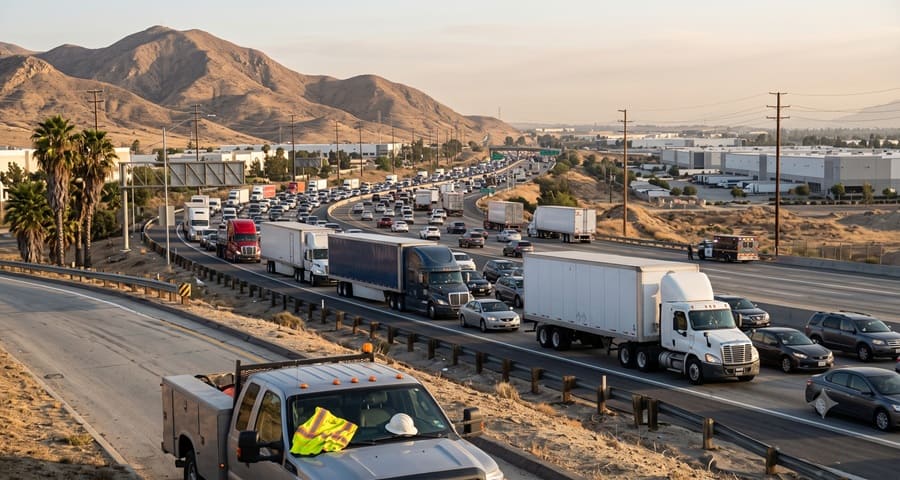
Much of my work sits at the point where workplace injuries and traffic crashes meet. The Inland Empire is one of the country’s major logistics hubs, and its freeways carry heavy truck traffic every hour of the day. When a crash involves a commercial truck, the injured person is often someone who was working at the time, and that single fact changes how the case has to be handled.
Two Systems That Apply at Once
Truck crashes frequently involve workers’ compensation, personal injury, and employment law at the same time. California’s workers’ compensation system pays medical treatment and disability benefits to employees injured on the job without requiring proof of fault. In exchange, under Labor Code § 3602, the employer is generally protected from a negligence lawsuit.
That protection does not extend to everyone else. When a delivery driver, a warehouse employee running an errand, or a field technician is hit by a truck owned by a different company, Labor Code § 3852 preserves the worker’s right to sue that third party. The two cases proceed in different forums under different rules, and the compensation carrier can assert a lien against the third-party recovery for benefits it paid and may take a credit against future benefits. Coordinating the two from the start protects the worker from settling one claim in a way that undercuts the other. Find Attorneys’ checklist for workers’ compensation accident victims covers the first steps on the compensation side.
How Denials Get Built
Time on the defense side makes one pattern clear. A workers’ compensation denial is rarely based on a finding that the worker was not hurt. More often, the insurer argues that the injury did not arise out of employment, that it was a pre-existing condition, or that the medical evidence is incomplete. Utilization review and independent medical review add another layer, since a treating doctor’s recommendation can be denied and then reviewed by physicians who never examined the patient. Knowing where those arguments come from makes it easier to answer them before they harden into a final decision.
An On-the-Job Crash That Went to Trial
Those details can decide a case. Among the results listed on our firm’s case results page, a worker seriously injured in a motor vehicle crash while on the job pursued a workers’ compensation claim that was contested through trial. The decision found 100 percent permanent total disability, which carries lifetime benefits. In another matter, a claim for a work-related embolism that the insurer initially denied ultimately resolved for $2.15 million. In both, the outcome turned on medical evidence and a record that answered the insurer’s arguments one by one.
Past results depend on the specific facts of each case and do not guarantee a similar outcome in any other matter.
Truck Crashes on Inland Empire Freeways
Interstate 10, Interstate 215, and State Route 60 connect distribution centers, rail yards, and ports, and the trucks moving between them share those roads with commuters. Interstate truck drivers are limited by federal hours-of-service rules to 11 hours of driving within a 14-hour window after 10 hours off duty, and California applies its own rules to carriers operating within the state. Commercial drivers also face a lower blood alcohol limit of 0.04 while operating a commercial vehicle under Vehicle Code § 23152. A driver who exceeded hours-of-service limits, a carrier that skipped inspections, or a shipper that overloaded a trailer can each share responsibility for a crash.
Evidence in these cases has a short shelf life. Electronic logging device data, dash camera footage, maintenance records, and the truck’s own event data recorder can show speed, braking, and hours of service, but some of that information is overwritten or discarded if no one asks for it to be preserved. A person consulting a Riverside truck accident lawyer after a collision should expect the first step to be written preservation requests to the carrier and any other company involved. Find Attorneys’ overview of the major causes of truck accidents describes the failures investigators look for.
Fault, Insurance, and Deadlines
California follows pure comparative negligence. An injured person can recover damages even if partly at fault, with the award reduced by that share. That rule gives trucking insurers an incentive to argue the injured driver was speeding, distracted, or changing lanes unsafely, since every percentage point lowers the payout. Commercial carriers typically carry far more insurance than private drivers, and several insurers may be involved when a crash includes a carrier, a broker, and a trailer owner.
| Deadline | Applies to |
| Two years (CCP § 335.1) | Most personal injury lawsuits |
| Two years (CCP § 335.1, § 377.60) | Most wrongful death lawsuits, from the date of death |
| Six months (Gov. Code § 911.2) | Written claim against a public entity, such as a city or transit agency |
Injuries that surface or worsen over time, such as spinal damage or traumatic brain injuries missed in the emergency room, can complicate that timeline, so medical follow-up in the weeks after a crash protects the claim as well as the patient.
When a Crash Is Fatal
Losing a family member in a truck crash creates legal questions no family expects to face. Under Code of Civil Procedure § 377.60, certain surviving relatives, including a spouse, domestic partner, and children, and in some circumstances others who depended on the person, can bring a wrongful death claim. A separate survival action can be brought on behalf of the estate for losses the person suffered before death.
One recent change matters here. From 2022 through 2025, California temporarily allowed survival actions to recover the decedent’s pain and suffering. That window closed on January 1, 2026, and under § 377.34 survival actions filed after that date are again generally limited to economic losses and, in some cases, punitive damages, as DLA Piper explains. The wrongful death claim, which compensates the family’s own losses, is unaffected.
When the person who died was working at the time, the family may also be entitled to workers’ compensation death benefits under Labor Code § 4702, which follow their own formula based on dependency. Those benefits do not bar a wrongful death claim against a negligent third party such as an outside trucking company. Families facing a work-related fatality often need both claims evaluated together, since the order in which they resolve can affect how liens and credits are applied.
Retaliation After an Injury Report
Injured workers sometimes face a second problem after the first. Labor Code § 132a prohibits employers from firing, demoting, or otherwise discriminating against employees for filing a workers’ compensation claim, and a firing or demotion that follows an injury report can become a separate claim of its own. In each of these situations, a worker is dealing with an employer or insurer that has more resources and more experience with the system.
The people who keep the Inland Empire’s warehouses and highways running rarely think about workers’ compensation or wrongful death law until the day they need them. When that day comes, knowing how both systems work, and how insurers approach them, can make the difference in what a family recovers.
Disclaimer
This article provides general information about California workers’ compensation, truck accident, and wrongful death law. It is not legal advice, and reading it does not create an attorney-client relationship. Deadlines and recoverable damages depend on the facts and on when a claim is filed. Anyone injured on the job or in a crash, or who has lost a family member, should consult a licensed California attorney.