

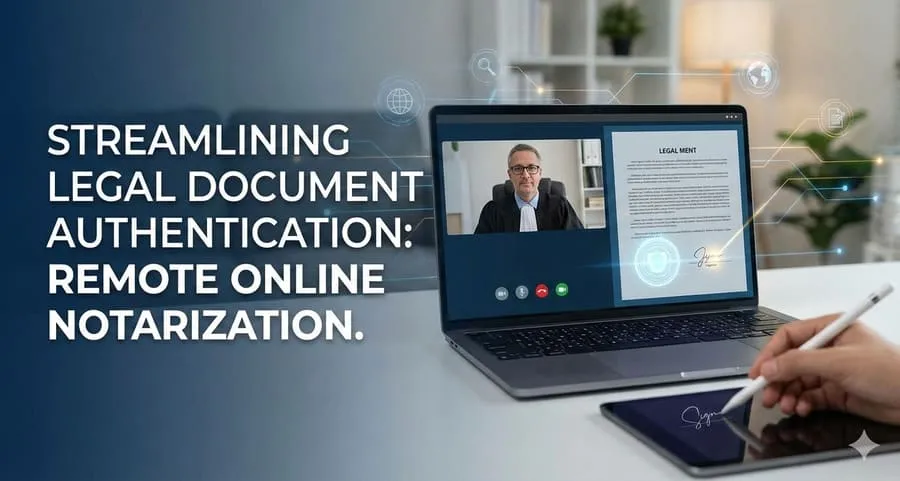
For decades, getting a document notarized meant finding a notary, scheduling an appointment, and showing up in person. It worked, but it was slow, location-dependent, and often inconvenient — especially for clients living abroad, working odd hours, or dealing with time-sensitive legal matters.
Remote Online Notarization, commonly known as RON, has changed that. Instead of meeting in person, the signer and notary connect through a secure audio-video session. The signer’s identity is verified electronically, the document is signed with an electronic signature, and the notary applies a tamper-evident digital seal. The entire session is recorded and stored for a minimum of ten years, depending on the state.
As of 2026, 47 states plus the District of Columbia have enacted laws authorizing some form of remote electronic notarization, according to the National Association of Secretaries of State (NASS). The federal SECURE Notarization Act has further solidified RON’s legal standing across jurisdictions. For attorneys and clients navigating complex paperwork, RON isn’t just a convenience — it’s becoming the standard.
The Legal Framework
Each state sets its own RON rules, but most share a common structure. The notary must be physically located in their commissioning state. The signer can be anywhere in the world.
Florida was among the early adopters, enacting its RON statute effective January 1, 2020, under Chapter 117 of the Florida Statutes. Florida’s framework requires two layers of identity verification: credential analysis (scanning and validating the signer’s government-issued ID) and knowledge-based authentication, or KBA (answering personal history questions drawn from public records databases). Both must be satisfied before any notarial act can proceed.
The notary applies an electronic seal, and the session is captured on video. Florida law mandates that notaries retain these recordings for a minimum of ten years — an audit trail that paper-based notarization cannot match.
At the federal level, the SECURE Notarization Act authorizes notaries to perform RON across state lines, providing a nationwide baseline. A Florida notary performing a RON session for a signer in Ohio is operating within a recognized legal structure, not a gray area.
Why RON Is Often More Secure Than In-Person Notarization
Traditional notarization relies on a single layer of identity verification: the notary visually inspects the signer’s ID. There’s no electronic verification, no video recording, no automated check against public records. Many states don’t even require traditional notaries to keep a journal.
RON platforms layer multiple safeguards. Credential analysis software checks security features embedded in government IDs — holograms, barcodes, microprinting — that are nearly impossible to verify with the naked eye. KBA generates questions only the actual person should be able to answer. The video session creates a permanent record of the signer’s appearance and behavior.
If a dispute arises about whether someone actually signed a document, the RON recording provides far stronger evidence than a notary’s memory from months earlier. For attorneys handling matters where document authenticity could be challenged — contested estates, disputed contracts, immigration proceedings — this evidentiary advantage matters.
Practical Applications for Legal Professionals
Immigration cases often involve clients located outside the United States. Affidavits of support, declaration letters, and consent forms require notarization. Before RON, overseas clients had to visit a U.S. embassy or navigate a time-consuming apostille process in their home country. Now a Florida-commissioned notary can handle that same affidavit in a fifteen-minute video session, regardless of where the client sits.
Family law frequently requires notarized documents under tight deadlines — parental consent forms, custody agreements, financial disclosure affidavits. When a parent has relocated to another state, RON eliminates the logistical barrier entirely.
Real estate transactions were among the first to adopt RON widely. Deeds, mortgage documents, and powers of attorney can be notarized remotely in all fifty states. Major title companies have integrated RON into their closing workflows.
Estate planning documents, including powers of attorney and healthcare directives, benefit when elderly clients have limited mobility or family members are spread across states.
For firms handling volume, providers that specialize in legal documents — like those offering remote online notarization services alongside certified translation and apostille processing — can be particularly useful when dealing with multilingual or international cases.
Cost, Process, and ID Requirements
The process is simple: upload a document, complete identity verification, join a live video call with a commissioned notary, sign electronically. Most sessions finish in under fifteen minutes.
Pricing ranges from $25 to $39 per document. Florida caps the statutory notary fee at $25 per notarial act, though platforms may charge separate technology and verification fees. Additional documents in the same session typically run $10 to $15 each.
Accepted IDs include U.S. driver’s licenses, U.S. passports, and foreign passports. A Social Security number is not universally required — many platforms accommodate international signers without U.S. credit histories. All you need is a device with a camera, a microphone, and a stable internet connection.
When an Apostille Is Needed After Notarization
If a notarized document will be used in a foreign country that’s party to the Hague Apostille Convention, it typically needs an apostille — a certificate from the Secretary of State authenticating the notary’s commission and seal.
Florida and most other RON-enabled states issue apostilles for electronically notarized documents. For firms handling cross-border matters, working with a provider that offers both online notarization in Florida and apostille processing under one roof reduces turnaround significantly. The entire chain — notarization, apostille, and certified translation if the document is in a foreign language — moves through a single workflow instead of three separate vendors.
Looking Ahead
Remote online notarization is no longer a pandemic-era workaround. It’s established legal infrastructure, backed by state statutes, federal legislation, and widespread industry adoption.
For attorneys, the question isn’t whether RON is legitimate — it’s how to integrate it into existing workflows. Firms still relying exclusively on in-person notarization are adding unnecessary friction, especially when clients are geographically dispersed or operating under deadlines. The legal framework is in place. The technology works. All that’s left is adoption.