

Updated November 2026
AI can help lawyers turn research notes into a first draft of a brief in minutes. But it can also invent case names, reporter numbers and pinpoint citations to cases that don’t exist. Courts take these errors seriously, and judges across the country have sanctioned lawyers for filing briefs with fake citations.
This guide explains why fake citations happen and how to match an AI tool to the type of brief. It also covers the review steps that keep a filing accurate, the ethics rules that apply, and who remains responsible for every citation.
Fake Citations Come From Tools That Write Without Reading a Source
A general chatbot predicts the next likely words in a sentence. Unless it runs a live search, it doesn’t look up a case before naming one, so it can produce a citation that looks correct but points to nothing. The format is right, but the case is not real.
Legal research tools work differently, since they retrieve opinions and statutes from a database before they write. That retrieval step lets a lawyer open the source and confirm it. A tool that cannot show what it read gives the lawyer nothing to check.
Retrieval lowers the risk but does not remove it. A Stanford-led study published in the Journal of Empirical Legal Studies in 2025 found that AI research tools from LexisNexis and Thomson Reuters still hallucinated on 17% to 33% of test queries, fewer errors than general chatbots but far from zero.
The Type of Brief Decides Which AI Tool Fits
AI brief-writing tools handle two kinds of documents. Each one cites different sources, so each one needs a different kind of check.
Litigation Briefs Need Checks Against Case Law and the Record
A motion or an appellate brief cites reported authority. It also cites evidence in the record, such as exhibits and deposition transcripts. Either one can be wrong on its own, so a litigation team needs to check both.
Transactional Briefs Need Checks Against the Team’s Own Precedent
An advice memo or a deal memo points to the governing agreement and the firm’s past deals. The useful check asks whether the team has accepted this language before, and on what terms. A case-law database cannot answer that question.
Sorting the work by brief type first narrows the field quickly. This breakdown of AI for legal brief writing groups tools by what each one checks a citation against, and it separates tools suited to court filings from those suited to advice memos.
Confidentiality Terms Decide Whether a Tool Can Handle Client Files
Before any client material goes into a tool, the firm should confirm how the vendor handles it. Ask whether the vendor has zero data retention agreements with its model providers and whether it trains models on uploaded documents, and get both answers in writing. Remove client names and identifiers that the drafting task does not need.
Consumer chatbot terms may not meet a firm’s confidentiality duties, and careless sharing can also put attorney-client privilege at risk. This guide to safer AI research, drafting and review covers vendor questions and internal AI policies in more detail.
What the Ethics Rules Require
The ABA’s Formal Opinion 512 (July 2024) applies the existing Model Rules to generative AI. Its main points for brief writing:
- Competence (Rule 1.1). Relying on AI output without appropriate independent verification can breach the duty of competence. How much checking is enough depends on the tool and the task.
- Confidentiality (Rule 1.6). Before entering client information into a tool that learns from inputs, a lawyer needs the client’s informed consent. Boilerplate language in an engagement letter isn’t enough.
- Candor to the tribunal (Rules 3.3 and 8.4(c)). Lawyers must review AI output, including citations, before filing and correct any errors. Even an unintentional misstatement to a court can be a misrepresentation.
- Supervision (Rules 5.1 and 5.3). Supervising lawyers should set clear firm policies on AI use and train the people who use it.
- Fees (Rule 1.5). Hourly clients pay for time actually spent, and lawyers shouldn’t bill for learning a tool they’ll use regularly.
In federal court, Rule 11 adds its own layer: by signing a filing, a lawyer certifies that its legal contentions are warranted by existing law. Many judges also have standing orders requiring lawyers to disclose or certify their AI use, so check the assigned judge’s procedures before filing.
Six Review Steps Keep an AI-Drafted Brief Accurate
AI saves time on the first draft. The review work does not compress, so every brief that starts with an AI draft needs the same checks.
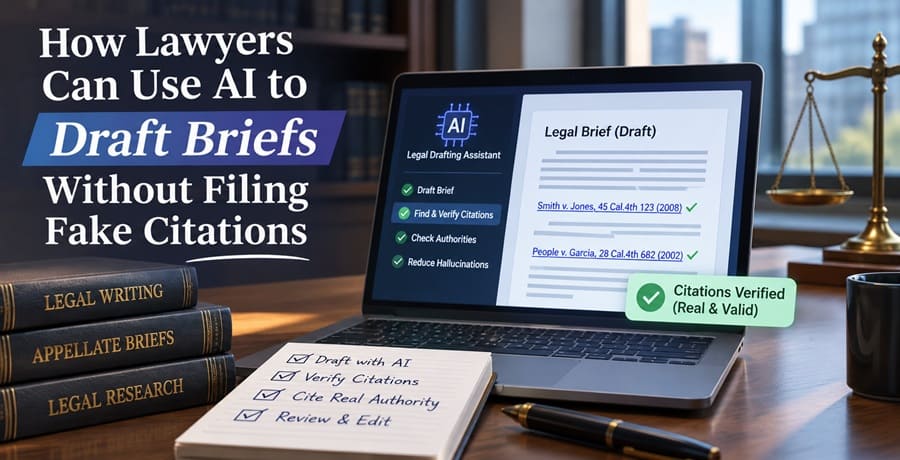
- Run the research first. Pull real authority in a research tool, then bring it into the drafting step. A draft written before the research has no basis.
- Give the tool the right documents. Upload the record, the governing agreement or the precedent file, so the tool works from those sources instead of from memory.
- Draft one section at a time. Short requests tied to specific authority produce text a reviewer can check. They also show quickly when support for a point runs out.
- Open and read every cited case. Confirm the case exists, then read the passage the brief relies on. A real case that says something else still misstates the law.
- Trace every record cite. Open the exhibit or transcript page and confirm it supports the fact as written.
- Check the court’s local rules and standing orders. Citation format, page limits and AI-disclosure requirements vary by court and judge, and a general AI tool does not track them.
Courts Sanction the Lawyer Who Signs the Brief
Courts hold the signing lawyer responsible for every citation, whatever tool produced it. The problem became widely known in 2023, when a federal judge in New York fined two lawyers and their firm $5,000 in Mata v. Avianca for filing a brief built on cases ChatGPT had invented.
The sanctions have grown since. As the ABA Litigation Section reported, the Sixth Circuit in Whiting v. City of Athens (March 2026) sanctioned two attorneys whose briefs across three consolidated appeals contained more than two dozen fake citations and misrepresentations of fact. The attorneys also refused the court’s order to explain who wrote the briefs and how they checked citations. The panel ordered them to pay the appellees’ full reasonable attorney fees on appeal and double costs. Each attorney also owed $15,000 in punitive sanctions, and the court referred both for possible discipline.
The court imposed the sanctions under Federal Rule of Appellate Procedure 38, which covers frivolous appeals, and its own inherent authority. It made no express finding that generative AI produced the errors. A court does not need to know which tool wrote a citation, so blaming the software does not reduce a firm’s exposure.
AI Speeds Up Brief Writing When the Lawyer Verifies Every Source
AI can cut first-draft time, especially for structure and routine sections. The safe approach starts with a tool that fits the type of brief. It ends with a lawyer who opens and reads every source before filing.
Firms that follow both steps keep the speed and lower the risk of sanctions. The signature on the brief stays the lawyer’s, and so does the duty to check it.
Disclaimer
This article is general information about using AI in legal writing and is not legal or ethics advice. Professional conduct rules and court requirements vary by jurisdiction. The sanctions described in other cases illustrate the risks but do not predict how any court will rule in a particular matter.