By Adrian R. Bridges, Partner and Board-Certified Civil Trial Lawyer, Michles & Booth · Pensacola, Florida | Last reviewed: October 2026
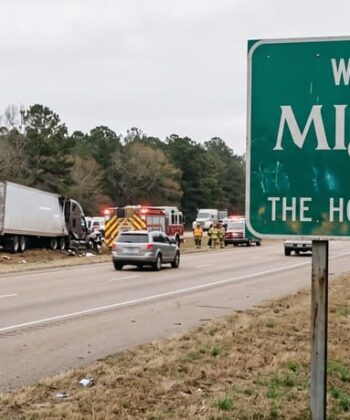
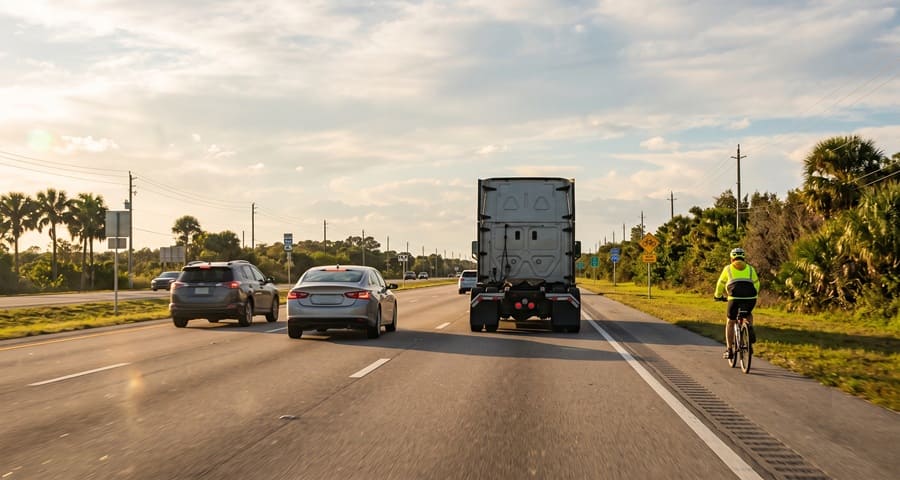
On a single stretch of US-98 or I-10 in the Panhandle, you can see a tourist in a rental car, a loaded tractor-trailer, a delivery van, and a cyclist within a few hundred feet of each other. When a crash involves more than one kind of vehicle, sorting out who pays becomes complicated, because each vehicle type brings its own rules, its own records, and often its own insurance.
Most Florida injury claims still start in the same place, with no-fault coverage, and then branch out depending on who was involved, how badly people were hurt, and how fault is divided.
At a Glance: Florida Rules That Shape These Claims
| Rule | What it means |
| PIP coverage | Pays up to $10,000 in medical bills and lost wages regardless of fault; initial treatment generally must begin within 14 days |
| Injury threshold | A claim for pain and suffering against the at-fault driver generally requires a permanent injury, significant scarring, or significant permanent loss of an important bodily function |
| Modified comparative fault | An injured person more than 50% at fault recovers nothing; at 50% or less, damages are reduced by their share |
| Two-year deadline | Most negligence lawsuits arising after March 24, 2023 must be filed within two years |
No-Fault Coverage Comes First
Florida requires most drivers to carry $10,000 in personal injury protection (PIP), which pays 80% of reasonable medical expenses and 60% of lost wages after a crash, regardless of who caused it. PIP is meant to handle smaller injuries quickly. To pursue the at-fault driver for pain and suffering, an injured person generally has to meet the threshold in § 627.737: a permanent injury within a reasonable degree of medical probability, significant and permanent scarring or disfigurement, or significant and permanent loss of an important bodily function. A treating physician’s opinion documenting permanency is often what moves a claim beyond PIP.
Timing matters. Under § 627.736, PIP medical benefits generally require initial treatment within 14 days of the crash, so waiting to see whether pain fades can cost coverage. And despite headlines and AI-generated answers suggesting otherwise, PIP remains the law in 2026; repeal bills died in committee, as Claims Journal reported in May 2026.
Find Attorneys’ article on whether an injury qualifies for a personal injury claim in Florida covers the threshold in more depth.
Commercial Trucks and the Paper Trail Behind Them
Crashes with tractor-trailers tend to cause more serious injuries and generate far more records than a typical car crash. Interstate property-carrying drivers are limited by federal hours-of-service rules to 11 hours of driving after 10 consecutive hours off duty, within a 14-hour window. Most trucks now carry electronic logging devices that record driving time automatically, replacing paper logbooks that were easier to alter.
Engine control modules often capture speed, braking, and throttle position in the seconds before impact. The carrier’s files can matter just as much: driver qualification records, drug and alcohol testing results, maintenance logs, and dispatch messages may show whether a driver was pushed to meet an unrealistic schedule.
Much of this information can be overwritten or discarded in the ordinary course of business. That is why a Pensacola truck accident lawyer or any attorney handling a commercial vehicle claim typically sends a preservation letter to the carrier early, asking it to keep logs, vehicle data, and camera footage. A company that destroys relevant evidence after receiving notice can face sanctions or an adverse-inference instruction at trial.
Liability in truck cases often reaches beyond the driver. The motor carrier, the trailer owner, a maintenance contractor, or the shipper that loaded the cargo may share responsibility, and each may carry its own insurance with separate limits. Find Attorneys’ overview of the major causes of truck accidents describes common failure points.
When Several Parties Share the Blame
Florida’s 2023 tort reform (HB 837) replaced pure comparative negligence with a modified system for most negligence claims. Under § 768.81(6), an injured person found more than 50% at fault cannot recover. Someone found 50% or less at fault has damages reduced by their share. The same law shortened the filing deadline for most negligence claims from four years to two under § 95.11. Florida had already largely abolished joint and several liability in 2006, so each defendant generally pays only its own share of the damages.
Multi-vehicle crashes put these rules to work together. Suppose a jury assigns 60% of the fault to a truck driver, 25% to a car that cut in front of the truck, and 15% to the injured person. The injured person recovers 85% of their damages, but collecting it means pursuing two insurers separately, each arguing for a smaller share. If the jury had instead found the injured person 51% at fault, they would recover nothing.
Cyclists and the Rules Drivers Forget
In Florida, a bicycle is legally a vehicle. Cyclists have the same rights to the road as drivers and the same duty to obey signals and signs. Drivers passing a cyclist must leave at least three feet of clearance under § 316.083, a rule frequently ignored on narrow two-lane roads. Between sunset and sunrise, § 316.2065 requires a bicycle to have a white front lamp visible from 500 feet and both a red rear reflector and a red rear lamp visible from 600 feet.
Insurers often scrutinize a cyclist’s conduct closely, pointing to dark clothing, riding outside a bike lane, or a missing light. With the 50% bar in place, those arguments carry more weight than they did before 2023, which makes scene photos, witness statements, and lighting evidence especially important.
Cyclists struck by a car may be able to use PIP from their own auto policy, or from a resident relative’s policy, even though they were on a bike. Many riders do not realize their car insurance can apply.
A Bicycle Crash Involving an Employee’s Vehicle
Cases involving cyclists often turn on who was responsible for the driver. Among the results published by Michles & Booth, an elderly cyclist was struck by a vehicle driven by an employee of a car wash, and a jury returned a $460,000 verdict holding the business accountable. Cases like this commonly depend on establishing that the driver was acting within the scope of employment, which can bring the employer’s insurance into play, along with the usual evidence of how the crash happened and how the rider’s injuries affected daily life.
Past results depend on the facts of each case. The facts and circumstances of any other case may differ, and these results do not guarantee a similar outcome.
The Few Seconds Every Claim Comes Down To
Every crash claim rests on a reconstruction of a few seconds: where each person was, how fast they were moving, and which rule each was expected to follow. The vehicles involved change which records exist and which regulations apply, but the question stays the same. The most useful steps happen early:
- Get medical care within 14 days to protect PIP benefits, and follow up consistently
- Photograph vehicles, road markings, lighting, and visible injuries
- Collect witness names and the crash report number
- Keep damaged bicycles, helmets, and clothing unrepaired
- In truck crashes, note the carrier name and USDOT number on the cab
About the Author
Adrian R. Bridges is a partner at Michles & Booth, a Northwest Florida injury firm. He is board certified in civil trial law by The Florida Bar and is admitted in Florida and Alabama. A former assistant public defender, he has tried more than a dozen cases to verdict and served as class counsel for nearly 700 people injured in the 2014 Escambia County Jail explosion. He earned his law degree from Florida State University.
Disclaimer
This article provides general information about Florida traffic crash law. It is not legal advice, and reading it does not create an attorney-client relationship. Florida law changed significantly in 2023, and the rules that apply depend on when and how a crash occurred. Anyone injured in a crash should consult a licensed Florida attorney about their situation.