
By Pat McWhirter, President and Founding Shareholder, McWhirter, Bellinger & Associates, P.A. | Last reviewed: October 2026
An injury lawsuit in South Carolina can start with one named defendant and end with a jury assigning part of the blame to a company that was never sued. Until this year, that was not how the state’s apportionment statute worked.
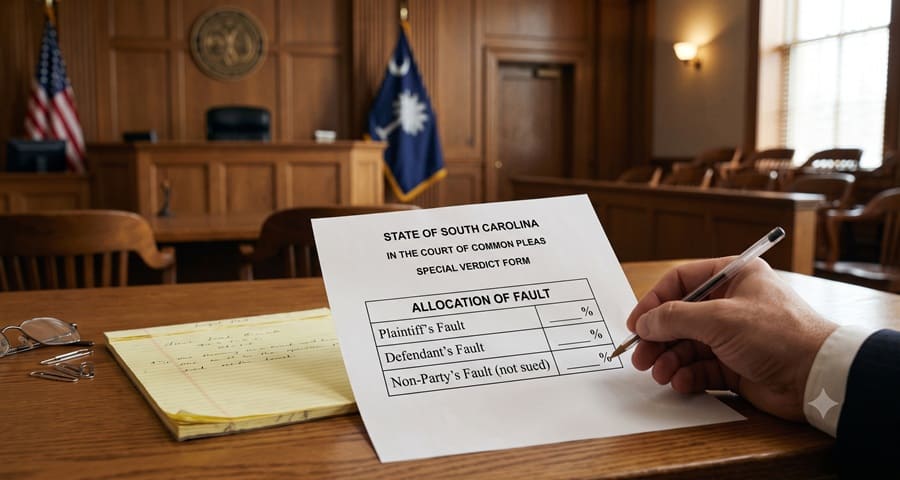
A 2025 tort reform law changed it. For claims arising after January 1, 2026, a defendant can ask the jury to allocate fault to certain nondefendant tortfeasors, sometimes called “empty chair” defendants. Because a defendant found less than 50% at fault pays only its own share, every percentage assigned to someone outside the case can reduce what the injured person actually collects.
| Claims arising before 2026 | Claims arising after Jan. 1, 2026 | |
| Who the jury can assign fault to | The plaintiff and the named defendants | The plaintiff, the named defendants, and qualifying nondefendant tortfeasors |
| Disclosure of a nonparty | Not applicable | Within 180 days of filing, or later for good cause |
| Settling tortfeasors | Settlement credited against the verdict | Placed on the verdict form unless an exclusion applies |
| Defendant under 50% at fault | Pays only its share | Pays only its share, now measured against a larger pool |
What the Amended § 15-38-15 Does
South Carolina’s Contribution Among Tortfeasors Act governs cases where more than one party contributes to the same indivisible injury. S.C. Code § 15-38-15, as amended by Act No. 42 of 2025 (H. 3430), now directs the jury, on a defendant’s motion, to assign a percentage of fault to “each defendant and tortfeasor” whose conduct was a proximate cause of the injury. The plaintiff’s own fault is included so the percentages total 100%.
Subsection (A) keeps the existing rule that a defendant less than 50% at fault is liable only for its percentage of the damages. Adding a nonparty to the calculation does not change that rule, but it changes the math underneath it.
There is an important exception. Under subsection (F), a defendant whose conduct is found willful, wanton, reckless, or intentional, or that involves illegal drug use or sale, remains jointly and severally liable for all the damages, regardless of its percentage.
How a Nonparty Gets onto the Verdict Form
The statute does not let a defendant point at an empty chair during closing argument. Subsection (G) sets out a procedure:
- Disclosure within 180 days. The defendant must identify the nondefendant tortfeasor within 180 days after the action begins, or later if the court finds good cause.
- Defendant’s burden. The defendant must prove that the nonparty breached a duty and that the breach was a proximate cause of the injury, unless the plaintiff adds that party to the case.
- Plaintiff’s challenge. If the plaintiff does not sue the nonparty directly, the plaintiff can challenge its inclusion through a summary judgment motion (Rule 56) or a directed verdict motion (Rule 50). If those motions are denied, the nonparty appears on the verdict form.
- Settling tortfeasors. A tortfeasor who has settled, whether or not it was ever a party, must be added to the verdict form regardless of the 180-day deadline, unless an exclusion applies.
The Plaintiff’s Choice: Contest It or Sue the Nonparty
Once the defense names another alleged tortfeasor, the plaintiff can amend the complaint and add that party as a defendant. The statute says the amended pleading relates back to the date the action began, which protects the plaintiff from a statute of limitations problem that might otherwise arise.
Consider a worker injured on a commercial construction site who sues the general contractor that controlled the site. Months into the case, the general contractor discloses that a framing subcontractor left the unguarded opening the worker fell through. The plaintiff now has two paths. Contest the allegation and keep the subcontractor off the verdict form, or bring the subcontractor into the case so that any fault the jury assigns to it becomes a collectible judgment rather than an empty percentage.
Neither choice is automatic. Adding a party means more discovery, another insurer, and sometimes a weaker defendant. Not adding one risks a verdict where the jury assigns 40% of the fault to a company that owes the plaintiff nothing.
A Percentage Is Not a Judgment
A nonparty placed on the verdict form does not become a defendant. The jury’s percentage simply reduces the named defendant’s share.
Suppose a jury finds $1,000,000 in damages, finds the plaintiff not at fault, and allocates 45% of the fault to the named defendant and 55% to a nonparty. Because the defendant is under 50%, it owes only its 45% share: $450,000. The nonparty’s 55% is not collectible in that case. Before 2026, with no nonparty on the form, the same jury could only divide fault between the plaintiff and the named defendant, and a defendant at 50% or more is jointly and severally liable for the whole award.
That is why the decision whether to add a newly identified tortfeasor is about the eventual recovery, not just trial strategy. FindAttorneys.org’s overview of accidents that commonly require a personal injury lawyer notes that cases with multiple parties are among the hardest to resolve. South Carolina’s amendment makes that especially true.
Who Cannot Be Added
Subsection (H) bars a nondefendant tortfeasor from the verdict form when:
- the nonparty is immune or cannot be sued in the action, although settled or released tortfeasors who were or could have been parties are not covered by this exclusion;
- the nonparty’s conduct was willful, wanton, reckless, or intentional;
- the defendant’s liability is imputed to it from the nonparty, as in many employer-employee situations;
- the claims involve strict liability;
- the claims involve asbestos; or
- the action is brought by the State or another governmental entity, with an exception for PFAS claims.
These limits matter. The new law is not a license to blame “anyone else.” An immune employer in a workers’ compensation setting, for example, generally cannot be placed on the form, and neither can a nonparty whose conduct was reckless.
Bars, Drunk Drivers, and the Same Injury
Multi-defendant cases are not new in South Carolina. McWhirter, Bellinger & Associates’ published results include a $1.1 million recovery in a drunk-driving crash case that also involved a claim against a bar. The listing does not give further facts, and that case arose before the 2026 amendment, so it is not offered as an example of the new procedure.
It does show the kind of case where the new rules will now shape strategy from the first weeks. A crash involving an impaired driver and an establishment that served that driver has at least two potential tortfeasors. Under subsection (H)(2), a nonparty whose conduct is found reckless cannot be added to the verdict form, and under subsection (F), a defendant whose conduct is reckless or involves illegal drugs stays jointly and severally liable. Which parties are sued, and how their conduct is characterized, can determine how the jury’s percentages translate into money.
Prior results do not guarantee a similar outcome in any other case. Every case depends on its own facts and law.
Which Claims the New Rule Covers
Act 42 took effect January 1, 2026, and applies to causes of action or claims arising after that date. A crash from 2024 or 2025 that goes to trial in 2026 is generally still decided under the earlier version of § 15-38-15, which allocated fault only among the plaintiff and named defendants.
The filing deadline has not changed. Most South Carolina personal injury claims must be filed within three years under S.C. Code § 15-3-530. The state also continues to follow modified comparative negligence: an injured person can recover if their own fault is not greater than the combined fault of the defendants, with damages reduced by their percentage.
For an injured person, the practical takeaway is to identify every possible contributor early, well inside the 180-day window the defense has to name nonparties. That means pulling police reports, contracts, maintenance records, and insurance information for every company involved, not just the obvious one. Attorneys at a statewide practice like McWhirter Law personal injury firm South Carolina, typically map those relationships before deciding whom to sue.
Frequently Asked Questions
What is an “empty chair” defense in South Carolina?
It is a defense argument that someone who is not in the lawsuit caused or contributed to the injury. Since January 1, 2026, a defendant can ask the jury to assign a formal percentage of fault to a qualifying nonparty under § 15-38-15(G).
Does the 2026 change apply to my 2025 accident?
Generally, no. The amendment applies to causes of action or claims arising after January 1, 2026.
Can a settling defendant still be blamed at trial?
Yes. A settling tortfeasor must be added to the verdict form even after the 180-day deadline, unless a subsection (H) exclusion applies.
If the jury blames a nonparty, can I collect that share from the defendant?
Not if the defendant was found less than 50% at fault and none of the joint and several liability exceptions in subsection (F) apply. The defendant pays only its own percentage.
Authorities & Sources
- S.C. Code § 15-38-15: Allocation of fault among defendants and nondefendant tortfeasors
- Act No. 42 of 2025 (H. 3430): Bill history and text
- S.C. Code § 15-3-530: Three-year limitations period for personal injury
Disclaimer
This article provides general information about South Carolina personal injury and tort law. It is not legal advice, and reading it does not create an attorney-client relationship. The 2026 amendments are new, and courts have not yet interpreted many of their provisions. Anyone injured in South Carolina should speak with a licensed South Carolina attorney about their situation.