
By Richard Grungo Jr., Esq., Founder and Certified Civil Trial Attorney, Grungo Law | Last reviewed: October 2026
A driver from Bucks County picks full tort coverage on a Pennsylvania auto policy, pays the higher premium, and assumes that choice protects the right to sue for pain and suffering after any crash. Then the driver is rear-ended on Route 70 in Cherry Hill.
Because the crash happened in New Jersey, a New Jersey law called the Deemer Statute may rewrite parts of that Pennsylvania policy for this one accident. It can add New Jersey benefits the driver never bought. It can also take away the full tort right the driver paid for.
| Three questions that usually decide whether the Deemer Statute applies |
| 1. Is the insurer authorized to sell auto insurance in New Jersey, or controlled by or affiliated with a company that is? Most large national carriers are. |
| 2. Was the insured vehicle being used or operated in New Jersey when the injury happened? |
| 3. Is the injured person the named insured or an immediate family member under that policy? |
If the answer to all three is yes, the injured person is generally treated as having chosen New Jersey’s limitation-on-lawsuit option, whatever the Pennsylvania policy says. There is one important exception, discussed below, that turns on the other driver’s insurance.
What the Deemer Statute Does
The rule appears in N.J.S.A. 17:28-1.4. It applies to insurers authorized to write auto coverage in New Jersey, and to insurers controlling, controlled by, or under common control with one, when they issue a policy in another state or a Canadian province. When the insured vehicle is used or operated in New Jersey, the policy is treated as including the coverage New Jersey requires: liability coverage at New Jersey’s minimum limits, uninsured motorist coverage, and personal injury protection (PIP) benefits.
PIP is New Jersey’s no-fault medical benefit. It pays for reasonable and necessary treatment after a crash regardless of who caused it. For a Pennsylvania driver whose own policy carries lower first-party medical limits, that added benefit can matter in the first months after a serious injury.
The tradeoff is in the next sentence of the statute. A named insured and any immediate family member under a deemed policy “shall be subject to” the tort option in N.J.S.A. 39:6A-8(a). That is New Jersey’s limitation-on-lawsuit option, still often called the verbal threshold.
The Injury Threshold for Pain and Suffering
Under N.J.S.A. 39:6A-8(a), a person bound by the limitation-on-lawsuit option can recover noneconomic damages, such as pain, suffering, and loss of enjoyment of life, only if the crash caused one of these injuries:
- death;
- dismemberment;
- significant disfigurement or significant scarring;
- a displaced fracture;
- loss of a fetus; or
- a permanent injury within a reasonable degree of medical probability, other than scarring or disfigurement.
An injury is “permanent” under the statute when the body part or organ has not healed to function normally and will not heal to function normally with further medical treatment. Ongoing pain alone does not meet the test.
The threshold does not touch economic losses in the same way. Medical bills not paid by PIP, lost wages above PIP limits, and other measurable financial losses are a separate category. FindAttorneys.org’s overview of filing a personal injury claim after an accident explains how those categories are usually separated.
The physician certification deadline
A plaintiff relying on permanent injury must serve a certification from a licensed treating physician, or a board-certified physician the treating doctor referred the plaintiff to, within 60 days after the defendant answers the complaint. The certification must rest on objective clinical evidence, such as imaging or nerve studies, not on the patient’s description of symptoms. A court can grant one extension of up to 60 days for good cause. Missing this step can end the noneconomic claim even when the injury is real.
Why a Pennsylvania Full Tort Election May Not Control
In Pennsylvania, 75 Pa.C.S. § 1705 lets drivers choose between full tort and limited tort. Full tort preserves the right to sue for pain and suffering after any injury. Limited tort costs less but bars most noneconomic claims unless the injury is “serious.”
The New Jersey Supreme Court addressed what happens to that choice in Whitaker v. DeVilla (1997). The plaintiff was a Pennsylvania resident with a full tort policy who was injured in Montgomery Township, New Jersey. His insurer was authorized to do business in New Jersey. The Court held that the Deemer Statute imposed New Jersey’s verbal threshold on him anyway, and that doing so was constitutional. The Court reasoned that out-of-state drivers receive real benefits in exchange, including PIP, minimum liability coverage, and uninsured motorist protection.
The practical lesson is that the declarations page of a Pennsylvania policy is only the starting point. The insurer’s relationship with New Jersey can matter more than the tort box the driver checked.
The Exception: When the At-Fault Driver Has No New Jersey PIP
The threshold is not automatic even when the injured person’s policy is deemed. In Zabilowicz v. Kelsey (2009), both drivers lived in Pennsylvania. The plaintiff was rear-ended in New Jersey. His insurer, State Farm, was authorized in New Jersey, so his policy was deemed. The defendant’s insurer was not authorized in New Jersey, so she was not eligible for New Jersey PIP.
The New Jersey Supreme Court held that a defendant who causes a crash and is not eligible for PIP benefits cannot hold the plaintiff to the limitation-on-lawsuit threshold. The plaintiff could pursue noneconomic damages without proving one of the six threshold injuries.
That makes the other driver’s insurance part of the analysis, not just the injured person’s. Two Pennsylvania residents hurt in nearly identical New Jersey crashes can end up with different rights depending on which carriers are involved on both sides.
Where Cross-Border Claims Usually Get Complicated
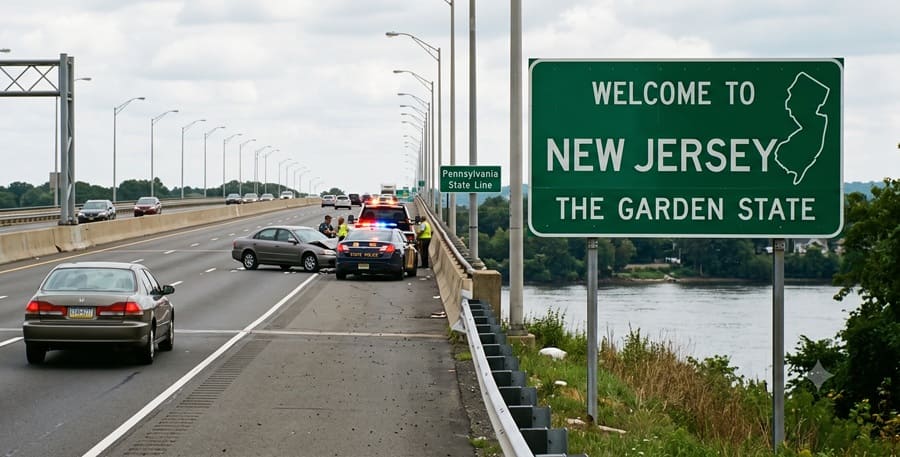
South Jersey sees a steady flow of Pennsylvania and Delaware drivers on the Walt Whitman, Ben Franklin, Betsy Ross, and Commodore Barry bridges, on I-295, and on the routes to the shore. A crash minutes after crossing the river can raise questions that a purely local crash would not:
- Which carrier wrote the policy, and whether it or an affiliate is authorized in New Jersey.
- Who the injured person is under the policy. A named insured or resident relative is treated differently from a passenger with no connection to the policy.
- Whether the vehicle was “used or operated” in New Jersey at the time of injury. Courts have examined cases where the injured person had already stepped out of the car.
- The at-fault driver’s insurer, because of the Zabilowicz exception.
These are the details that South Jersey personal injury attorneys and insurance adjusters tend to sort out first, often before anyone discusses what the claim is worth. Keeping the complete policy, not just the ID card, saves time. The declarations page, the full policy form, the names of household members, and the state of issue all feed into the answer. FindAttorneys.org also has a general guide to the first steps after a car accident in New Jersey.
A Neck Injury Settlement and the Permanent-Injury Question
Grungo Law’s published case results include a $134,423 settlement for a car accident that caused a neck injury. The firm’s listing does not describe the policy involved or the full facts, so this example is not offered as a Deemer Statute case. It illustrates the kind of claim where the threshold rules often decide whether pain-and-suffering damages are on the table at all.
Neck injuries rarely involve a displaced fracture or visible scarring. When the limitation-on-lawsuit option applies, a claim like this generally depends on showing a permanent injury through objective findings, such as MRI evidence of a disc injury or nerve conduction results, supported by a timely physician certification. Without that medical support, the noneconomic part of a soft-tissue claim can be dismissed even when the person is still in pain.
Past results do not guarantee a similar outcome in any other case. Each claim depends on its own facts and law.
Deadlines and Fault Rules Still Apply
A New Jersey crash claim generally must be filed within two years under N.J.S.A. 2A:14-2. New Jersey also uses modified comparative fault: an injured person can recover if found 50% or less at fault, with damages reduced by that percentage, but recovers nothing if found more than 50% at fault. Both rules apply on top of any threshold question.
Frequently Asked Questions
Does the Deemer Statute apply to every out-of-state driver in New Jersey?
No. It applies only when the driver’s insurer, or an affiliated company, is authorized to write auto insurance in New Jersey. A driver insured by a carrier with no New Jersey connection is not covered by the statute.
Does it apply to Pennsylvania passengers?
The statute’s threshold language covers the named insured and immediate family members under the deemed policy. A passenger’s status depends on which policies apply to that passenger, so it has to be checked case by case.
I had limited tort in Pennsylvania. Am I worse off in New Jersey?
Not necessarily. If the Deemer Statute applies, New Jersey’s threshold governs instead of Pennsylvania’s “serious injury” standard, and you may also receive New Jersey PIP benefits. The two standards are worded differently, so the comparison depends on the injury.
Who pays my medical bills after a New Jersey crash if my policy is deemed?
Deemed PIP coverage under your own policy generally pays first, regardless of fault. Amounts beyond PIP may be claimed from the at-fault driver.
Authorities & Sources
- N.J.S.A. 17:28-1.4: The Deemer Statute
- N.J.S.A. 39:6A-8: Tort exemption and limitation on lawsuit
- Whitaker v. DeVilla, 147 N.J. 341 (1997)
- Zabilowicz v. Kelsey, 200 N.J. 507 (2009)
- 75 Pa.C.S. § 1705: Pennsylvania full tort and limited tort election
- N.J.S.A. 2A:14-2: Two-year limitations period for personal injury
Disclaimer
This article provides general information about New Jersey and Pennsylvania auto insurance and personal injury law. It is not legal advice, and reading it does not create an attorney-client relationship. Insurance rules and court interpretations change, and the result in any claim depends on its specific facts and policies. Anyone injured in a crash should speak with a licensed attorney in the state where the claim arises.