

By Andy Callif, Licensed Ohio Surety Bail Bond Agent, Andy Callif Bail Bonds | Last reviewed: October 2026
When a family hears that a judge set a $10,000 bond, the first reaction is usually panic: where are we supposed to find $10,000? In Ohio, the dollar figure alone doesn’t answer that. The type of bond the court ordered matters just as much, and in some cases the amount that has to be paid up front is a fraction of the number on the paperwork, or nothing at all.
What a $10,000 Bond Can Mean Up Front
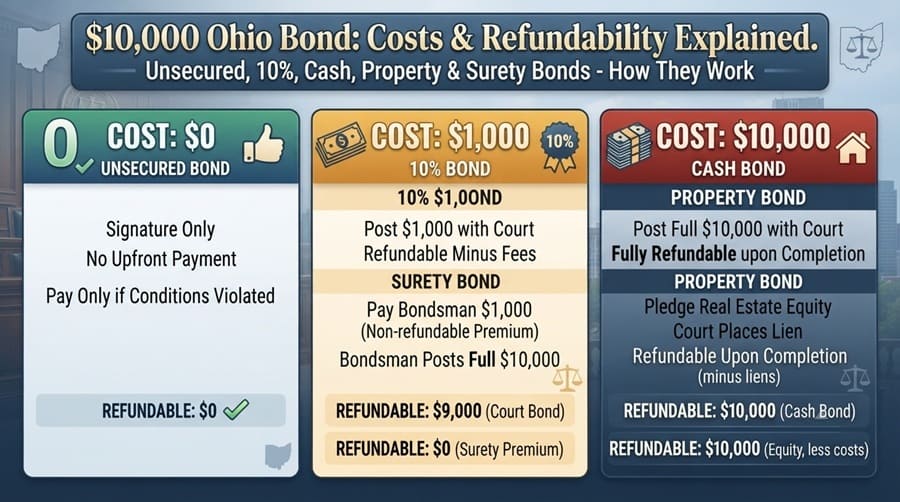
| Type of bond | Paid before release | What happens to the money |
| Unsecured bond | Nothing | The defendant owes the amount only if the bond is breached |
| 10% deposit bond | $1,000 to the court | 90% ($900) is returned if all conditions are met |
| Full cash bond | $10,000 to the court | Generally returned at the end of the case if conditions are met, subject to court rules |
| Surety bond through a bail agent | The agent’s state-approved premium and any disclosed fees, plus any collateral | The premium is the agent’s fee and is not refunded; collateral is returned under statutory rules |
| Property bond | No cash; qualifying real estate or securities pledged | The property secures the bond and is released when the case ends |
Ohio’s Starting Point: The Least Restrictive Conditions
Ohio’s pretrial release statute, O.R.C. § 2937.011, directs courts to release defendants on the least restrictive conditions that will reasonably assure their appearance in court, protect public safety, and prevent obstruction of the case, unless the court orders detention under § 2937.222 or other law. If the court imposes financial conditions, they must be the least costly type and amount sufficient to assure future appearance.
The Ohio Constitution also shapes these decisions. Since a 2022 amendment, Article I, Section 9 requires courts setting the amount of bail to consider public safety, including the seriousness of the offense and the defendant’s criminal record, alongside the likelihood of appearance.
The Types of Bail Ohio Courts Can Set
Under § 2937.011(C), a defendant entitled to release may be released on one or more of these forms of bail, in the amount the court sets:
- An unsecured bail bond. No money is deposited. The defendant promises to comply and becomes liable for the amount if the bond is breached.
- A 10% deposit bond. The defendant deposits 10% of the bond amount in cash with the court. The court returns 90% of that deposit if all bond conditions are met.
- A surety bond, a bond secured by real estate or securities, or a full cash deposit, at the option of the defendant.
That last phrase is easy to overlook. When the court orders this third category, the defendant can generally choose which of those forms to use. Each court must also provide a way to post bail by credit card under its local rules.
A 10% Bond Is Not a $10,000 Cash Bond
The difference is clearest with numbers. On a $10,000 bond with a 10% deposit, the family deposits $1,000 with the court and gets $900 back if the defendant meets every condition. A full cash bond requires the entire $10,000. A commercial surety bond works differently from both: the family pays the bail agent’s premium rather than depositing money with the court.
Before borrowing money or calling anyone, read the exact wording of the bond order. FindAttorneys.org’s guide on how to get a bail bondsman explains the general role of surety bonds, but in Ohio, which bond type the court ordered decides whether a surety is even needed.
How a Surety Bond Works
When the court allows a surety bond, a licensed bail agent executes the bond through an insurance company and becomes responsible for the full amount if the defendant fails to appear. Ohio regulates bail agents through the Department of Insurance. Under O.R.C. § 3905.93, an agent must charge the premium rate filed with and approved by the superintendent of insurance and must disclose any expense fee. That premium pays for the agent’s guarantee; unlike a court deposit, it isn’t refunded when the case ends.
You can confirm that an agent is licensed through the Ohio Department of Insurance agent lookup. Individuals who are not licensed corporate sureties must justify their financial responsibility to the court by affidavit, and a licensed attorney may not act as a surety.
Collateral is a separate number
Some surety arrangements also involve collateral: cash, a promissory note, an indemnity agreement, or an interest in real estate. Under O.R.C. § 3905.92, collateral must be reasonable in relation to the bond amount, can’t be used by the agent for personal benefit, and must be returned according to the statute’s requirements. Three different numbers can come up in the same conversation:
- the face amount of the bond set by the court,
- the premium and disclosed fees for a commercial surety bond, and
- any collateral pledged to protect the surety against loss.
Anyone signing an indemnity agreement or pledging property should understand what they are pledging, when it could be used, and when it should come back.
The Court May Not Require Money at All
Bail isn’t simply a price tag on every case. Ohio courts can release a defendant on personal recognizance or set nonfinancial conditions, such as supervision, travel restrictions, electronic monitoring, no-contact orders, or treatment requirements. When a defendant appears in response to a court summons, the statute creates a presumption of release on personal recognizance absent good cause.
In deciding conditions, the judge must consider factors including the nature of the charge and any weapon involved, the weight of the evidence, the defendant’s family and employment ties, financial resources, length of residence, criminal record, history of appearing in court, and whether the defendant is already on probation, parole, or bail.
Timing: How Fast the First Bail Hearing Happens
Under § 2937.011(J), a person who has been arrested and not released must be brought before a judicial officer for an initial bail hearing no later than the second court day after arrest. If the defendant didn’t have a lawyer at that hearing and is still detained, the court must hold a second bail hearing two court days later, with appointed counsel for an indigent defendant. Bail conditions can also be modified later on request, which matters when a family can’t meet the original amount.
Bond Schedules Have a Narrow Purpose
Ohio courts keep bail schedules for misdemeanors, including traffic offenses, so that someone can be released before seeing a judge. The statute says the schedule’s sole purpose is release before the initial appearance; once a judge holds the bail hearing, the schedule isn’t a factor in the individualized decision. Courts must review their schedules every two years to avoid detention caused only by inability to pay. In Newark, misdemeanor and traffic cases are generally handled by the Licking County Municipal Court.
After Release: Missing Court Changes Everything
However, release is secured; the obligations continue. Under § 2937.011(K), failing to appear can result in forfeiture of bail, and violating a condition can lead the court to change the bond. For someone who signed an indemnity agreement or pledged collateral to a surety, a missed court date can put that money or property at risk. Court dates, travel limits, no-contact orders, and monitoring requirements have to be followed until the case ends and the bond is discharged.
Questions to Ask Before Paying Anything
- What type of bond did the court set: unsecured, 10%, cash, property, or surety?
- If it’s a 10% bond, can the family post the deposit directly with the court?
- If a surety is needed, is the agent licensed, and what are the approved premium and disclosed fees?
- Is collateral required, and on what terms will it be returned?
- Is a bond modification hearing possible if the amount is unaffordable?
Families working through these questions after an arrest in Licking County often speak with a Newark Ohio bail bondsman and the defendant’s attorney before deciding how to proceed. The right choice depends on what the court actually ordered.
Frequently Asked Questions
How much do I need to pay for a $10,000 bond in Ohio?
It depends on the bond type: nothing for an unsecured bond, $1,000 for a 10% deposit bond, $10,000 for a full cash bond, or the agent’s approved premium and fees for a surety bond.
Do I get my 10% bond money back in Ohio?
Generally, 90% of the deposit is returned if all conditions of the bond are met. The other 10% of the deposit is retained.
Is a bail bond premium refundable?
No. The premium is the bail agent’s fee for guaranteeing the bond. Collateral, if any, is returned under the rules in O.R.C. § 3905.92.
Can a judge release someone without bail in Ohio?
Yes. Courts can release defendants on personal recognizance or nonfinancial conditions, and there is a presumption of recognizance release when a defendant appears on a summons.
How soon after arrest is a bail hearing held in Ohio?
No later than the second court day after arrest, with a second hearing for unrepresented defendants who remain in custody.
Disclaimer
This article provides general information about Ohio bail and pretrial release and is not legal advice. The author is a licensed bail bond agent, not an attorney. Bail decisions depend on the facts of each case and local court rules. For legal advice about a criminal case, consult a licensed Ohio criminal defense attorney.