

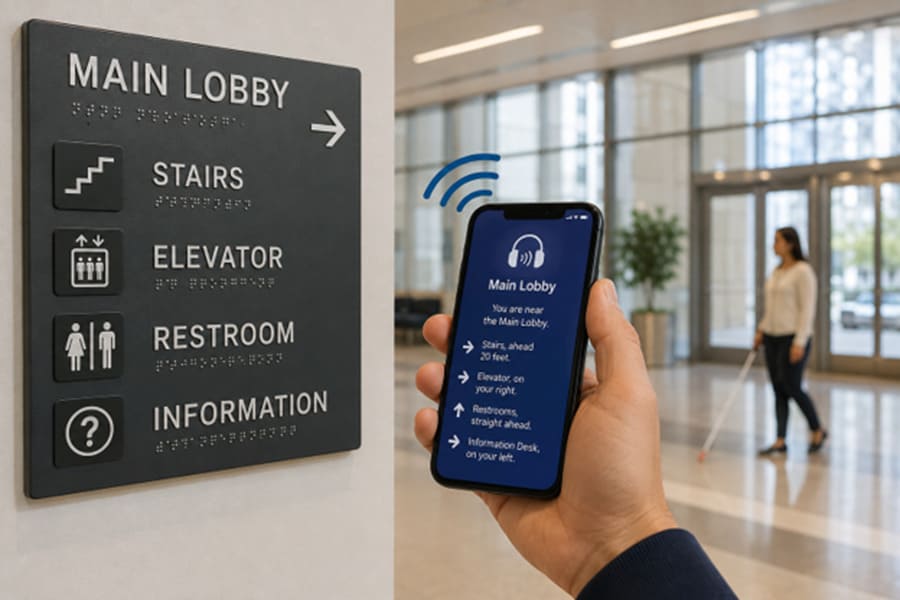
Accessibility laws continue to evolve alongside technology, requiring businesses to consider whether traditional accommodations alone are enough to provide meaningful access for individuals with disabilities. While Braille signage remains an essential accessibility feature under the Americans with Disabilities Act (ADA), it may not fully address the needs of every blind or visually impaired individual. As digital accessibility tools become more widely available, businesses are increasingly exploring talking sign solutions as a complementary resource that enhances navigation, communication, and equal access within public spaces.
The ADA establishes minimum accessibility requirements, but legal compliance often extends beyond meeting technical specifications. Courts, regulators, and disability advocates increasingly emphasize the importance of providing effective communication and equal opportunity rather than relying solely on minimum design standards. As a result, many organizations are evaluating whether modern accessibility technologies can reduce barriers while demonstrating a proactive commitment to accessibility.
Understanding the Legal Role of Braille Signage
Braille signage has long served as a foundational accessibility requirement under the ADA Standards for Accessible Design. Permanent room identification signs, exits, restrooms, stairwells, and similar locations generally require tactile characters accompanied by Grade 2 Braille.
However, Braille signage has practical limitations. It requires users to physically locate and touch the sign before obtaining information. For unfamiliar environments, this process can be challenging, particularly in large facilities such as:
- Hospitals
- Universities
- Government buildings
- Airports
- Shopping centers
- Hotels
While Braille remains legally significant, it represents only one component of an accessible environment rather than a complete accessibility solution.
Talking Signage as an Emerging Accessibility Tool
Talking signage refers to technology that delivers spoken navigation and location information through smartphones or other assistive devices without requiring users to physically locate a sign. These systems can provide audio guidance, identify nearby destinations, and assist individuals in independently navigating unfamiliar environments.
Although talking signage is generally not mandated as a specific ADA requirement, it may support broader legal obligations involving effective communication and equal access. Businesses that voluntarily adopt these technologies often demonstrate a stronger commitment to removing accessibility barriers beyond minimum compliance standards.
Why Talking Signage May Have Legal Importance
The legal significance of talking signage lies less in whether it is expressly required and more in its ability to help businesses satisfy broader accessibility objectives. Depending on the circumstances, enhanced wayfinding technology may contribute to:
- Improving effective communication for blind or visually impaired visitors
- Reducing unnecessary barriers to independent navigation
- Supporting reasonable accessibility accommodations
- Demonstrating good-faith efforts toward inclusive design
- Lowering the likelihood of accessibility-related complaints or disputes
As accessibility expectations continue to develop, courts often evaluate whether accommodations provide meaningful access rather than focusing exclusively on whether minimum technical standards have been met.
Risk Management Through Proactive Accessibility
From a legal risk management perspective, businesses that invest in accessibility often place themselves in a stronger position should questions arise regarding ADA compliance. While no technology guarantees immunity from legal claims, implementing additional accessibility measures may help demonstrate that an organization has taken reasonable steps to promote equal access.
Industries that frequently benefit from enhanced accessibility include healthcare providers, educational institutions, transportation facilities, hospitality businesses, financial institutions, and government agencies, where visitors regularly navigate complex environments.
Organizations should remember that accessibility is an ongoing process rather than a one-time compliance project. Regular accessibility assessments, employee training, and adoption of emerging assistive technologies may collectively strengthen an organization’s accessibility program.
Looking Beyond Minimum ADA Compliance
Businesses should view accessibility as an evolving legal responsibility and an opportunity to improve the customer experience for all individuals. While Braille signage remains an indispensable component of ADA compliance, modern talking signage technologies offer an additional layer of accessibility that supports independence, dignity, and effective communication.
As accessibility standards and public expectations continue to advance, organizations that embrace innovative solutions may be better positioned to demonstrate both legal diligence and a genuine commitment to inclusion. By looking beyond minimum compliance requirements, businesses can create environments that are more welcoming, more navigable, and more equitable for everyone.