By Shawn McCann, Esq., Partner, BD&J, PC | Updated September 2026
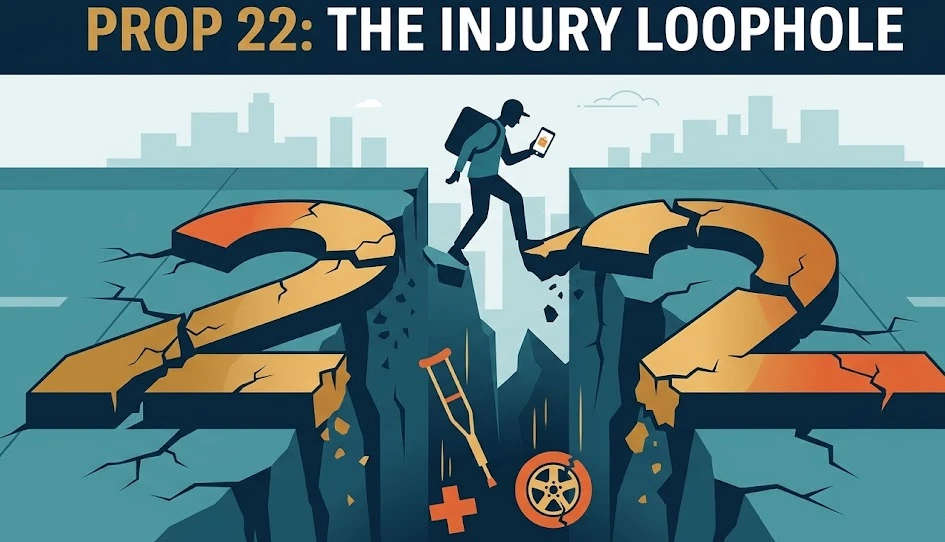
Every day, thousands of rideshare drivers and delivery couriers navigate the freeways and city streets of California, racing against app algorithms to deliver food, groceries, and passengers. That environment puts gig workers at real risk for severe traffic accidents, and when a crash results in a brain injury or spinal cord damage, these workers face a legal reality most employees never have to think about. Under Proposition 22, codified as California Business and Professions Code section 7451, app-based drivers are classified as independent contractors rather than employees, which removes them from the standard workers’ compensation system. Navigating a severe crash under these rules is genuinely difficult, and it’s why injured drivers often benefit from experienced catastrophic injury counsel.
The rule survived its biggest legal test relatively recently. In Castellanos v. State of California, 16 Cal.5th 588 (2024), the California Supreme Court unanimously upheld Prop 22’s constitutionality, rejecting the argument that it improperly encroached on the legislature’s authority over workers’ compensation. As of this writing, Prop 22 remains valid, enforceable law in California.
Workers’ Compensation vs. Prop 22 Occupational Accident Insurance
Under traditional California employment law, an injured employee is protected by a robust workers’ compensation system: a no-fault safety net covering medical treatment, temporary disability payments, and long-term benefits for permanent disability.
Prop 22 replaces that system for gig workers with something narrower. Under Business and Professions Code § 7455, network companies must provide occupational accident insurance covering medical expenses up to at least $1 million, along with disability payments equal to 66% of the driver’s average weekly earnings for up to 104 weeks, and accidental death benefits. A million dollars sounds substantial, but a catastrophic injury requiring multiple surgeries, extended intensive care, and lifetime rehabilitation can exhaust that limit quickly. Once the cap is reached, the injured driver is responsible for any remaining medical costs.
The Three Phases of Gig Apps and the Coverage Gap
Another obstacle for injured gig workers is figuring out which insurance policy applies at the exact moment of a collision, since coverage shifts based on the app’s status at that instant:
- Period 1 — App off: the driver’s personal auto insurance applies. Personal policies almost always exclude commercial driving, so insurers may deny a claim if they suspect the driver was working.
- Period 2 — App on, waiting for a match: this is where the real danger lies. Companies provide only limited, contingent liability coverage during this waiting period, and available policy limits are often much lower than most people assume.
- Period 3 — En route or on a trip: from accepting a ride or delivery until the task is completed, the company’s full commercial liability policy is active.
Insurance adjusters routinely examine digital telematics and app data specifically to argue that a driver was only in Period 2 at the time of a crash, which minimizes the company’s financial exposure.
Pursuing Financial Recovery Through Third-Party Claims
Because the coverage under Prop 22 is often inadequate for a serious, long-term injury, injured workers frequently need to pursue a third-party personal injury lawsuit against the at-fault driver directly. California law allows a victim in that kind of case to recover both economic and non-economic damages: future medical treatment beyond the Prop 22 caps, lost earning capacity if the injury prevents a return to work, and pain and suffering. The challenge comes when the at-fault driver carries minimal insurance or none at all, which is one of several reasons the initial hours after a rideshare crash matter so much for preserving evidence of fault.
For a broader sense of how a personal injury claim generally moves from filing to resolution, this overview of what to expect when working with a personal injury lawyer walks through the standard process, most of which applies here as well.
Frequently Asked Questions
Is Prop 22 still valid law in California? Yes. The California Supreme Court unanimously upheld its constitutionality in Castellanos v. State of California (2024), and it remains in effect.
What happens if my medical bills exceed the $1 million occupational accident insurance cap? The remaining costs generally fall to the injured driver, unless a viable third-party claim against an at-fault driver, or another liable party, can cover the difference.
Which coverage period is riskiest for an injured gig worker? Period 2, when the app is on but the driver hasn’t yet accepted a ride or delivery. Coverage during this window is far more limited than during an active trip.
The Necessity of Specialized Legal Representation
Proposition 22 was presented to voters as a way to preserve flexibility for independent workers, but it created a real gap in financial security for those who suffer severe injuries on the road. Recovering from a major accident requires significant financial resources, and the legal framework built around gig work doesn’t make that easy. Sorting through digital evidence, insurance coverage periods, and corporate liability rules typically requires legal counsel with direct experience in exactly this kind of case.
Authorities & Sources
- Business and Professions Code § 7451 — App-Based Driver Classification
- Business and Professions Code § 7455 — Required Insurance Coverage
- Castellanos v. State of California, 16 Cal.5th 588 (2024)
Disclaimer
This article is provided for general informational purposes only and does not constitute legal advice. California’s gig-worker classification and insurance rules are fact-specific and can change through future legislation or litigation. Reading this article does not create an attorney-client relationship. Anyone injured while working as an app-based driver in California should consult a licensed attorney promptly about the specific facts and coverage that apply to their situation.