

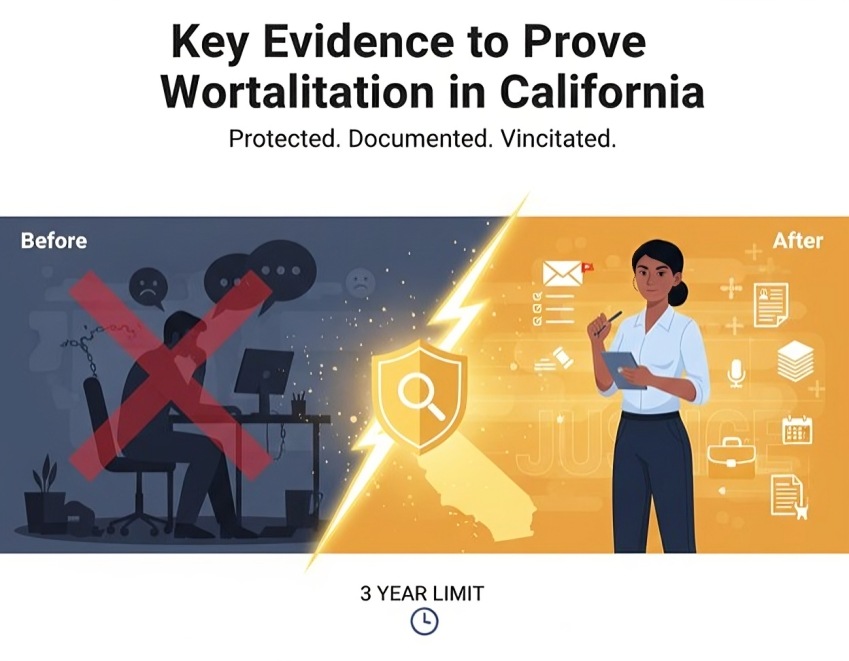
If you have been fired, demoted, or mistreated after speaking up, you aren’t just dealing with a difficult boss. You may be the victim of illegal workplace retaliation. But in the eyes of the court, knowing it happened isn’t enough. You have to prove it.
This guide breaks down exactly what counts as retaliation under California’s Fair Employment and Housing Act (FEHA) and Labor Code, and more importantly, the specific evidence you need to gather for a workplace retaliation lawyer to build a winning claim. If you believe your rights have been violated, speaking with an Employment Attorney is the most effective first step to protecting your future.
Most people assume that if they report harassment or illegal activity at work, the law protects them from being fired or punished. And while California law does offer strong protections, the reality is that employers often retaliate anyway. They just try to hide it behind excuses like “poor performance” or “budget cuts.”
The unfortunate truth is that retaliation is a growing problem. In California, workers filed an average of 706 claims of workplace retaliation per month with the state’s Labor Commissioner’s Office in 2022, a staggering 50% increase over the pre-pandemic monthly average in 2019. This surge highlights a critical reality: while strong labor laws like the Fair Employment and Housing Act exist, securing justice depends entirely on your ability to produce compelling evidence. An employer will rarely admit their illegal motive, so it’s up to you to build a case that exposes the truth behind their actions. This guide is your roadmap to gathering that crucial proof.
Understanding Workplace Retaliation Under California Law
Before you can gather evidence, you need to understand exactly what you are trying to prove. Workplace retaliation is not just general meanness or a boss having a bad day. It is a specific legal concept involving an employer punishing an employee for engaging in a legally protected activity. To build a successful retaliation claim, you must prove three core elements: you engaged in a protected activity, you suffered an adverse employment action, and there is a causal link between the two.
What Legally Counts as Workplace Retaliation
In California, retaliation occurs when an employer takes an “adverse employment action” against you because you exercised a legal right. This adverse action must be significant enough to materially affect the terms and conditions of your job. The landmark case Yanowitz v. L’Oreal USA Inc. helped establish that even a series of smaller actions can collectively count as an Adverse Employment Action.
While termination is the most obvious form of retaliation, it is far from the only one. Courts recognize various adverse actions as retaliatory, including:
- Demotion: Lowering your rank or job title.
- Pay cuts: Reducing your salary, hourly wage, or benefits.
- Reduced hours: Cutting your shifts significantly, affecting your income.
- Schedule changes: Purposely assigning you to “graveyard” shifts or times they know you cannot work (e.g., conflicting with childcare).
- Exclusion: Shutting you out of essential meetings, training, or opportunities for advancement.
- Unwarranted Discipline: Subjecting you to a sudden barrage of negative performance reviews or disciplinary warnings for issues that were previously ignored.
Laws Protecting Employees
California employees benefit from some of the strongest labor protections in the country. The primary laws governing retaliation include:
- The California Fair Employment and Housing Act (FEHA): This is California’s primary anti-discrimination law. It prohibits retaliation against employees who oppose harassment or discrimination based on protected categories like race, gender, disability, or sexual orientation.
- California Labor Code § 98.6: This statute prohibits employers from discharging or discriminating against an employee for exercising rights under the Labor Code, such as filing a wage claim or complaining about unpaid overtime.
- California Whistleblower Protection Act (Labor Code § 1102.5): This protects employees who report reasonable beliefs of legal violations to a government agency, law enforcement, or even internally to a person with authority over the employee.
- Other Labor Code Protections: Sections like Labor Code Sections 1197.5 (protecting discussions about wages) and Labor Code section 98.7 (outlining the complaint process with the Labor Commissioner) provide additional safeguards.
Identifying Protected Activities You Must Prove First
To win a retaliation claim, the first piece of evidence you need to establish is that you engaged in a “protected activity.” If you cannot prove you engaged in a protected activity, you cannot prove retaliation. This is the foundational element that triggers your legal protections.
Reporting Harassment or Discrimination
The most common form of protected activity is reporting misconduct. This includes:
- Internal Complaints: Following your employee handbook or company policies to report sexual harassment, racial discrimination, or a hostile work environment to your HR department or a supervisor.
- External Filings: Filing a formal discrimination complaint or Retaliation complaint with an agency like the California Civil Rights Department (CRD) or the federal Equal Employment Opportunity Commission (EEOC).
- Safety Reports: Reporting unsafe working conditions or violations to the California Occupational Safety and Health Administration (Cal/OSHA).
Participating in Workplace Investigations
You don’t have to be the original complainant to be protected. Participating in an investigation is also a protected activity. This includes:
- Acting as a witness: Answering questions honestly during an internal or external investigation, which could involve providing witness statements.
- Providing statements: Writing a declaration or affidavit in support of a coworker’s discrimination allegation.
- Assisting others: Helping a colleague draft a complaint or navigate the HR process. Your witness testimony can be crucial.
Other Protected Activities
California law covers a wide range of actions beyond harassment complaints. You are also engaging in protected activity if you:
- Request Medical Leave: Asking for time off under the California Family Rights Act (CFRA) or FMLA.
- Request Accommodations: Asking for reasonable adjustments for a disability or pregnancy.
- Discuss Wages: Discussing your salary with coworkers. Employers cannot silence these wage discussions.
- Refuse Illegal Instructions: Refusing to perform an act that would violate a statute or regulation.
- Report Wage Theft: Filing a claim for unpaid wages or overtime with the Labor Commissioner’s Office.
Gathering Evidence of Retaliation at Employment Place
Once you have established that you engaged in protected activity, the core of your case is proving the retaliation itself. The numbers show this is a common battle in Los Angeles County alone, with retaliation comprising 25% of the 12,459 employment complaints filed with the Civil Rights Department in one year. Since employers rarely admit, “I fired you because you complained,” you must build a case based on documentation and timing.
Documenting Adverse Employment Actions
You need concrete proof that your job situation changed negatively. This is the second pillar of your claim: demonstrating you suffered an adverse employment action.
- Official Letters: Save termination letters, demotion notices, or disciplinary write-ups.
- Pay Stubs: Collect pay stubs showing a reduction in hours, loss of bonuses, or a decrease in hourly rate.
- Schedule Logs: Keep copies of work schedules showing a shift to less desirable hours compared to your previous schedule.
- Emails and Memos: Preserve any communication that confirms a negative change, such as being removed from a project or denied a promotion.
Establishing the Causal Connection
The “Causal Connection” is the bridge between your protected activity and the adverse action. You must show that one caused the other.
- Timing (Temporal Proximity): This is often your strongest evidence. If you reported sexual harassment on Tuesday and were fired on Friday, the timing suggests a connection.
- Behavioral Changes: Document if a previously friendly supervisor suddenly became hostile, silent, or hyper-critical immediately after your complaint. Note the manager’s response.
- Lack of Justification: If you were fired for “budget cuts” but the company immediately hired a replacement, that evidence suggests the reason was a pretext (a lie to cover the real motive).
Maintaining Ongoing Records
Memory fades, but written records do not. Diligent evidence collection is your best weapon.
- Daily Journal: Start a journal immediately. Note dates, times, witnesses, and details of every retaliatory incident. Do not keep this on a work computer, keep a physical notebook or use a personal device.
- Save Everything: Do not delete anything. Keep physical copies of documents in a safe place at home, away from the office.
- Log Conversations: After a verbal meeting, send a follow-up email to yourself (or the supervisor) summarizing what was said to create a time-stamped record.
Collecting Communications That Support Your Claim
Digital trails are often where employers make mistakes. Recovering these communications can make or break a case when building a prima facie case of retaliation.
Preserving Emails, Texts & Messages
- Direct Instructions: Save emails where supervisors give impossible deadlines or contradictory instructions shortly after your complaint.
- Hostility: Screenshots of text messages or Slack/Teams chats that are dismissive, threatening, or unprofessional.
- The Complaint Itself: You absolutely must have proof that you made the complaint. Save the email you sent to HR. If you made a verbal complaint, follow it up with an email: “I am writing to confirm our conversation this morning regarding my concerns about…” This creates a paper trail.
Gathering Witness Statements
Your coworkers can be valuable resources, though they may be fearful of speaking up.
- Direct Observers: Identify colleagues who witnessed the harassment or the subsequent retaliation (e.g., a supervisor yelling at you).
- Pattern Witnesses: Coworkers who have seen the employer retaliate against others in the past. Their testimony can establish a pattern of retaliatory conduct.
- Overheard Comments: Anyone who heard management discuss “getting rid of” you or expressing frustration about your complaint. This type of testimonio de testigos can be powerful.
Keeping Performance Reviews & Work History
One of the most common employer defenses is: “We didn’t fire them because they complained. We fired them because they were bad employees.” You need evidence to disprove this.
- Past Reviews: Gather all previous performance reviews. If you had 5 years of “Exceeds Expectations” reviews and suddenly received a “Poor” rating two weeks after complaining, that is powerful evidence. Request a copy of your personnel file.
- Awards and Commendations: Save emails praising your work from your performance reports, certificates of achievement, or your employment contract goals.
- Sudden Shift: Highlight the lack of documented performance issues before the protected activity. This contrast is key.
Understand Employer Behavior and Shifting Explanations
Inconsistencies are the enemy of the employer and the best friend of the employee. Scrutinize everything they say and do after your complaint.
Identifying Retaliation Patterns Over Time
Retaliation isn’t always a single explosion. It can be a slow burn. Look for retaliation patterns that show targeted behavior. Does the employer have a history of disciplining employees who file harassment complaints? Is there a noticeable trend where whistleblowers are sidelined? Establishing a pattern helps prove intent and speaks to a poor organizational culture and flawed administrative policies.
Examining Employer’s Changing Reasons
Pay close attention to why the employer says they are punishing you.
- Moving Goalposts: Did they say you were fired for being late, but then later claim it was for poor sales numbers?
- Inconsistent Paperwork: Does the termination letter say “Layoff” but the report to the unemployment office says “Misconduct”?
- Contradictory Explanations: If the story changes every time you ask, it implies the employer is searching for a justification to cover up an illegal motive.
Navigating the Legal Process in California Court Rooms

Proving retaliation is only part of the battle. You also have to navigate the procedural hurdles of California’s legal system and understand your derechos.
Understanding State & Federal Complaint Options
Before you can file a lawsuit in court, you typically must “exhaust administrative remedies” by filing agency complaints.
- California Civil Rights Department (CRD): For harassment and discrimination retaliation, you usually file here first to obtain a “Right to Sue” notice. The CRD (formerly the Department of Fair Employment and Housing or DFEH) has a Complaint Investigation Unit to handle these cases.
- EEOC: The Federal EEOC handles claims under federal law. The CRD and EEOC have a work-sharing agreement, so filing with one often preserves dates for the other. The EEOC complaint process can be complex, and national statistics show a rise in filings. The EEOC received 88,531 charges alleging employment discrimination during its last fiscal year.
- Labor Commissioner (DLSE): For retaliation related to wage theft or Labor Code Sections 98.6 violations, you can file a claim directly with the Labor Commissioner, who leads the Division of Labor Standards Enforcement (DLSE).
Importance of Timelines & Deadlines
Missing a deadline can permanently bar you from pursuing justice for your reclamaciones laborales (labor claims).
- CRD Filing: Generally, you have three years from the date of the retaliatory act to file a complaint with the CRD.
- Whistleblower Claims: Deadlines for Labor Code Sections 1102.5 claims can vary but generally follow the three-year statute of limitations for statutory penalties.
- Government Entities: If you work for a city, county, or state agency, you may have as little as six months to file a government tort claim.
- Takeaway: Do not wait. The sooner you act, the safer your claim is.
Role of Employment Attorneys
Retaliation law is complex. A skilled Workplace Retaliation Lawyer specializing in California Labor & Employment Law plays a critical role in:
- Evaluating Strength: Telling you honestly if you have enough evidence to win, with knowledge of local courts from Orange County to Oakland, CA.
- Evidence Gathering: Assisting with subpoenas and formal requests to secure documents the employer won’t provide voluntarily.
- Negotiation: Many cases are settled out of court. Setarehlaw lawyer for workplace retaliation knows how to calculate your damages to ensure a fair settlement.
- Litigation: If a settlement isn’t reached, top California employment trial lawyers like Thomas Segal will represent you in court, potentially filing a Writ in superior court to challenge an agency decision.
Preparing for Settlements Before Legal Action Against the Employer
If you decide to move forward, preparation is key. A strong case is built on organized, compelling evidence.
Building a Comprehensive Case File
Your attorney will need a well-organized file. This should include your timeline, your journal, contact info for witnesses, and every scrap of documentation you saved. The more organized you are, the faster your attorney can build a strategy based on a clear evidence checklist. Consistency is vital. Your story must match the documents.
Possible Outcomes & Remedies
If your claim is successful, California law provides for several types of legal remedies to make you “whole”:
- Back Pay: Wages (salarios atrasados) and benefits you lost from the
- Reinstatement: Getting your job back (though often this is negotiated into “front pay” if the relationship is too damaged).
- Front Pay: Compensation for future lost wages while you look for a new job.
- Emotional Distress: Damages for the anxiety, depression, and suffering caused by the retaliation.
- Punitive Damages: Money awarded to punish the employer if their conduct was particularly malicious (this is where high-value verdicts often come from).
- Attorney’s Fees: In many FEHA cases, the employer must pay your legal fees if you win.
When to Seek Legal Support from an Attorney
You should consider seeking legal counsel if:
- The retaliation is escalating despite your attempts to resolve it internally.
- You have been fired or demoted.
- Your employer is ignoring your complaints or gaslighting you.
- You are being asked to sign a severance agreement (never sign without a lawyer reviewing it).
FAQs
1. What qualifies as retaliation under California law?
Retaliation is any adverse employment action such as firing, demotion, pay cuts, or harassment taken by an employer because an employee engaged in a protected activity, like reporting discrimination or safety violations.
2. How do I prove the causal link between my complaint and retaliation?
The strongest proof is usually timing (temporal proximity). If the adverse action happened shortly after your complaint, it suggests a link. Other proof includes sudden hostility from supervisors, lack of prior performance issues, or evidence that other employees were not punished for similar behavior.
3. What evidence is strongest in a California retaliation case?
Written documentation is the strongest evidence. This includes emails, text messages, positive performance reviews prior to the complaint, termination letters, and a personal journal documenting the timeline of events.
4. Can my employer fire me for reporting unsafe working conditions?
No. Reporting unsafe working conditions to Cal/OSHA or your employer is a protected activity. Firing you for doing so is illegal retaliation under the California Labor Code.
5. How long do I have to file a retaliation claim in California?
For most harassment and discrimination-based retaliation (FEHA), you typically have three years from the date of the incident to file a complaint with the California Civil Rights Department (CRD).
6. Should I talk to HR or a lawyer first if I suspect retaliation?
If you are currently employed, reporting to HR creates a record of the retaliation (which is helpful evidence). However, consulting a lawyer simultaneously is wise so they can guide you on how to make that report effectively and protect yourself.
7. What if my employer claims the adverse action was for performance reasons?
This is a common defense called “pretext.” You can defeat it by showing past positive performance reviews, proving that the rules are being applied unevenly, or showing that the “performance issues” were fabricated only after you complained.
8. Can I collect damages for emotional distress in a retaliation lawsuit?
Yes. In California, you can recover damages for the pain, suffering, anxiety, and humiliation caused by wrongful termination or workplace retaliation, in addition to lost wages.
The Final Verdict
Workplace retaliation can leave you feeling like you’ve been run through a meat grinder. Your career in tatters, your bank account overdrawn and your mental health shot to bits. But California law is actually on your side. You just need to know how to use it to your advantage. The thing is, there’s a huge difference between feeling like you’re getting hammered by your employer – and actually being able to prove it in court. And the key to that comes down to gathering a solid load of evidence – proof of the changes in your treatment, copies of emails & messages, timeline records and a clear grasp on what actually constitutes retaliation.
California’s FEHA, Labor Code protections, and whistleblower laws are some of the most worker-friendly in the nation. Still, they only work in your favor if you take action early and gather the proof needed to support your claim. Whether you’re dealing with sudden write-ups, reduced hours, unfair discipline, or termination after reporting misconduct, every detail matters, and every document strengthens your case.
You shouldn’t have to face your employer alone. If you believe you’re being punished for speaking up, a California workplace retaliation lawyer can help you understand your options, preserve critical evidence, and pursue the compensation you’re entitled to. Getting legal guidance early can be the difference between a dismissed claim and a successful outcome.
If you suspect retaliation, take action immediately. Protect your documentation, assert your rights, and speak with an experienced employment attorney who can guide you through the next steps and help you secure the justice you deserve.