
By Ronald S. Cook, Esq. New York Bankruptcy, Debt Defense & Consumer Protection Attorney | Ronald S. Cook, P.C. Last reviewed: September 2026
A credit report can contain several kinds of accounts: credit cards, auto loans, student loans, mortgages, retail accounts, and other credit obligations. Scoring models may consider that mix, but the existence of different account types does not prove that a person is financially stable.
That distinction matters. A borrower can have a varied credit file and still carry high balances, miss payments, or struggle with debt. Another person may have only a few accounts and still manage them exceptionally well. Credit mix is best understood as one part of a broader record, not as a standalone measure of financial health.
This guide explains how credit mix fits into credit scoring, why opening accounts merely to create variety is usually a poor strategy, and what consumers should know about credit reports, disputes, counseling, and debt-management options.
What Credit Mix Actually Means
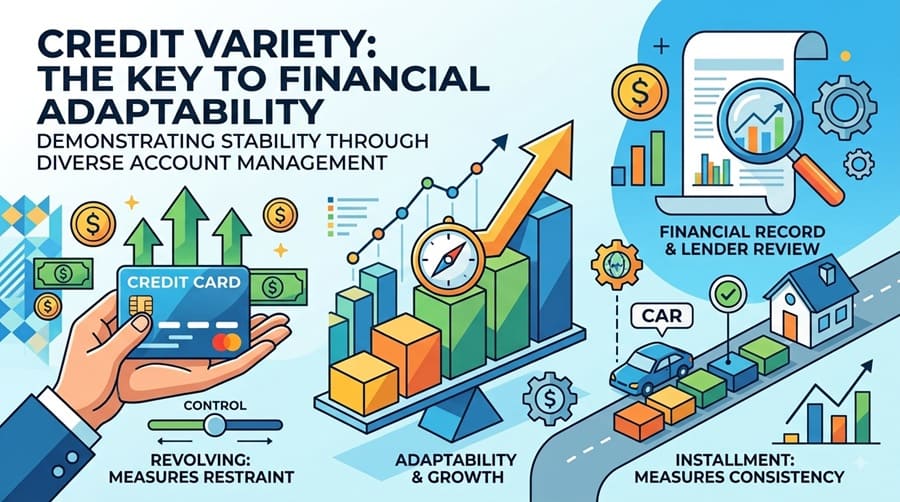
Credit mix refers to the different types of credit accounts appearing on a consumer’s credit report. Common categories include revolving credit, such as credit cards, and installment credit, such as auto loans, student loans, personal loans, and mortgages.
FICO states that credit mix accounts for about 10% of a typical FICO Score. Payment history is generally weighted more heavily, followed by amounts owed, length of credit history, and other factors. The exact impact can vary from person to person.
FICO – What’s in your FICO Scores
The Consumer Financial Protection Bureau also cautions that consumers do not have a single universal credit score. Scores can differ depending on the model, the credit product, the data source, and the date the score is calculated.
CFPB – What is a credit score?
Revolving and Installment Accounts Tell Different Parts of the Story
Revolving Credit
Credit cards and similar revolving accounts allow repeated borrowing up to a limit. Scoring models may consider payment history, balances, utilization, account age, and the overall way the account is managed.
A low or manageable balance relative to the credit limit can be more useful than simply having several revolving accounts. The CFPB notes that getting close to a credit limit can hurt scores and that consumers do not need to carry a balance to build a good score.
Installment Credit
Installment accounts usually involve a set amount borrowed and repaid over time according to a schedule. Auto loans, mortgages, student loans, and many personal loans fit this pattern.
A history of making installment payments on time can provide a different kind of payment record than a revolving account. But taking out an installment loan solely to add variety can create interest expense and new-credit activity without guaranteeing a meaningful score improvement.
Credit Variety Is Not the Same as Financial Stability
The original version of this article described credit variety as evidence of adaptability. That idea can be useful as a metaphor, but it should not be treated as a lending rule. Credit reports and scores measure credit behavior, not the full condition of a household’s finances.
A consumer can have a strong credit score while carrying little emergency savings. Another can have substantial assets but a thin credit file. Credit scores generally do not measure income, savings, investment balances, or whether a person can comfortably absorb a financial shock.
For that reason, the safer conclusion is narrower: a history of responsibly managing more than one type of account can add information to a credit profile, but it is not proof of overall financial stability.
Do Not Open New Debt Just to Improve Credit Mix
Opening a new account can affect more than one scoring factor. A hard inquiry may be added, the average age of accounts may decline, and a new monthly payment may increase financial pressure.
FICO – How new credit affects your score
FICO specifically warns against opening several new accounts in a short period, particularly for consumers with a shorter credit history. A new account should make financial sense on its own merits, not merely because it creates a different account type.
Payment History and Balances Usually Matter More
For many consumers, the most productive credit habits are less complicated than trying to engineer a perfect account mix. Paying bills on time, keeping revolving balances under control, avoiding unnecessary applications, and allowing accounts to age can have a larger practical effect.
CFPB – How to get and keep a good credit score
The CFPB also recommends checking credit reports for errors. A strong mix of accounts cannot compensate for incorrect late payments, duplicate debts, accounts that are not yours, or balances reported inaccurately.
Check the Credit Report Before Trying to ‘Fix’ the Score
Consumers should review the information behind a score rather than chasing the score itself. The three nationwide credit reporting companies collect account and payment information that can affect lending decisions.
The CFPB recommends checking credit reports at least annually and notes that consumers can currently request reports more frequently through the authorized national credit-report service.
CFPB – Credit reports and scores
Common errors include accounts belonging to another person, incorrect balances or limits, closed accounts shown as open, inaccurate late-payment information, and duplicate debts.
Consumers Have a Legal Right to Dispute Credit Report Errors
The Fair Credit Reporting Act gives consumers the right to dispute inaccurate or incomplete information. The CFPB recommends disputing an error with both the credit reporting company and the company that furnished the information.
CFPB – How to dispute a credit report error
A dispute should identify the specific item, explain why it is wrong, and include supporting documents where available. Consumers should keep copies of what they send.
Accurate negative information generally cannot be removed simply because it hurts a score. The CFPB warns consumers to be cautious of companies promising to erase current, accurate negative information.
CFPB – Accurate negative credit information
When Credit Counseling May Make Sense
Credit counseling is different from credit repair. A reputable counselor typically reviews income, expenses, debts, and repayment capacity before recommending a course of action.
Consumers comparing debt-management options may also encounter Credit Counseling resources from National Debt Relief. That page can be useful for understanding common counseling concepts, but it is a commercial source. Consumers should compare any recommendation with guidance from neutral sources such as the Federal Trade Commission and should understand whether the provider is offering counseling, debt management, debt settlement, or another service.
The FTC explains that a debt management plan is not appropriate for everyone. A counselor should first review the consumer’s financial situation, and a plan can take years to complete. Consumers should also verify any promised creditor concessions.
FTC – How to get out of debt and evaluate credit counseling
Credit Counseling, Debt Management, and Debt Settlement Are Not the Same
These terms are often used together online, but they describe different approaches.
- Credit counseling generally involves reviewing the consumer’s finances and discussing budgeting or repayment options.
- A debt management plan usually involves making one payment to a counseling organization, which then distributes payments to participating unsecured creditors under an agreed schedule.
- Debt settlement generally involves attempting to resolve debts for less than the full balance and can involve different fees, credit effects, collection risks, and possible tax consequences.
Before enrolling in any program, ask what service is actually being provided, how the company is paid, whether creditors have agreed to the plan, how accounts will be reported, and what happens if payments are missed.
When a Credit Problem Becomes a Legal Problem
Many credit-score questions are financial rather than legal. Legal advice may become more relevant when the issue involves inaccurate reporting that remains unresolved, identity theft, a debt-collection lawsuit, garnishment, a frozen bank account, bankruptcy, or a creditor’s alleged violation of federal or state consumer law.
The Fair Credit Reporting Act can provide remedies when a credit reporting company fails to comply with its legal duties, but the facts, dispute history, damages, and applicable deadlines matter. A lawyer cannot improve a valid score by simply demanding that accurate negative information disappear.
For related legal context, see Find Attorneys’ guide to credit-report and Equifax claims.
For consumers whose debt problems are broader than a single credit-report issue, Find Attorneys also covers bankruptcy and its interaction with longer-term financial planning. That article is New Jersey-specific, so its state-law details should not be applied elsewhere.
A Practical Way to Think About Credit Mix
Credit mix is easiest to understand as a supporting factor. If different account types arise naturally because they fit real financial needs, managing them responsibly may add depth to a credit history. It is usually not worth paying interest, taking on debt, or opening accounts solely to create variety.
For most consumers, the fundamentals remain more important: pay on time, avoid unnecessary debt, keep balances manageable, review reports for errors, and address repayment problems before they become lawsuits or defaults.
Frequently Asked Questions
Does having different types of credit automatically raise a credit score?
No. Credit mix can affect some scoring models, but the impact depends on the rest of the credit file. Payment history, balances, account age, and new credit can matter more.
How much of a FICO Score is credit mix?
FICO states that credit mix accounts for about 10% of a typical FICO Score, although the importance can vary depending on the consumer’s overall credit profile.
Should I take out a loan just to improve my credit mix?
Usually not. A new loan can create interest expense, a new account, an inquiry, and another required payment. There is no guaranteed score increase from adding a new account type.
Do I need to carry a credit card balance to build credit?
No. The CFPB states that consumers do not need to carry a balance to obtain a good credit score. Paying balances in full can reduce interest costs.
Can I remove accurate negative information from my credit report?
Generally no. Consumers can dispute inaccurate or incomplete information, but accurate negative information usually remains for the period allowed by law.
What should I do if my credit report contains an error?
Dispute the error with the credit reporting company and the company that furnished the information. Explain the error clearly and include supporting documents where available.
Is credit counseling the same as debt settlement?
No. Counseling typically focuses on reviewing finances and repayment options. Debt settlement involves attempting to resolve debts for less than the amount owed. The risks, fees, and credit consequences can differ.
When might a lawyer be useful for a credit problem?
Legal advice may be useful when inaccurate reporting persists after disputes, identity theft is involved, a creditor files suit, wages or accounts are being restrained, bankruptcy is being considered, or a consumer-law violation may have occurred.
Authorities & Sources
- Consumer Financial Protection Bureau – What Is a Credit Score?
- Consumer Financial Protection Bureau – Understand Your Credit Score
- Consumer Financial Protection Bureau – Credit Reports and Scores
- Consumer Financial Protection Bureau – How to Dispute a Credit Report Error
- Consumer Financial Protection Bureau – Accurate Negative Information
- FICO – What’s in Your FICO Scores
- FICO – Credit Mix
- Federal Trade Commission – How to Get Out of Debt
Disclaimer
This article provides general educational information and is not legal, credit, tax, or financial advice. Credit scores vary by scoring model, lender, data source, and date. Opening or closing accounts, using debt-management or settlement services, disputing credit information, or filing bankruptcy can have consequences that depend on individual circumstances. Reading this article or following a link does not create an attorney-client relationship. Consumers should verify current information and obtain individualized professional advice when needed.