By Michael Louis Kelly, Senior Partner, Kirtland & Packard LLP · Redondo Beach, California | Last reviewed: October 2026
Quick answer: A fall in a public place does not automatically make the city, store, or property owner responsible. In California, liability usually follows control: who controlled the area, what created the hazard, and whether that party knew or should have known about it in time to fix it or warn people. When the property belongs to a government agency, a six-month claim deadline applies before any lawsuit can be filed.
A successful claim also requires proof that the dangerous condition caused the injury. Identifying the responsible party starts with the property, the hazard, and the evidence gathered in the first days after the fall.
The Legal Starting Point
California’s general negligence statute, Civil Code § 1714, makes everyone responsible for injuries caused by a lack of ordinary care in managing their property. The state’s civil jury instructions on premises liability, CACI 1000 and following, turn that duty into four questions a jury must answer:
- Did the defendant own, lease, occupy, or control the property?
- Was the defendant negligent in using or maintaining it?
- Was the injured person harmed?
- Was the defendant’s negligence a substantial factor in causing that harm?
Notice is usually where these cases are won or lost. The owner or occupier must have known about the hazard, or it must have existed long enough that a reasonable inspection would have found it. In Ortega v. Kmart Corp. (2001), the California Supreme Court held that an injured shopper does not have to prove exactly how long a hazard was present. Evidence that the store had not inspected the area within a reasonable time can be enough for a jury to infer constructive notice.
Who Can Be Responsible
| Party | When liability may attach |
| Property owner | Controls the area and failed to inspect, repair, or warn |
| Tenant or business occupant | Controls the floor or space where the fall happened, such as a store aisle or restaurant entrance |
| Property manager | Took on inspection, cleaning, or repair duties by contract |
| Contractor or maintenance company | Its work created the hazard, such as a defective repair or leftover construction debris |
| Government agency | A dangerous condition of public property under Government Code § 835 |
Owners, Landlords, and Tenants
The owner often carries responsibility for keeping premises reasonably safe, including aisles, walkways, entrances, restrooms, and stairways. Ownership alone does not resolve the question. A landlord who has leased a space to a tenant is generally responsible only for hazards the landlord knew about and had the right and ability to fix, while the tenant answers for conditions within its own control. Lease terms and maintenance agreements often decide how responsibility is split.
Businesses and Their Employees
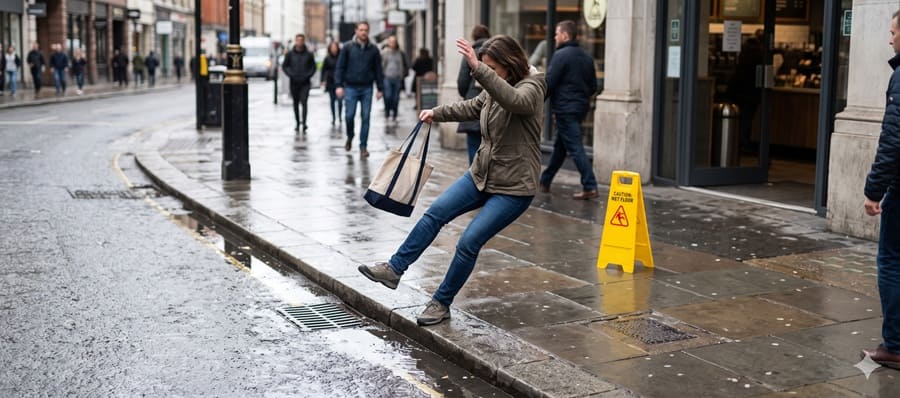
Stores, restaurants, and offices can face liability when employees create a hazard or fail to correct one. A leaking freezer, a freshly mopped floor without a sign, fallen merchandise, or a blocked walkway can all create foreseeable risk. Employees do not need to witness the fall. Sweep logs, inspection schedules, employee statements, prior complaints, and security video can show how long a condition existed. Find Attorneys’ discussion of whether a supermarket slip and fall is worth pursuing covers the grocery-store version of these facts.
Contractors and Maintenance Companies
A contractor can share responsibility when its work creates a dangerous condition, such as improperly installed flooring, faulty lighting work, or inadequate cleanup after construction. A contract between the owner and the contractor can affect who pays in the end, but it does not automatically remove the owner’s duty to visitors.
When more than one party is at fault, California’s Civil Code § 1431.2 matters. Each defendant pays only its own percentage share of non-economic damages, such as pain and suffering, while economic damages such as medical bills remain joint. Identifying every responsible party early can affect the total recovery.
Falls on Government Property
Falls on public sidewalks, in government buildings, in parks, or at transit stations follow a different set of rules. Under Government Code § 835, a public entity can be liable for a dangerous condition of its property if the condition created a reasonably foreseeable risk of the kind of injury that occurred and the entity either created it or had notice in time to fix it.
- Six-month claim deadline: A written claim must be presented to the agency within six months of the injury under Government Code § 911.2. A standard insurance demand letter does not satisfy this requirement.
- Lawsuit deadline after rejection: If the claim is rejected in writing, a lawsuit generally must be filed within six months of the rejection notice under § 945.6.
- Trivial defect defense: Under Government Code § 830.2, a condition is not dangerous if the risk it creates is minor, trivial, or insignificant. Agencies often use this defense in sidewalk cases involving small height differences, which makes photographs with a measuring reference especially important.
- Federal property: Falls at post offices, federal buildings, and other federal sites fall under the Federal Tort Claims Act, which requires an administrative claim within two years under 28 U.S.C. § 2401(b).
Sidewalks raise one more question. Streets and Highways Code § 5610 requires owners of adjoining property to maintain the sidewalk, but that duty alone does not usually make them liable to an injured pedestrian. Some cities have ordinances that shift liability to adjacent owners, so the local rules matter.
A Roadside Hazard the State Should Have Removed
Government property claims depend on showing that a condition was dangerous and that the agency should have dealt with it. Among the results listed on the author’s firm’s verdicts and settlements page, an elderly couple was injured when their car struck a tree about 19.5 feet from Interstate 80. A jury found that the tree was a dangerous condition of public property that the state transportation agency should have removed as part of a freeway repaving project and returned a verdict of $2,020,495. The same principle applies to public walkways: the question is whether the agency had the opportunity to correct a known risk and did not.
Past results depend on the specific facts of each case and do not guarantee a similar outcome in any other matter.
The Injured Person’s Own Conduct
California follows pure comparative negligence. A person who ignored a visible warning, was looking at a phone, or wore unsuitable footwear can still recover, but the award is reduced by that person’s share of fault. An obvious hazard does not automatically bar a claim in California, though it can affect how fault is divided. Find Attorneys’ overview of California personal injury compensation explains how those reductions work in practice.
Evidence That Decides These Cases
Medical care comes first, but documentation should follow quickly, because conditions change and recordings are overwritten:
- Report the fall to a manager or agency employee and ask for a copy of the incident report.
- Photograph the hazard, the surrounding area, any warning signs or their absence, and the shoes worn.
- Collect names and phone numbers of witnesses.
- Send a written request to preserve surveillance video, since many systems record over footage within days or weeks.
- Keep medical records, bills, and documentation of missed work.
Someone consulting a slip and fall accident attorney in Redondo Beach or elsewhere in California should bring those records to the first meeting, along with the date of the fall, since that date controls both the six-month government deadline and the general two-year deadline for injury lawsuits against private parties.
Control, Notice, and Timing
Liability after a public slip and fall usually follows control over the dangerous condition, not ownership alone. The evidence must show what caused the fall, how long the condition existed, and which party had a duty to address it. When a government agency may be involved, the clock starts running much sooner than most people expect.
Disclaimer
This article provides general information about premises liability and slip and fall claims in California. It is not legal advice, and reading it does not create an attorney-client relationship. Deadlines, local ordinances, and liability rules depend on the facts and on who controls the property. Anyone injured in a fall should consult a licensed California attorney promptly, especially when a public agency may be involved.