By Brett Schreiber, Founding Partner, Singleton Schreiber · Admitted to the State Bar of California in 2005 | Updated November 2026
A serious injury rarely speaks for itself. What decides your case is the proof you can gather and keep. Most injury claims never see a courtroom: in the Bureau of Justice Statistics’ study of tort cases in the country’s 75 largest counties, about three-quarters ended in a settlement or voluntary dismissal and only 3% in a trial verdict. A later national survey found that nearly 4% of tort cases were disposed of by trial. In practice, the file you build, not a jury, usually decides what your injury is worth.
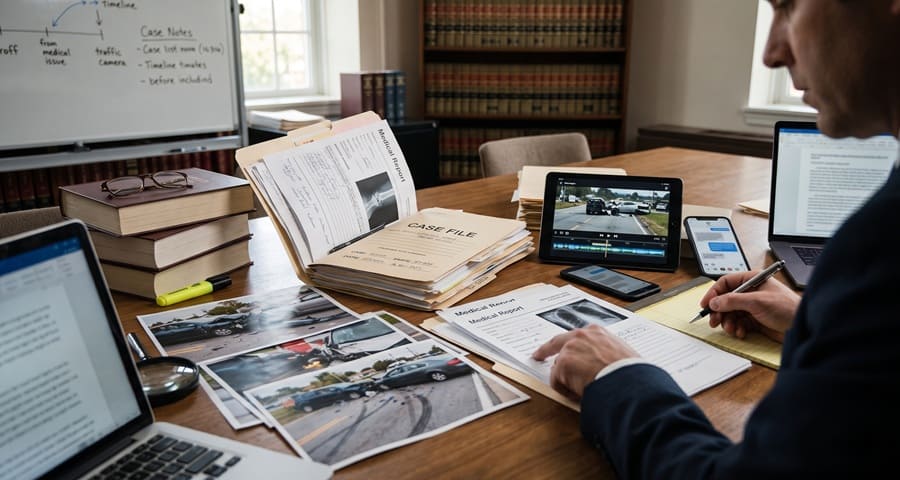
That is why evidence, not emotion, sits at the center of every strong claim. At plaintiff firms such as Singleton Schreiber, much of the early work in a serious case goes into locking down records, footage, and expert findings before they disappear or get explained away. The rest of this guide walks through the categories of proof that tend to move a serious personal injury case from a disputed story into a documented, compensable loss, with notes on the California rules that shape each one.
Proving Who Was at Fault
Every negligence claim starts with liability. You have to show the other party owed you a duty of care, broke it, and caused your harm. The cleaner your proof on that first point, the less room an insurer has to shift blame onto you, which matters in California because each party’s share of fault reduces what they recover.
The strongest liability evidence tends to be the kind no one can argue with later. Police and incident reports create an official record of the scene. Traffic camera video, business surveillance, and dashcam clips capture what actually happened, though much of that footage is recorded over within days. Photos of the vehicles, the hazard, or your injuries freeze details before anyone cleans up or repairs them.
In serious crashes, an accident reconstruction expert can pull data from a vehicle’s event data recorder to pin down speed, braking, and the force of impact. In California, that data belongs to the vehicle’s owner: under Vehicle Code section 9951, it can generally be retrieved only with the registered owner’s consent or a court order. When the other vehicle belongs to a company or a carmaker holds the data, a written preservation demand and, if needed, a court order are what keep it from being overwritten. If a party willfully suppresses evidence, Evidence Code section 413 lets the jury consider that against them.
When the Data the Defense Said Didn’t Exist Turned Up
One case on the firm’s published results page shows how much can turn on a single piece of electronic evidence. A 2019 nighttime crash in the Florida Keys killed a 22-year-old woman and seriously injured her boyfriend after a car operating on a driver-assist system ran through an intersection. For years, the automaker said key crash data could not be found. The plaintiffs hired a forensic data expert who recovered it, showing the company’s own systems had recorded the moments before impact. In August 2025, with the author as lead trial counsel, a federal jury in Miami found the automaker partly responsible and awarded $243 million. The company said it would appeal.
The lesson for any serious case is practical: assume the evidence exists until someone proves it doesn’t, demand that it be preserved early, and be prepared to bring in an expert who can find it. Past results do not guarantee a similar outcome, and every case turns on its own facts.
Linking the Injury to the Crash
Insurers scrutinize the connection between the accident and your medical condition, so this is often where cases are won or lost. Prompt treatment matters. Emergency room notes, ambulance records, and early imaging like X-rays, MRIs, and CT scans show the injury appeared right away rather than weeks later.
Consistency matters just as much. Ongoing treatment plans, specialist visits, and therapy logs show you followed medical advice instead of letting gaps form. Some of the most serious harm is also the hardest to see on a scan, and documenting brain injuries, whiplash, or other soft-tissue damage often takes careful symptom tracking and specialized evaluation to make the loss visible. This overview of medical evidence in personal injury claims covers which records carry the most weight.
Putting a Number on the Harm
Physical suffering has to be translated into dollars, and that takes paperwork. The economic side of a claim rests on tangible records, and a few categories do most of the work:
- Medical costs: Itemized hospital bills, pharmacy receipts, and invoices for equipment or therapy. In California, past medical damages are generally limited to what was actually paid or still owed, not the full amount billed, under the state Supreme Court’s decision in Howell v. Hamilton Meats. Payment records and insurer explanations of benefits matter as much as the bills themselves.
- Lost income: Pay stubs, employer letters, and tax returns that show missed work or reduced hours.
- Out-of-pocket expenses: Mileage to appointments, home modifications, and other costs the injury forced on you.
For catastrophic injuries that limit a career for good, a forensic economist and a life-care planner often calculate future medical needs and lost earning capacity, so the settlement reflects the whole arc of the loss rather than just today’s bills. This guide to the role of expert witnesses in personal injury cases explains how those experts are used.
The Human Side of the Record
Numbers and reports establish the skeleton of a case, but they rarely capture what an injury does to a life. That is where corroborating accounts come in. Neutral eyewitnesses who saw the incident and have nothing to gain carry real weight on questions of fault.
A daily journal tracking pain, lost sleep, and the activities you can no longer manage turns vague suffering into a concrete timeline. Statements from family, friends, and coworkers describe the before and after in plain terms, and in the most serious cases, a short “day in the life” video can show a jury what words cannot. Expert witnesses then tie it together, explaining a long-term prognosis or lost earning power in language a jury or adjuster can follow.
The same record can cut the other way. Insurers routinely review public social media, and a single photo can be used to argue an injury is less serious than claimed. Keep posting to a minimum while a claim is open.
Deadlines That Cut Off Evidence and Claims
Evidence has a shelf life, and so does the right to use it. Under Code of Civil Procedure section 335.1, most California personal injury lawsuits must be filed within two years. If a city, county, or other public agency is involved, such as a dangerous roadway or a government vehicle, Government Code section 911.2 generally requires a written claim to the agency within six months. Waiting until near either deadline also means the footage, vehicle data, and witness memories may already be gone.
Conclusion
A serious personal injury case is really a contest of documentation. The side with the clearer, more complete, and harder-to-dispute record usually controls the outcome, whether the claim settles across a conference table or goes the distance in court.
If you have been badly hurt, the most useful move is to start preserving proof early and get experienced legal advice before memories fade, footage is erased, or deadlines pass. Evidence gathered in time is what gives your story the weight it deserves.
Disclaimer: This article provides general information about personal injury evidence and California law and is not legal advice. Reading it does not create an attorney-client relationship. Laws and deadlines change, and exceptions apply, so speak with a licensed attorney about your situation. The case described above is drawn from the firm’s published results and public court reporting. Past results do not guarantee a similar outcome in any future matter.