
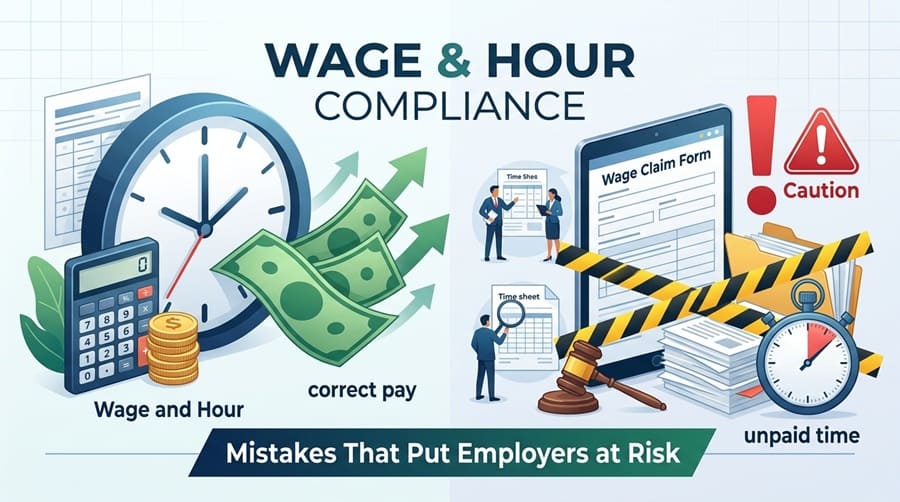
Wage and hour law sounds straightforward until a business actually has to apply it across a real workforce with different roles, shifts, and pay structures. Overtime rules, classification standards, and recordkeeping requirements all carry specific technical definitions, and small missteps in any of them can snowball into a Department of Labor audit or a class-action claim. Many employers only discover the gap in their practices after a complaint has already been filed, often prompting them to bring in a labor defense attorney to assess the damage and respond. Understanding where these mistakes typically occur can help a business catch problems before they lead to litigation.
Misclassifying Employees as Exempt
One of the most common and costly mistakes involves treating employees as exempt from overtime when they don’t actually meet the legal criteria. Exempt status isn’t just about job title or salary level — it depends on the employee’s actual duties meeting specific tests under federal and state law. A manager title alone doesn’t make someone exempt if their day-to-day work doesn’t involve the kind of independent judgment or supervisory authority the law requires.
Businesses that assign exempt status based on convenience or industry norms, rather than a careful duties analysis, often end up owing back pay once a misclassification is identified. Because these claims frequently involve multiple employees in similar roles, they tend to grow into larger, more expensive disputes than a single individual complaint.
Miscalculating the Regular Rate of Pay
Overtime pay isn’t simply time and a half of an employee’s base hourly wage. The regular rate of pay used to calculate overtime has to include most forms of compensation, including certain bonuses, commissions, and shift differentials. Employers who calculate overtime using only base pay, while leaving out these other components, frequently underpay employees without realizing it.
This mistake tends to compound over time, since it usually isn’t a single missed calculation but a pattern built into payroll systems that repeats every pay period until someone catches it.
Treating Independent Contractors as a Default Category
Classifying workers as independent contractors can reduce payroll tax obligations and administrative overhead, which makes it an appealing option for many growing businesses. The problem is that contractor status depends on the actual working relationship, not on what a contract calls someone. Factors like how much control the business exercises over the work, whether the role is central to the business, and how the worker is paid all factor into whether the classification holds up.
Misclassified contractors can be entitled to back overtime, benefits, and other protections retroactively, and these cases often draw scrutiny from both state agencies and the Department of Labor simultaneously.
Off-the-Clock Work That Goes Unpaid
Requiring or allowing employees to perform work before clocking in, after clocking out, or during unpaid breaks is a persistent source of wage claims, particularly in retail, hospitality, and healthcare settings. This often happens informally — an employee answering a quick email at home, finishing a task after their shift ends, or being interrupted during an unpaid lunch break. Even small amounts of off-the-clock work, multiplied across a workforce and a period of years, can add up to significant liability.
Inadequate Timekeeping and Recordkeeping
Federal and state law require employers to maintain accurate records of hours worked, and gaps in that documentation create real exposure. When a wage dispute arises and an employer’s records are incomplete, courts and agencies often give more weight to the employee’s account of hours worked, since the employer bears the responsibility for accurate recordkeeping. Businesses relying on outdated timekeeping systems, informal tracking methods, or manager estimates instead of verified records are particularly vulnerable when a dispute escalates.
Applying the Wrong Overtime Threshold Across State Lines
Businesses operating in multiple states face an added layer of complexity, since state overtime and minimum wage rules can be stricter than federal law and vary significantly from one jurisdiction to the next. A pay practice that complies with federal standards may still violate a specific state’s requirements. Employers who apply a single, uniform policy across all locations without adjusting for local law often find themselves out of compliance in ways they didn’t anticipate.
Responding to a Complaint or Audit
Even businesses that take compliance seriously can end up facing a wage and hour complaint, an internal audit request, or a Department of Labor investigation. How an employer responds in those early stages often shapes the outcome. Missteps like providing incomplete records, making informal statements to investigators, or missing response deadlines can turn a manageable situation into a much larger liability. This is typically the point where employers bring in a labor defense attorney, both to manage communication with investigating agencies and to build a defense strategy around the specific facts of the case.
Building Better Practices Before a Claim Arises
The most effective way to reduce wage and hour exposure is a periodic internal audit of classification decisions, pay calculations, and timekeeping practices, ideally before a complaint forces the issue. Many businesses find it useful to have a labor defense attorney review policies proactively, since catching a classification error or a payroll miscalculation internally is far less costly than defending it after a claim has already been filed. Wage and hour law changes regularly at both the state and federal level, and practices that were compliant a few years ago may no longer hold up under current standards.