

By Crymes M. Pittman, Partner, Pittman, Roberts & Welsh, PLLC
Last reviewed: September 2026
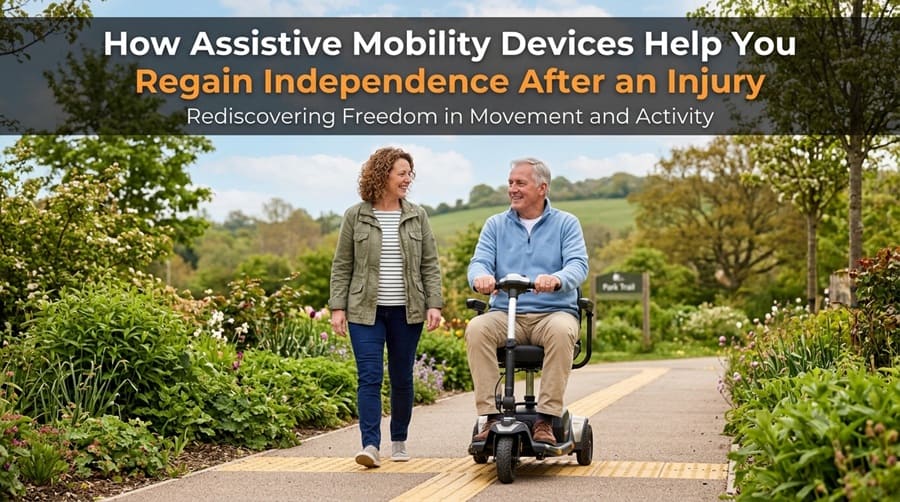
An injury, illness, or age-related change to your mobility can turn routine tasks into real obstacles. Grocery shopping, walking through your own home, visiting friends, or getting to a medical appointment may suddenly require planning and help from someone else. Assistive mobility devices exist to close that gap. Used correctly, they make movement safer and less physically demanding, and they hand a measure of freedom back to the person using them.
The category runs from simple equipment like canes and crutches to more advanced options like rollators, wheelchairs, and mobility scooters. Which one fits depends on the person’s physical abilities, their day-to-day environment, and what they’re trying to accomplish. Selected and used correctly, these devices support real independence rather than just compensating for a limitation.
Understanding Assistive Mobility Devices
Assistive mobility devices help people move when balance, strength, or endurance make walking difficult on its own. Some devices add stability; others shift weight away from an injured or weakened part of the body. A cane offers light support for someone with a relatively minor balance issue. A wheelchair fits someone who can’t walk safely, or for long stretches, on their own. In between are walkers, rollators, and transfer devices, each suited to a different level of need.
The CDC’s STEADI initiative, developed to reduce fall-related injuries among older adults, treats proper device selection and fit as a core part of fall prevention — not an afterthought. An improperly sized or adjusted device can do the opposite of its job, making movement less stable rather than more. A physical therapist, occupational therapist, or physician can evaluate gait, strength, and home layout to recommend the right device and confirm it’s fitted correctly.
Making Everyday Activities More Achievable
The clearest benefit of mobility equipment is that it makes ordinary tasks possible again. Someone who struggles to walk unassisted may find it hard to move safely around their own home. A rollator or walker can change that, turning a room-to-room trip from a risk into a routine.
That shift matters beyond convenience. Getting dressed, preparing a meal, getting to the store, or making it to a medical appointment without waiting on someone else’s schedule restores a piece of daily autonomy that’s easy to take for granted until it’s gone.
Independence at Home
The home itself is often where mobility limitations show up first. Slick flooring, stairs without handrails, bathrooms with no support, and narrow hallways all create hazards for someone with limited mobility. Mobility devices help, but they usually work best paired with changes to the space itself.
Grab bars, shower seats, stair lifts, ramps, and better lighting all complement a mobility aid rather than replace it. Doorways matter more than people expect: under the ADA Standards for Accessible Design, a compliant doorway provides at least 32 inches of clear width — a useful benchmark even in a private home, since a standard wheelchair typically needs 26 to 28 inches just to clear the frame. Widening a single doorway or adding a threshold ramp can open up an entire section of a house that was otherwise off-limits.
Getting a Mobility Device: What to Know
Cost is often the first question people ask, and it’s a fair one. For Medicare beneficiaries, canes, walkers, and wheelchairs generally qualify as durable medical equipment (DME) under Medicare Part B when a doctor documents medical necessity and prescribes the specific device. Power wheelchairs and scooters carry a stricter standard: Medicare generally won’t cover one unless the person can’t safely use a cane, walker, or manual wheelchair, and the device is needed for use inside the home, not just outside it. Private insurance plans vary, but many follow a similar prescription-and-documentation model.
Getting the paperwork right on the front end — a clear diagnosis, a documented functional limitation, and a specific device recommendation from a treating provider — tends to prevent the coverage denials and delays that otherwise slow this process down.
Better Access to Community and Work
Independence isn’t confined to the house. Being able to work, attend classes, see family, or take part in community life affects quality of life just as much as getting around at home does. Wheelchairs, scooters, and other devices extend how far someone can go without exhausting themselves in the process.
Accessible transportation — public transit, paratransit services, or a vehicle modified for a specific disability — often determines whether those opportunities are actually reachable. Combined with the right mobility device, it lets someone keep working, stay social, and stay connected to their community instead of scaling life back to fit around a limitation.
Minimizing Physical Strain
Walking with an unaddressed mobility limitation is exhausting in a way that’s hard to appreciate until you’ve lived with it, whether the cause is a chronic condition or a recent injury. Every trip across a room can turn into overexertion.
A properly selected device redistributes that effort. Crutches take weight off an injured leg; a walker widens the base of support and reduces the balance work the body has to do on its own. Less physical strain means more energy left over for everything else in the day — which matters most during rehabilitation, when regaining mobility is itself the goal.
Mobility Devices After an Injury
Injuries can affect a person’s ability to move independently, sometimes temporarily and sometimes permanently. Spinal injuries, serious soft tissue damage, traumatic brain injuries, and fractures can all create real mobility challenges during recovery, and a mobility aid often bridges the gap while the body heals. Someone recovering from a leg injury, for example, might move from crutches to a cane before walking independently again.
When the injury happened because of someone else’s negligence, the practical costs stack up alongside the physical recovery: mobility equipment, ongoing medical treatment, rehabilitation, and lost income while the person is unable to work. People navigating that combination often benefit from talking with a personal injury attorney, such as the attorneys at Pittman, Roberts & Welsh, about their legal options — separate from the medical decisions their care team is helping them make.
How This Plays Out in Practice
The following is a composite illustration based on the type of situation personal injury attorneys commonly see when mobility loss follows an injury caused by someone else. Identifying details have been altered to protect confidentiality.
A warehouse worker suffered a serious leg injury when unsafe conditions at a job site caused a fall. Initial treatment addressed the physical injury, but the worker also needed a rollator for several months, followed by a cane during the later stages of recovery — equipment his health coverage only partially reimbursed. Because a third party’s negligence had caused the fall, an attorney was able to help him pursue compensation covering the mobility equipment, ongoing physical therapy, and the wages he lost while he couldn’t work, in addition to the underlying injury claim.
Pittman, Roberts & Welsh has represented clients in cases involving serious, mobility-altering injuries, including an oil field explosion that resulted in a client losing part of his leg — a case that resolved for $8,000,000. Cases like this one illustrate why mobility equipment and long-term rehabilitation costs are often a real part of what a personal injury claim needs to account for, not an afterthought to the medical treatment itself.
More Confidence and Self-Reliance
Physical independence and emotional independence aren’t really separate things. Losing the ability to move on your own terms can leave someone feeling vulnerable and dependent on the people around them. A well-fitted mobility device changes that equation. Being able to move from room to room without waiting for help restores a level of confidence that’s easy to underestimate until it’s been missing.
Disclaimer
This article is for general informational purposes only and does not constitute medical or legal advice. Always consult a qualified physician, physical therapist, or occupational therapist before selecting or using a mobility device. If your injury involves a potential legal claim, consult a licensed attorney in your state to discuss the specific facts of your situation.
Authorities & Sources
- 2010 ADA Standards for Accessible Design, § 404.2.3 — Minimum clear doorway width — U.S. Department of Justice
- CDC STEADI Initiative — Older Adult Fall Prevention — Centers for Disease Control and Prevention
- Medicare Coverage of Durable Medical Equipment & Other Devices — Medicare.gov