
By Beau Blackley, Partner, Blackley & Wingad, Attorneys at Law, PLLC | Salt Lake City, Utah | Last updated: October 2026
The short answer. An assault conviction can be appealed, but the appeal is not a second trial. A Utah appellate court looks only at the trial record and asks whether a legal error changed the result. The notice of appeal is due 30 days after the judgment is entered. Errors nobody objected to at trial face a much harder standard, and claims that depend on facts outside the record usually need a Rule 23B motion or a separate post-conviction petition.
Most people convicted of assault assume the appeal is about whether the jury got it wrong. It rarely is. Appellate judges do not hear witnesses, they do not reweigh credibility, and they rarely second-guess a jury’s choice between two believable stories. What they will do is check whether the jury was told the law correctly, whether evidence came in that should have stayed out, and whether the trial was fair in the ways the Constitution requires.
That narrow lens is why the most important appellate decisions often get made during trial, by whoever is (or isn’t) objecting.
How Many People Actually Appeal
Federal numbers give a sense of scale. In the 12 months ending March 31, 2025, the 12 regional federal courts of appeals received 40,612 new appeals, and 10,092 of them were criminal, a 7 percent jump over the prior year, according to the Administrative Office of the U.S. Courts.
Assault cases mostly live outside those figures. The vast majority are charged in state court, and in Utah that means simple assault under Utah Code § 76-5-102 or aggravated assault under § 76-5-103. When a Utah district court enters an assault conviction, the appeal ordinarily goes to the Utah Court of Appeals. The Utah Supreme Court takes direct criminal appeals only for first-degree and capital felonies, though it can move cases between the two courts.
An Appeal Reviews the Record, Not the Verdict
The federal judiciary’s own description of appeals is blunt: the appellant has to show the trial court made a legal error that affected the decision. There are no witnesses, no new exhibits, and no jury. Many appeals are decided on the written briefs alone, and when a court does hear oral argument, each side usually gets about 15 minutes.
So “the jury should have believed me” is not, by itself, an appellate issue. “The jury was never told the prosecution had to disprove self-defense” is. The work of an appeal is finding the second kind of problem in hundreds of pages of transcript and explaining why it mattered to the outcome.
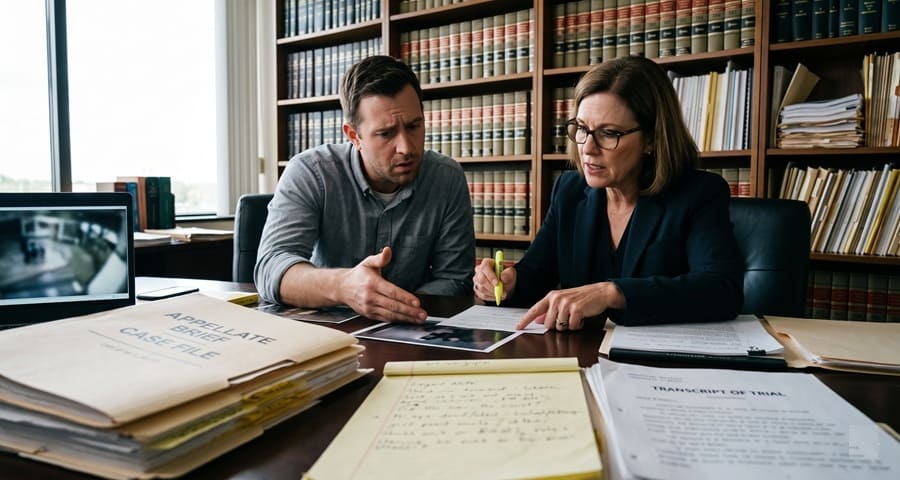
That is a different skill from trying a case, and it is why some Utah defense firms treat appellate review as separate work from trial defense. A criminal appeals lawyer usually starts by ordering the full transcript, docket, and exhibits, then reading the record for errors that were preserved, errors that were not, and gaps that point toward an ineffective-assistance claim.
Utah’s Deadlines Are Short and Mostly Unforgiving
Missing a filing deadline can end an appeal before anyone reads a word of the transcript. The key windows for a Utah assault conviction:
| Step | Deadline |
| Motion for a new trial | 14 days after sentence is imposed |
| Notice of appeal | 30 days after entry of judgment (a timely new-trial motion restarts the clock from the ruling on it) |
| Motion to remand for ineffective-assistance findings | Before or with the appellant’s opening brief |
| Reinstating a lost appeal | When the right was lost through no fault of the defendant |
| Post-conviction petition | Generally one year after the claim accrues |
| Federal criminal appeal (for comparison) | 14 days after entry of judgment |
Rule 4(f) is worth knowing about. If a trial lawyer promised to file an appeal and never did, Utah lets the defendant ask the trial court to restart the 30-day period. It is a safety valve, not a strategy, and the defendant still has to prove the lost appeal was not his or her fault.
Ordering transcripts and briefing take real time, which is also what drives most of the cost of an appeal. If you are comparing fee structures, this overview of what criminal lawyers typically charge explains the flat-fee and hourly models you are likely to see.
The Objection That Wasn’t Made
A strong appellate issue can be lost long before the verdict. When trial counsel does not object, Utah appellate courts generally treat the issue as unpreserved. The Utah Supreme Court reaffirmed in State v. Johnson, 2017 UT 76, that unpreserved issues get reviewed only through narrow exceptions, most often plain error or ineffective assistance of counsel.
Utah’s plain error test asks three things: Was there an error? Should it have been obvious to the trial judge? Was it harmful, meaning there is a reasonable likelihood of a better outcome without it? Federal courts add a fourth step under Rule 52(b) and United States v. Olano, asking whether the error seriously affects the fairness, integrity, or public reputation of judicial proceedings. Articles that quote only the federal version can mislead readers in state court.
Preservation even applies to the claim people expect to be automatic. In State v. Holgate, 2000 UT 74, the Utah Supreme Court held that a sufficiency-of-the-evidence challenge generally has to be raised in the trial court, usually by a motion to dismiss or for a directed verdict, or it is reviewed only for plain error.
Where Utah Assault Appeals Tend to Turn
Self-defense instructions
Self-defense is the defense raised most often in assault trials, and the jury instructions explaining it are a frequent source of reversible error. Under Utah Code § 76-2-402, a person generally has no duty to retreat from a place where he or she has a lawful right to be. Once the evidence supports self-defense, the defendant carries no burden to prove it; the prosecution has to prove beyond a reasonable doubt that the force was not justified, as Utah’s model instruction CR532 puts it.
Appellate questions follow directly from those rules. Did the judge give a self-defense instruction at all? Did the instruction, read alongside the elements instruction, make clear who carried the burden? Did it suggest a duty to retreat that Utah law does not impose? Utah also allows a pretrial justification hearing under § 76-2-309, where the prosecution must show by clear and convincing evidence that the force was not justified, so how that hearing was handled can become part of the record too.
Prior incidents and statements at the scene
Assault trials often involve two people with a history. Evidence of earlier fights or threats is governed by Utah Rule of Evidence 404(b), which bars using past conduct to show someone acted “in character” but allows it for other purposes such as motive or intent. Whether the trial court did the required analysis, and whether the jury was told how it could use that evidence, are common appellate issues. Many of these cases also carry a domestic violence designation, which adds its own consequences; this guide to defending domestic assault charges covers that side of things.
Statements the complainant made to responding officers raise two separate questions. One is hearsay, often argued under the excited-utterance or medical-diagnosis exceptions in Rule 803. The other is the Confrontation Clause. Under Davis v. Washington, statements made to resolve an ongoing emergency are usually admissible, while statements describing past events for investigative purposes may be testimonial and inadmissible if the speaker never testifies. Medical records offered without their author raise similar issues. Each of these generally needs a timely, specific objection to be reviewed on the regular standard.
Sufficiency of the evidence
Sufficiency challenges are the hardest to win. Under Jackson v. Virginia, the court views the evidence in the light most favorable to the verdict and asks whether any rational juror could have found every element proven beyond a reasonable doubt. Where these claims do succeed in assault cases, it is usually on a specific element: for example, whether an aggravated assault charge was proven when the State’s evidence of a dangerous weapon or the level of injury was thin.
When the Problem Isn’t in the Transcript
Some of the most serious claims cannot be proven from the record. A witness the defense never called, a plea offer that was never relayed, a self-defense instruction counsel chose not to request for reasons nobody wrote down: these turn on facts outside the trial transcript.
Ineffective-assistance claims are judged under Strickland v. Washington, which requires showing both deficient performance and prejudice. In federal court, the Supreme Court said in Massaro v. United States that these claims are usually better brought in a post-conviction motion than on direct appeal.
Utah handles this differently, and the difference matters. Rule 23B lets an appellant ask the appellate court to send the case back to the trial court to develop non-record facts that, if true, could show counsel was ineffective. The motion has to be supported by affidavits, must allege facts that are not speculative, and is generally due no later than the opening brief. Utah’s Post-Conviction Remedies Act also bars many claims that could have been raised on direct appeal (§ 78B-9-106), so waiting for post-conviction to raise something that belonged in the appeal can backfire.
Post-conviction relief has its own one-year limit under § 78B-9-107, which usually starts running after the appeal ends or after the time to appeal expires.
A Self-Defense Instruction Nobody Objected To
Blackley & Wingad reviewed the appeal of a Salt Lake County client convicted of aggravated assault after a parking-lot confrontation. The defense at trial was self-defense, and the judge gave a self-defense instruction. The problem was what the instruction left out. It described when force is justified but never told the jury that the prosecution had to disprove self-defense beyond a reasonable doubt, and trial counsel did not object.
Because there was no objection, the issue could not be argued as ordinary instructional error. The appeal had to frame it as plain error and, separately, as ineffective assistance of counsel. The transcript was silent on why trial counsel had not requested the burden language, so the firm supported a Rule 23B motion with a declaration addressing that gap. The case shows the pattern discussed above: the strongest issue in the file was one that had to be rebuilt through the narrower doors Utah law leaves open.
Questions People Ask After an Assault Conviction
Can I bring new evidence on appeal?
Not on a direct appeal. The appellate court is limited to the trial record. New facts generally come in through a Rule 23B remand (for ineffective-assistance claims) or a post-conviction petition.
If I win, is the case over?
Usually not. The most common remedy for a trial error is a new trial. Outright dismissal is more typical when the evidence was legally insufficient.
Should the appeal be handled by my trial lawyer?
It depends. A fresh set of eyes can spot problems the trial team cannot, and an attorney cannot easily argue his or her own ineffectiveness. On the other hand, trial counsel knows the case well. Many defendants have new counsel review the record before deciding.
Disclaimer
This article provides general information about Utah and federal criminal appeals and is not legal advice. Reading it does not create an attorney-client relationship. Appellate deadlines are strict and depend on the facts and procedural history of each case, so anyone considering an appeal should speak with a licensed Utah attorney promptly. Past results do not guarantee a similar outcome.