
By Jack D. Edwards, Founder, Edwards Law Office, P.C. · Wyoming | Last reviewed: October 2026
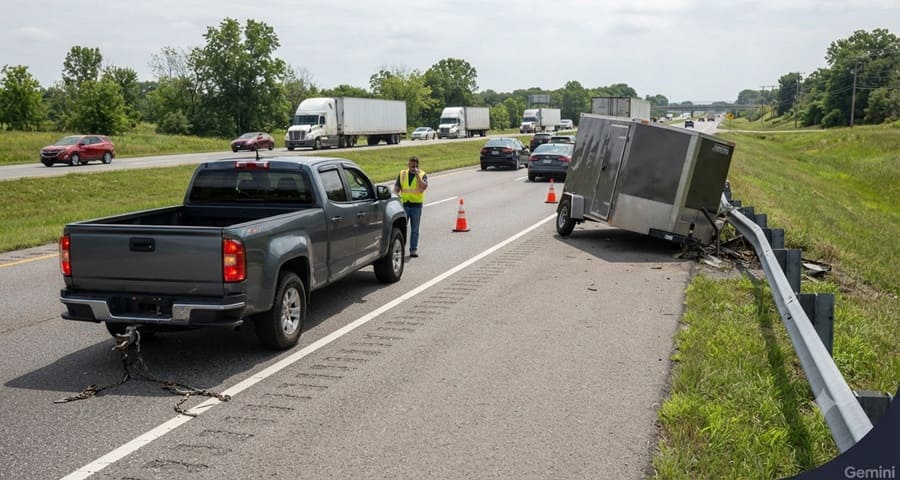
On Interstate 80 across southern Wyoming, a loaded semitrailer separates from its tractor on a downhill grade. For a few seconds, it keeps rolling at highway speed with no driver, no steering, and possibly no working brakes, drifting across lanes toward oncoming traffic.
Trailer separations are relatively rare, but when they happen, other drivers have almost no time to react. They are also among the most preventable truck crashes, because federal rules require specific equipment and inspections designed to stop a trailer from coming loose, and to stop it quickly if it does.
| Failure point | What is supposed to prevent it | Federal rule |
| Fifth wheel not locked onto the kingpin | Locking mechanism that holds until a positive manual release | 49 C.F.R. § 393.70 |
| Coupling missed or done wrong | Driver’s pre-trip inspection and coupling check | 49 C.F.R. § 396.13 |
| Worn jaws, kingpin, or mounting bolts | Systematic inspection, repair, and maintenance | 49 C.F.R. § 396.3 |
| Trailer rolling free after separation | Breakaway brakes that apply automatically for at least 15 minutes | 49 C.F.R. § 393.43 |
| Full trailer or dolly tow-bar failure | Safety chains or cables strong enough to hold the towed weight | 49 C.F.R. § 393.70 |
How a Semitrailer Is Supposed to Stay Attached
A semitrailer connects to the tractor through the fifth wheel, the horseshoe-shaped plate on the tractor, and the kingpin, a steel pin under the front of the trailer. When the trailer is backed in correctly, the fifth wheel’s jaws close around the kingpin and lock. Under 49 C.F.R. § 393.70, every fifth wheel must have a locking mechanism that prevents separation unless a positive manual release is activated, and the lower half must be securely mounted to the tractor frame.
Full trailers and converter dollies, common in double and triple combinations, connect differently, through a tow-bar and pintle hook. For those, the same rule requires safety chains or cables strong enough to hold the full weight of the towed unit and keep the tow-bar from dropping to the ground if the main connection fails.
Common Causes of Trailer Separation
High hitch and missed coupling
One of the most frequent errors is a “high hitch,” where the kingpin rides above the jaws instead of locking into them. The trailer may seem connected in the yard and then drop off at the first bump or hard turn. A proper coupling includes a tug test against the trailer brakes and a visual check that the jaws have closed around the kingpin shank and the release handle is in the locked position.
Worn or damaged components
Fifth-wheel jaws wear over time. Kingpins can wear, bend, or crack. Mounting bolts loosen, and the plate can crack. These parts carry tremendous loads, and small amounts of wear can let the jaws release under stress.
Skipped inspections
Under 49 C.F.R. § 396.13, drivers must be satisfied that the vehicle is in safe operating condition before driving and must review and sign the previous inspection report when required. Carriers must systematically inspect, repair, and maintain their equipment and keep records under 49 C.F.R. § 396.3. Delivery pressure can push drivers and carriers to skip those steps.
Wind and road conditions
In Wyoming, high crosswinds regularly overturn and damage high-profile trailers on I-80 and I-25, and WYDOT frequently closes stretches of interstate to light, high-profile vehicles during wind events. Strong wind can stress a coupling and contribute to a separation or rollover, especially with an empty or lightly loaded trailer. Driving into posted closures or advisories can itself be evidence of negligence.
Why Breakaway Brakes Matter
Federal rules anticipate that a trailer may separate anyway. Under 49 C.F.R. § 393.43, trailers required to have brakes must have brakes that apply automatically and immediately if the trailer breaks away from the towing vehicle, and they must stay applied for at least 15 minutes. With air brakes, a separation that ruptures the air lines should trigger the trailer’s spring brakes.
When a trailer rolls on after separating, a key question is why its brakes did not stop it: poor maintenance, out-of-adjustment brakes, a defective valve, or air lines that did not separate the way they should have. That question can expand the case to include a maintenance shop or a component manufacturer.
Secondary Crashes
A runaway trailer does not have to hit anyone to cause harm. Drivers who swerve to avoid it can hit guardrails, other vehicles, or each other. Under ordinary negligence principles, the party responsible for the separation can be liable for those secondary crashes if they were a foreseeable result.
Who May Be Responsible
Responsibility depends on why the trailer came loose. Potential defendants include:
- the driver, for a faulty coupling or a missed pre-trip inspection;
- the motor carrier, for poor maintenance, inadequate training, or pressure to skip inspections;
- a trailer owner or leasing company that was responsible for maintenance;
- a repair shop, for improper work on the fifth wheel, kingpin, or brakes; and
- a manufacturer, if a fifth wheel, kingpin, or brake component was defective.
FindAttorneys.org’s overview of the major causes of truck accidents covers how equipment failures fit among other trucking crash causes.
Evidence That Answers “Why Did It Come Loose?”
Trailer separation cases are won or lost on physical evidence, and much of it is controlled by the trucking company. Investigators typically need:
- the tractor and trailer themselves, preserved before repair, especially the fifth wheel, kingpin, jaws, mounting, air lines, and brakes;
- driver vehicle inspection reports and maintenance and repair records;
- engine and telematics data showing speed and braking before separation;
- dash camera footage and electronic logging device records; and
- scene photographs, including where the trailer came to rest and any marks it left.
Because equipment can be repaired and returned to service quickly, a written preservation demand sent early is often essential. FindAttorneys.org’s guide to evidence that strengthens a commercial vehicle accident claim explains the broader set of trucking records. Lawyers handling these claims, such as those at Edwards Law Office, P.C., typically arrange for a qualified engineer to inspect the coupling and brake components before anything is altered.
A Wyoming Trucking Recovery
Edwards Law Office’s published case results include a $450,000 settlement for a person injured in a trucking case and a $1.8 million wrongful death settlement against a commercial trucking company whose driver fell asleep at the wheel. The listings do not describe trailer separations, so they are offered only as examples of the commercial trucking claims where equipment, inspection, and driver records come into play.
Prior case results do not guarantee a similar outcome.
Wyoming Deadlines and Fault Rules
In Wyoming, most personal injury claims must be filed within four years under Wyo. Stat. § 1-3-105, while wrongful death claims must be filed within two years of the death under Wyo. Stat. § 1-38-102. Wyoming uses modified comparative fault (Wyo. Stat. § 1-1-109): an injured person recovers nothing if found more than 50% at fault, and lower fault reduces the award. The Wyoming Constitution prohibits caps on damages for injury or death. Other states have different deadlines and fault rules.
Frequently Asked Questions
What should stop a trailer that comes loose?
Federal rules require breakaway brakes that apply automatically when a trailer separates and stay applied for at least 15 minutes. Full trailers also need safety chains or cables.
Who is liable if a trailer detaches?
It depends on the cause. The driver, the trucking company, a maintenance shop, a trailer owner, or a parts manufacturer may share responsibility.
What is a high hitch?
It is a coupling error where the kingpin sits above the fifth-wheel jaws instead of locking into them, so the trailer can drop free once the truck is moving.
How long do I have to file a truck accident claim in Wyoming?
Generally four years for personal injury and two years for wrongful death, but deadlines differ in other states and for claims against government entities.
Authorities & Sources
- 49 C.F.R. § 393.70: Coupling devices and towing methods
- 49 C.F.R. § 393.43: Breakaway and emergency braking
- 49 C.F.R. § 396.13: Driver inspection before driving
- 49 C.F.R. § 396.3: Inspection, repair, and maintenance
Disclaimer
This article provides general information about trailer separation crashes and trucking safety rules. It is not legal advice, and reading it does not create an attorney-client relationship. Laws differ by state and change over time, and every case depends on its own facts. Anyone injured in a truck crash should speak with a licensed attorney in the state where it occurred.