
By Aaron Sachs, Esq. | Missouri Personal Injury Attorney | Last reviewed: October 2026
Quick answer: A crash involving a Missouri state, city, county, or transportation-related vehicle is not handled exactly like an ordinary private-driver claim. Missouri generally preserves sovereign immunity for public entities, but § 537.600 creates important exceptions, including negligent operation of motor vehicles by public employees acting within the course of employment. As of August 28, 2026, the statute also expressly includes certain agents of the Missouri Department of Transportation. Damage caps, insurance rules, accident-date law, and entity-specific notice requirements can all affect the claim.
A collision with a private driver usually starts with familiar questions: who violated the rules of the road, what insurance applies, and what injuries resulted. Replace that driver with a city utility employee, state worker, county employee, or MoDOT-related operator and another question comes first: does Missouri law permit the public-entity claim at all?
That threshold issue matters because sovereign immunity can change who may be sued, the legal theory that must be pleaded, the maximum amount recoverable from a public entity, and which version of the statute applies based on the accident date.
Missouri Starts With Sovereign Immunity, Then Creates Exceptions
Missouri Revised Statute § 537.600 preserves sovereign or governmental tort immunity except where the General Assembly has waived it. For roadway injuries, two exceptions are especially important.
- Motor-vehicle exception: injuries directly resulting from negligent acts or omissions involving the operation of motor vehicles or motorized vehicles by public employees acting within the course of employment. The current 2026 statute also includes an agent of the Missouri Department of Transportation within the specified language.
- Dangerous-condition exception: injuries caused by a dangerous condition of public property when the claimant can prove the statutory elements, including causation, foreseeable risk, and qualifying creation or notice of the dangerous condition.
These are different theories. A city employee who runs a red light in a government truck presents a motor-vehicle-negligence question. A crash allegedly caused by an unsafe public roadway, missing barrier, or dangerous public-property condition raises a different statutory analysis.
What Changed on August 28, 2026?
Missouri Senate Bill 916 took effect on August 28, 2026. The enacted version amended § 537.600 so the motor-vehicle waiver now refers not only to public employees but also to an agent of the Missouri Department of Transportation in the statutory circumstances. Missouri Senate SB 916 bill information
The amendment also created statutory causes of action involving certain MoDOT agents and displaced some common-law claims against private contractors, subcontractors, engineers, or their employees for specified design, condition, or maintenance claims connected with MoDOT projects. The exact effect depends on the type of claim and when the project work occurred.
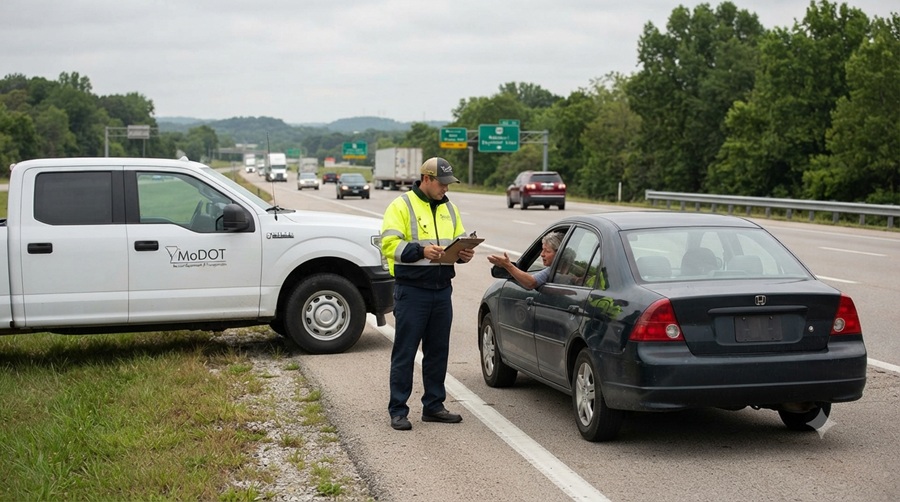
That is why a vehicle with a MoDOT logo, contractor markings, or highway-project connection does not answer the liability question by itself. The investigation may need to determine who employed the driver, who controlled the work, whether the person qualifies as a MoDOT agent under the statute, and whether the accident occurred before or after the 2026 amendment took effect.
The Accident Date Can Change Which Law Applies
SB 916 became effective on August 28, 2026. An accident on August 27 and an otherwise similar accident on August 29 may therefore require analysis under different statutory language. The same accident-date principle matters for Missouri’s annually adjusted sovereign-immunity limits.
The 2026 version of § 537.610 provides that the applicable cap is the limitation in effect on the date of the accident or occurrence giving rise to the claim. Older accidents should not automatically be evaluated using current published limits.
Missouri Public-Entity Claims Have Statutory Damage Limits
Missouri adjusts its sovereign-immunity limits annually for inflation. The Missouri Register published the 2026 amounts as $532,148 for any one person and $3,547,658 for all claims arising from a single accident or occurrence.
These caps can matter most in catastrophic or multi-victim crashes. A claimant may prove damages exceeding the statutory limit without necessarily being able to collect the full amount from the public entity. Section 537.610 also bars punitive or exemplary damages on claims within the sovereign-immunity framework.
Insurance Does Not Automatically Eliminate Sovereign Immunity
Section 537.610 allows Missouri and political subdivisions to purchase liability insurance, but the statute controls the extent to which insurance operates as a waiver. The 2026 amendment clarifies that, for political subdivisions, a qualifying “purchase” means direct acquisition of coverage by the governing body and does not include indirect arrangements such as merely requiring another person or contractor to name the public entity as an additional insured.
That distinction matters in contractor-heavy transportation projects. A contractor can have substantial liability coverage without automatically proving that the government entity waived immunity for every theory in the case.
Who Can Be a Defendant After a Government-Related Crash?
A public-entity accident can involve more than one legally relevant party. Depending on the facts, the investigation may examine:
- the public entity that employed the driver;
- the individual driver and whether the driver was acting within the course of employment;
- a MoDOT agent covered by the 2026 statutory language;
- a private contractor, subcontractor, engineer, or employer involved in transportation-project work;
- another private motorist who contributed to the collision; and
- a separate dangerous-condition theory involving public property.
The legal position of those parties may differ. One defendant may be subject to sovereign-immunity rules while another is governed by ordinary negligence and insurance law.
Missouri Risk Management Handles State Auto Claims
For accidents involving Missouri state vehicles, the Office of Administration Risk Management section administers bodily-injury and property-damage claims arising from negligent operation of state vehicles within the course of public employment. The state’s driver guidance instructs state employees to report crashes and preserve information such as police details, witnesses, and vehicle facts.
A claimant should not assume that the internal state accident-reporting procedure replaces every legal filing, notice, or lawsuit requirement. It is an administrative claims process, while statutes and court rules still govern legal rights and deadlines.
How Long Do You Have to Bring a Missouri Claim?
Missouri generally provides a five-year limitations period for many personal-injury actions under § 516.120. But a government-related injury should never be evaluated by the general five-year rule alone.
Some public-entity theories carry much shorter notice requirements. For example, Missouri § 82.210 requires written notice to the mayor within 90 days for certain injury claims against cities with populations of at least 100,000 when the injury grows out of a defect in a bridge, boulevard, street, sidewalk, or thoroughfare. The U.S. Census Bureau estimated Springfield’s 2025 population at 169,847, so a Springfield dangerous-street theory may raise that statute. The notice rule is not a universal 90-day deadline for every government-vehicle crash, however; its application depends on the defendant and legal theory.
Missouri Revised Statute § 82.210 | U.S. Census Bureau QuickFacts: Springfield, Missouri
Missouri Uses Pure Comparative Fault
Missouri follows pure comparative fault in negligence cases. The Missouri Supreme Court adopted that system in Gustafson v. Benda, and Missouri’s approved jury-instruction commentary explains that a claimant’s fault reduces recovery in proportion to the percentage of fault rather than operating as an automatic complete bar when comparative fault is supported by the evidence.
So even in a government-vehicle claim, the public entity can dispute how much of the crash was caused by the injured person, another driver, or another responsible party. Sovereign immunity and comparative fault are separate questions: first the claim must fit a recognized waiver, and then ordinary negligence and fault issues still have to be proved.
Evidence to Preserve After a Government Vehicle Crash
- the police crash report and the government vehicle’s unit, plate, agency, or department information;
- photographs of vehicle markings, work-zone signs, cones, traffic-control devices, and road conditions;
- names, job titles, employers, and contact information for drivers and witnesses;
- dash-camera, body-camera, fleet-camera, business-surveillance, or traffic-camera footage;
- dispatch records, work orders, route assignments, maintenance records, and project documents when relevant;
- medical records, bills, rehabilitation records, and future-care recommendations;
- wage and employment records supporting lost-income or earning-capacity claims; and
- all letters, emails, claim forms, and communications from the agency, Risk Management, insurer, or contractor.
Government and contractor records can be harder to reconstruct after time passes, particularly when several entities participated in the project or vehicle operation. Identifying the correct agency and preserving evidence early can be as important as proving how the collision occurred.
When the vehicle owner, driver’s employment status, MoDOT relationship, insurance arrangement, or applicable notice rule is unclear, a Springfield accident attorney may review the crash report, agency records, contract relationships, and applicable Missouri statutes before a claimant signs a release or assumes the case works like an ordinary private-auto claim. That review is most useful when it focuses on identifying the correct defendant and legal theory rather than simply negotiating with an insurer.
First-Party Case Result: What It Can – and Cannot – Show
Aaron Sachs & Associates publishes a $6 million court-approved settlement for an anonymized client involved in a semi-truck accident. The firm’s public results page does not identify the case as involving a government vehicle, public entity, or sovereign-immunity issue, so it would be inaccurate to present it as a government-vehicle precedent.
Its limited relevance here is practical: serious vehicle claims can require substantial investigation, damages documentation, and identification of every available source of recovery. A public-entity case adds a further layer because statutory immunity, damage caps, and government-specific procedures may apply before the ordinary negligence questions are reached.
Source: Aaron Sachs & Associates case results. Past results do not guarantee a similar outcome.
Related reading: 5 Key Ways Missouri Car Accident Lawyers Protect Your Claim Against Insurance Adjusters and What Should Injury Victims Know Before Contacting a Car Accident Lawyer?.
Questions to Ask After a Missouri Government Vehicle Accident
- Who owned the vehicle, and which agency, city, county, contractor, or employer controlled the driver?
- Was the driver acting within the course of public employment or qualifying MoDOT work?
- Did the accident occur before or after August 28, 2026?
- Is the claim based on negligent vehicle operation, a dangerous condition of public property, or both?
- Does a special notice statute apply before the ordinary limitations period expires?
- What sovereign-immunity cap was in effect on the date of the accident?
- Is there a private contractor or other motorist whose liability is not limited in the same way?
- What insurance or self-insurance applies, and does it actually waive immunity under § 537.610?
- What government records, contracts, video, or project documents should be preserved immediately?
Frequently Asked Questions
Can I sue Missouri if a state employee hits me with a government vehicle?
Potentially. Section 537.600 waives sovereign immunity for injuries directly resulting from negligent operation of a motor vehicle by a public employee acting within the course of employment. The facts still must satisfy the statute, and damage limits and procedural rules can apply.
Did Missouri change its sovereign-immunity law in 2026?
Yes. Senate Bill 916 took effect August 28, 2026, and amended § 537.600 and § 537.610, including new language involving agents of the Missouri Department of Transportation and political-subdivision insurance.
What are Missouri’s 2026 sovereign-immunity damage limits?
The Missouri Register published 2026 limits of $532,148 for any one person and $3,547,658 for all claims arising from a single accident or occurrence. The applicable cap is tied to the date of the accident or occurrence.
How long do I have to sue after a Missouri government vehicle accident?
Missouri generally uses five years for many personal-injury actions, but government-related claims can have shorter notice requirements depending on the defendant and theory. A dangerous-street claim against certain cities, for example, can trigger a 90-day notice statute.
Does government insurance mean sovereign immunity is waived?
Not automatically. Section 537.610 controls when the purchase of insurance waives immunity. The 2026 version also clarifies that certain indirect additional-insured arrangements do not count as a political subdivision’s purchase of coverage.
What if a private MoDOT contractor caused the crash?
The answer can depend on the type of work, agency relationship, accident date, and the 2026 statutory changes. SB 916 created new statutory rules involving MoDOT agents and certain project-related claims, so contractor cases require careful classification.
Can I recover if I was partly at fault?
Potentially. Missouri uses pure comparative fault in negligence cases, so a claimant’s proven percentage of fault generally reduces the recovery rather than automatically eliminating it. Sovereign-immunity limits can still separately restrict the amount recoverable from a public entity.
Disclaimer
This article is for general educational purposes and is not legal advice. Missouri sovereign-immunity law is highly fact-specific, and the correct analysis can depend on the identity of the public entity, the driver’s employment or agency relationship, the accident date, insurance arrangements, notice statutes, and the legal theory asserted. Reading this article does not create an attorney-client relationship. Anyone dealing with a serious government-vehicle or public-property claim should confirm the law and deadlines that apply to the specific facts.