

By Elliot Singer, Founding Attorney, Conduit Law
Updated September 2026 · 5 min read
Key Takeaways
- Thorough medical documentation is the foundation of any spinal injury claim in Denver — it proves severity, treatment, and long-term impact.
- Claimants may recover economic damages, non-economic damages such as pain and suffering, and, in egregious cases, exemplary damages.
- Colorado’s filing deadlines and comparative fault rules make early legal guidance from a spinal injury attorney a practical advantage.
Introduction
Spinal injuries are among the most severe traumas a person can suffer, and their consequences — paralysis, chronic pain, lost mobility — often last a lifetime. In Denver, the strength of a compensation claim rests on two things: complete medical documentation and a careful accounting of damages. Whether the injury came from a car crash, a fall, or a workplace incident, understanding how the claim process works makes a real difference for victims and their families.
The stakes are high. Victims face ongoing treatment, lost income, emotional distress, and permanent changes to daily life. The quality of the medical evidence largely determines whether compensation reflects those realities or falls short of them.
Anyone dealing with a spinal injury in Denver should understand the legal standards that apply, the categories of damages available, and the records a successful claim requires. Colorado’s deadlines add urgency: most personal injury claims must be filed within two years (C.R.S. § 13-80-102), extended to three years when the injury arises from a motor vehicle accident (C.R.S. § 13-80-101(1)(n)).
For medical background on spinal cord injuries — mechanisms, treatment, and long-term prognosis — the National Institute of Neurological Disorders and Stroke publishes a detailed, plain-language overview.
The Importance of Medical Documentation in Spinal Injury Claims
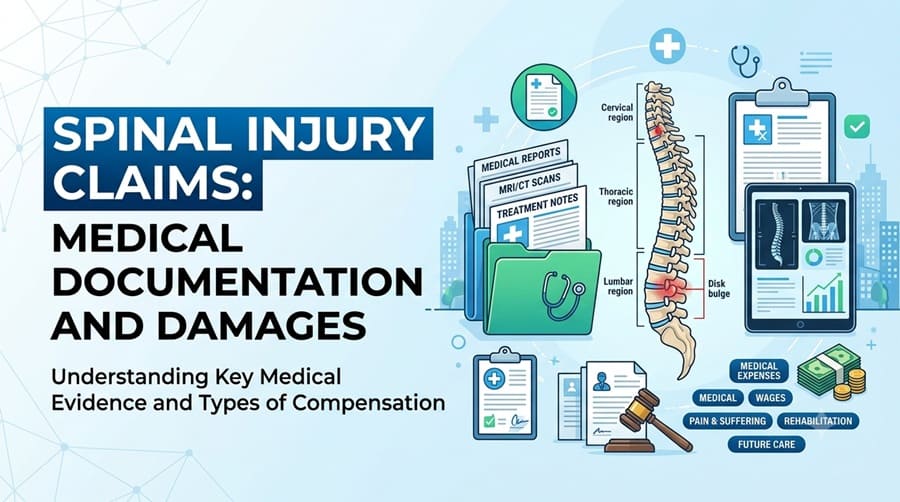
Medical documentation is the backbone of a spinal injury claim. Accurate, detailed records prove the injury’s severity, the treatment it required, and its lasting effect on the victim’s life. The core file typically includes emergency room reports, physician notes, diagnostic imaging (MRIs and X-rays), surgical reports, and rehabilitation therapy logs. Together, these records establish both how the injury occurred and what it will cost going forward.
Attorneys often advise clients to keep a personal injury journal recording pain levels, physical limitations, and treatment milestones. That record can be reinforced with testimony from treating physicians and specialists, who explain the injured person’s future medical needs and realistic recovery trajectory.
What to Collect
- Hospital admission records
- Surgical and procedure notes
- Physical therapy progress reports
- Prescription information and medication logs
- Psychological counseling documentation, if applicable
Documentation at this level does more than confirm the injury exists — it establishes the necessity and frequency of every medical intervention, which is the basis for calculating both current and future damages. Courts and insurers apply established principles when valuing these losses; Cornell’s Legal Information Institute offers a useful primer on how damages are categorized and proven.
Damages Recoverable in Denver Spinal Injury Cases
A spinal injury claimant in Denver may seek compensation across several categories. The goal of the law is to restore the injured person, as nearly as money can, to the position they held before the accident. Colorado personal injury law recognizes these recoverable losses:
Economic Damages
- Medical expenses, both current and anticipated future costs
- Physical therapy and rehabilitation
- Lost wages and diminished earning capacity
- Costs of assistive devices and necessary home or vehicle modifications
Non-Economic Damages
- Pain and suffering
- Emotional distress or psychological trauma
- Loss of enjoyment of life
Exemplary Damages
Where the liable party acted with fraud, malice, or willful and wanton conduct, Colorado law permits punitive damages to deter similar behavior.
Valuing the claim correctly requires evidence, not estimates. Life-care planners, vocational experts, and economists are often brought in to project long-term medical costs and wage losses — and one more Colorado rule matters here: under the state’s modified comparative negligence statute (C.R.S. § 13-21-111), a claimant’s recovery is reduced by their share of fault and barred entirely at 50% or more.
Steps to Strengthen a Spinal Injury Claim in Denver
A strong spinal injury claim combines early action, meticulous documentation, and sound legal strategy. Seek medical attention immediately, preserve all evidence from the scene, and avoid giving statements to insurance adjusters before getting advice — early recorded statements are routinely used to dispute later diagnoses.
The right preparation also means anticipating the defense. Insurers in spinal cases probe for gaps in treatment, pre-existing conditions, and inconsistencies between records and reported limitations. Consistent treatment and consistent records close those openings.
- Seek prompt and ongoing treatment for all injuries.
- Keep detailed records of all accident-related expenses and impacts.
- Document the injury’s effect on work, family, and daily life.
- Consult a Denver-based spinal injury attorney early, before speaking with an insurance adjuster.
A Look at How These Cases Play Out
A pattern like this comes up often in spinal injury claims: a claimant treats for a few weeks after a crash, feels well enough to stop, and then experiences a serious flare-up of symptoms months later. The insurer’s first move is to point to the treatment gap as evidence the later symptoms aren’t related to the original accident.
The gap itself usually isn’t fatal to the claim — what matters is whether the medical record can explain it. A treating physician’s note tying the flare-up back to the original injury, combined with a personal injury journal documenting symptoms during the gap, is often enough to keep the claim intact. Cases that fall apart tend to do so not because the injury wasn’t real, but because nothing on paper explained the gap when the insurer went looking for one.
This example reflects a pattern seen across spinal injury claims generally; details have been generalized and don’t describe a specific, identifiable case. Every case turns on its own facts.
Conclusion
Spinal injury claims in Denver demand diligence from day one. Complete medical documentation and a well-supported accounting of economic and non-economic damages form the backbone of a successful claim, and Colorado’s filing deadlines and comparative fault rules leave little room for delay. Claimants who understand the process — and who build the evidentiary record early — give themselves the strongest realistic chance at full financial recovery and long-term security. Consider speaking with a spinal cord injury attorney in Denver early in the process to help coordinate the medical and legal sides of the claim.
Authorities & Sources
- C.R.S. § 13-80-102 — General two-year statute of limitations for personal injury claims.
- C.R.S. § 13-80-101(1)(n) — Three-year statute of limitations for motor vehicle accident claims.
- C.R.S. § 13-21-111 — Colorado modified comparative negligence statute.
- NINDS — Spinal Cord Injury — National Institute of Neurological Disorders and Stroke.
- Justia — Spinal Cord and Back Injuries — Overview of spinal injury claims.
- Cornell LII — Damages — Legal Information Institute, Wex.
Legal information can change, and how a specific spinal injury claim is evaluated depends on the facts, medical evidence, and jurisdiction involved. This article is for general informational purposes and is not a substitute for legal advice about a specific case.