

By Find Attorneys Editorial Team | Last reviewed: October 22, 2026
The numbers at a glance
| Item | 2026 figure | Source |
| Minimum share capital (OÜ) | €0.01, paid in at registration | Invest in Estonia |
| State registration fee | €265 (online) | e-Residency help centre |
| Tax on distributed profits | 22% (22/78 of the net amount) | PwC tax summary |
| Standard VAT rate | 24% (since 1 July 2025) | Estonian Tax and Customs Board |
| VAT registration threshold | €40,000 of taxable supplies in a calendar year | Estonian Tax and Customs Board |
Estonia is one of the few EU countries where a founder who has never visited can form a company, sign its documents and file its reports entirely online. That reputation is deserved, but it has produced a lot of marketing copy that skips the parts that cause trouble later: the contact person rule, the share capital change in 2023, the tax changes of 2025, and the annual filings that get companies struck off.
This guide to Estonia company formation covers what you need to set up a private limited company (osaühing, or OÜ), what it costs, how long each step really takes, and the obligations that start the day the company is registered.
Is an OÜ the Right Vehicle?
The OÜ is the default choice for founders, freelancers and small holding structures. It has limited liability, can have a single shareholder, and needs at least one management board member, who does not have to live in Estonia. Larger ventures planning to raise public capital may need a public limited company (AS), which has higher capital requirements and a supervisory board.
An Estonian company is not automatically the right answer for every founder. Your home country may treat a company you manage from there as tax-resident locally, which can cancel out Estonia’s deferred-tax advantage. If you are comparing EU jurisdictions, it is worth reviewing alternatives such as incorporating in Cyprus with a tax adviser in your own country before you file.
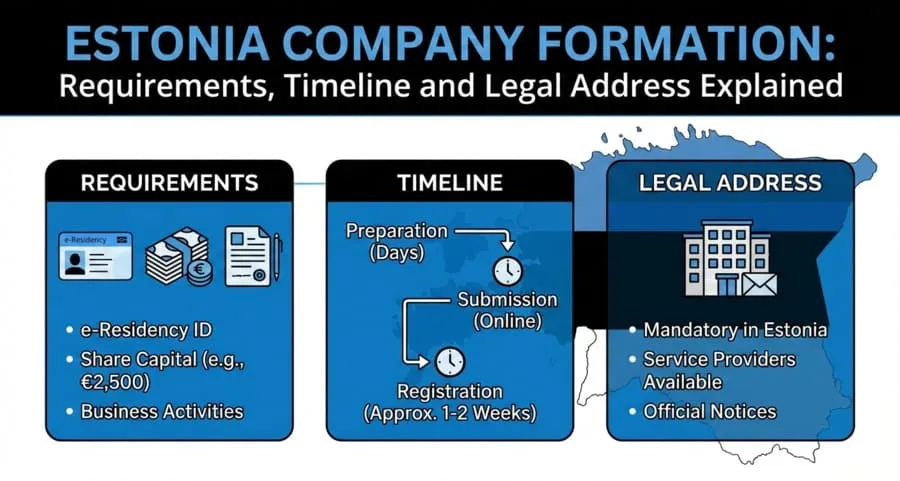
What You Need Before You File
- A unique company name that is distinguishable from existing entries in the Commercial Register.
- At least one shareholder and one management board member, who can be the same person.
- Articles of association. Online filings can use the standard articles provided in the portal.
- Share capital of at least €0.01. Since 1 February 2023, founders confirm at registration that their contributions have been made. The older option of registering a €2,500 company and deferring payment no longer applies to new companies.
- An address in Estonia for the company, and a contact person if the management board is abroad (see below).
- A way to sign digitally: an Estonian ID card, an e-Residency card, or a supported EU eID. Without one, you file through an Estonian notary.
The Legal Address and Contact Person Rules
Every Estonian company must have an address in Estonia, recorded in the Commercial Register. It is where official correspondence and procedural documents are sent, so it needs to be monitored, not just listed. Founders without premises in Estonia usually rent a legal address from a licensed service provider, which also scans and forwards mail.
The contact person rule is where older guides, including earlier versions of this one, often go wrong. Since an amendment to the Commercial Code took effect on 15 January 2018, a company must appoint a contact person whenever its management board is located outside Estonia, not only when it is outside the EU or EEA. The e-Residency programme’s explanation of the change sets out the details:
- The contact person must be a notary, an advocate or law firm, a sworn auditor or audit firm, a non-resident tax representative, or a licensed trust and company service provider.
- Documents delivered to the contact person count as delivered to the company.
- Where a contact person is appointed, their address serves as the company’s address.
- A board member, shareholder or procurator who lives in Estonia can act as the contact person instead.
Before choosing a provider, check its licence in the Financial Intelligence Unit’s register and read the contract terms on mail handling, scanning times and what happens if you stop paying. A lapsed contact person agreement leaves the company without a valid address, which the registrar can act on.
Registration Step by Step
The process of registering a company in Estonia online follows the same sequence for most founders. Realistic timings are shown for each step.
- Get a digital ID (if you do not have one). e-Residency applications usually take several weeks, including collecting the card in person at a pickup point.
- Arrange the address and contact person. Have the provider’s consent ready; it is filed with your application. Allow one to three days.
- File in the e-Business Register portal. Enter company details, shareholders and board members, and upload any required consents. Then pay the €265 state fee. Filing takes about an hour.
- Wait for the registrar. Complete online applications are usually processed within a few working days. Notary filings for founders without digital ID typically take one to two weeks.
- Open a business account. Traditional Estonian banks often require an in-person visit and a local business connection. Many e-resident companies use licensed payment institutions instead. Expect one to four weeks, depending on your business profile.
- Register for VAT if needed. You must apply within three working days of exceeding €40,000 in taxable supplies in a calendar year, and you can register voluntarily earlier.
How the Company Is Taxed
Estonia taxes companies on distributions, not on profit as it is earned. Retained and reinvested profits are not taxed at company level. When profit is paid out as a dividend, the company pays 22% calculated as 22/78 of the net dividend. The lower 14% rate that used to apply to regular dividends was abolished from 2025.
The government scrapped a planned 2% tax on corporate profits and a temporary “security tax” in May 2025, but kept the VAT increase to 24% that took effect on 1 July 2025. Hidden profit distributions, such as personal expenses paid by the company or non-business loans to shareholders, are taxed as if they were dividends.
Obligations From Day One
- Bookkeeping under the Estonian Accounting Act, usually through an accountant familiar with e-resident companies.
- The annual report, filed through the e-Business Register within six months of the end of the financial year (by 30 June for calendar-year companies). Persistent failure to file can lead to fines and, eventually, deletion from the register.
- Beneficial owner data, which must be entered in the register and kept current. Failing to submit or update it can bring fines of up to €32,000 for a company.
- Monthly tax returns for any month in which the company pays salaries or makes distributions, and VAT returns once registered.
- A valid address and contact person for as long as the board is outside Estonia.
When a Board Moved Abroad and the Address Lapsed
The following is an illustrative composite based on situations commonly raised with corporate service providers. It is not a single client’s case.
A software consultant formed an OÜ while living in Tallinn, so the company needed no contact person and used his apartment as its address. Two years later he moved to Lisbon and changed the board member’s address in the register, but did not appoint a contact person or change the company’s Estonian address. Official mail went to a flat he no longer rented, and the company missed its annual report deadline after a reminder never reached him.
Fixing it took an address and contact person agreement with a licensed provider, a register amendment with its €25 fee, and a late annual report before the registrar moved further. The lesson: when a board member moves abroad, update the company’s address and contact person at the same time as the board member’s details.
Frequently Asked Questions
Do I need e-Residency to form an Estonian company?
No. You can file through an Estonian notary, in person or in some cases remotely, or use another supported EU eID. e-Residency makes online filing and later administration much easier.
What is the minimum share capital for an OÜ?
€0.01 for companies formed since 1 February 2023, contributed at registration. Many founders still choose a higher figure so the company looks credible to banks and partners.
Does an Estonian company need a local director?
No. Board members can live anywhere, but if the board is located outside Estonia, the company must appoint a licensed contact person in Estonia.
Is Estonian company profit really tax-free?
Retained profit is not taxed at company level. Distributions are taxed at 22% (22/78 of the net amount). Your own country may also tax the company or the dividend, so get advice where you live.
Disclaimer
This article provides general information about Estonian company formation as of the review date above and is not legal or tax advice. Fees, tax rates and registry procedures change, and your obligations also depend on where you live and manage the company. Confirm current requirements with the Estonian authorities or a qualified adviser before you register. Find Attorneys may receive compensation from some service providers linked on this site.