

By Erin L. Thompson, Esq. | Founder & Managing Attorney at The Law Office of Erin L. Thompson, LLC
Having a child outside of marriage doesn’t mean giving up parental rights — but in New Jersey, unmarried mothers and fathers don’t start on equal legal footing the way married parents do. Understanding how custody actually works for unmarried parents can save families a lot of confusion, and in some cases, a lot of heartache.
Here’s a clear breakdown of how New Jersey law treats unmarried parents when it comes to custody, paternity, and parenting time.
Key Takeaways
- An unmarried mother automatically has sole legal and physical custody at birth — the father has no custody rights until paternity is established.
- Paternity is established either by signing a Certificate of Parentage (COP) or through a court-ordered paternity action, and can be done any time before the child turns 23.
- Once paternity is established, unmarried parents have the same custody rights as married or divorcing parents — decisions are based on the child’s best interests, not the parents’ marital status.
- Unmarried parents’ custody, support, and parenting time matters are handled through a non-dissolution “FD” case, not a divorce.
- Child support is owed regardless of the custody arrangement and cannot be waived by informal agreement.
The Default Rule: Mothers Start With Sole Custody
When a child is born to unmarried parents in New Jersey, the mother is automatically recognized as the child’s sole legal and physical custodian. She’s treated as the child’s natural guardian, with full authority to make decisions about the child’s education, medical care, residence, and general upbringing — no court order required.
The father, by contrast, has no automatic custodial rights. Until paternity is legally established, he has no legal standing to seek custody or parenting time, and technically no enforceable right to see the child, even if he is biologically certain he’s the father.
This often surprises new fathers. Being named informally as “dad,” living with the child, or even being present at the birth doesn’t, by itself, create legal fatherhood in New Jersey. That requires a separate legal step: establishing paternity.
Step One: Establishing Paternity
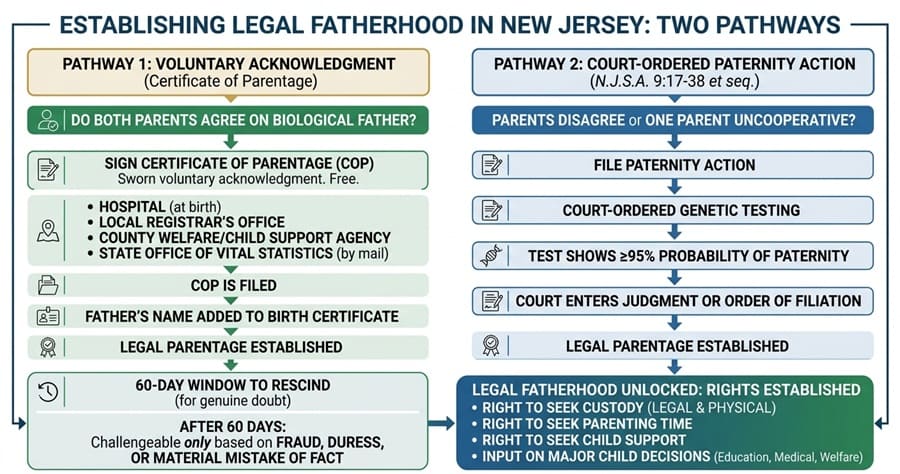
Before an unmarried father can pursue custody or parenting time, paternity must be legally established. New Jersey offers two main paths:
1. Certificate of Parentage (COP)
This is the fastest and most common route. If both parents agree on who the biological father is, they can sign a Certificate of Parentage — a sworn voluntary acknowledgment of paternity. It’s free and can be completed:
- At the hospital at the time of birth
- Afterward at the local municipal registrar’s office
- At the county welfare or child support agency
- By mail through the State Office of Vital Statistics and Registry
Once filed, the father’s name is added to the birth certificate and he becomes the child’s legal parent. Either parent has 60 days after signing to rescind it if there’s genuine doubt about paternity. After that window, the COP can generally only be challenged based on fraud, duress, or a material mistake of fact.
For official guidance and the current forms, see the New Jersey Judiciary’s Child Support and Custody self-help page.
2. Court-Ordered Paternity Action
If the parents disagree about who the father is, or one parent won’t cooperate, either party can file a paternity action under New Jersey’s Parentage Act (N.J.S.A. 9:17-38 et seq.). The court can order genetic testing, and a man is typically deemed the legal father if testing shows at least a 95% probability of paternity. The court then enters a Judgment or Order of Filiation establishing legal fatherhood.
Paternity can be established any time before the child’s 23rd birthday, but doing it early matters — it’s what unlocks a father’s right to seek custody, parenting time, and a say in the child’s upbringing. It’s also what allows either parent to request child support formally.
Once Paternity Is Established: Equal Legal Footing
Here’s the part that surprises a lot of people: once paternity is legally established, New Jersey law does not treat unmarried parents any differently than married ones. Custody, parenting time, and support are all decided using the same standards that apply in a divorce.
Custody in New Jersey generally breaks down into two categories:
- Legal custody — the right to make major decisions about the child’s health, education, and welfare
- Physical custody — where the child actually lives day to day
Either can be awarded solely to one parent or shared jointly. Many arrangements involve joint legal custody (both parents weigh in on major decisions) paired with one parent designated as the primary residential parent, though true 50/50 physical custody arrangements are increasingly common as well.
How Courts Decide Custody: Best Interests of the Child
If unmarried parents can’t agree on a custody arrangement, a New Jersey family court will decide based on the “best interests of the child” standard set out in N.J.S.A. 9:2-4(c). Judges consider factors such as:
- The parents’ ability to communicate and cooperate on issues involving the child
- Each parent’s willingness to accept custody and any history of unwillingness to allow parenting time absent a good reason
- The child’s relationship with each parent and any siblings
- The child’s own preference, when the child is of sufficient age and capacity to reason
- Each parent’s fitness, and any history of domestic violence
- The stability of the home environment
- The geographic proximity of the parents’ homes
- Each parent’s employment responsibilities and the age and needs of the child
No single factor controls, and courts generally start from the premise that a child benefits from a meaningful relationship with both parents whenever that’s safe and workable.
Where the Case Gets Filed: Non-Dissolution “FD” Cases
Since unmarried parents were never married, there’s no divorce to file for. Instead, New Jersey courts use a separate track called a non-dissolution case, commonly referred to as an “FD” docket. This process is used to formally establish paternity, custody, parenting time, and child support for parents who were never married to each other.
An FD case starts with a complaint filed in the Family Division of the county where either parent lives. Unlike divorce cases, these matters are often handled initially with the help of a court staff member — a hearing officer or panel — rather than going straight before a judge. If the parents can’t reach an agreement, the matter proceeds to a judge for a formal ruling.
The New Jersey Judiciary provides step-by-step instructions and current forms on its Filing a Non-Dissolution Case page, and the full packet of FD-related forms is available in the NJ Courts forms catalog.
Child Support Is a Separate (and Non-Negotiable) Issue
Regardless of the custody arrangement, both unmarried parents have a legal obligation to financially support their child. Child support in New Jersey is calculated using the state’s Child Support Guidelines, which weigh both parents’ incomes, the parenting time arrangement, and the child’s needs, including healthcare and childcare costs.
A few points worth knowing:
- Support cannot be waived by informal agreement between the parents — it’s the child’s right, not something the parents can bargain away.
- Support is owed regardless of whether the paying parent has parenting time.
- Either parent can request a modification later if there’s a significant change in income or circumstances.
- Child support cannot be requested until paternity has been legally established, which is one more reason to complete that step early.
Practical Steps for Unmarried Parents in New Jersey
- Establish paternity as early as possible — ideally with a Certificate of Parentage at the hospital, or promptly afterward.
- Put agreements in writing. Even an informal custody or parenting time arrangement should eventually be memorialized and, ideally, submitted to the court so it’s enforceable.
- Keep records. Documentation of caregiving, financial support, and communication can matter significantly if a custody dispute arises later.
- Don’t assume “no contact” without a court order is safe. Denying an established legal parent access to a child, or removing a child without agreement, can create serious legal problems for either parent.
- Talk to a family law attorney early, especially if paternity is disputed, if there are safety concerns, or if the other parent is unwilling to cooperate.
Frequently Asked Questions
Does an unmarried father have automatic custody rights in NJ?
No. An unmarried mother automatically holds sole physical and legal custody until paternity is legally established. Until that step is completed, the father has no enforceable right to custody or parenting time.
What is an FD docket in New Jersey family court?
An FD docket is a non-dissolution court track used for unmarried parents (and certain other adults) to establish paternity, custody, parenting time, and child support without filing for divorce.
How long does a father have to establish paternity in New Jersey?
Paternity can be legally established at any point before the child reaches 23 years of age, though establishing it early gives the father earlier access to custody and parenting time rights.
The Bottom Line
Unmarried parents in New Jersey have real, enforceable custody rights — but fathers, in particular, have to take an affirmative legal step (establishing paternity) before those rights exist on paper. Once that’s done, the law treats unmarried parents the same as divorcing ones: custody and parenting time are decided based on what’s best for the child, not on the parents’ marital history.
If you’re an unmarried parent navigating custody, paternity, or parenting time questions in New Jersey, the smartest first move is usually a conversation with a family law attorney who can walk you through your specific situation and help you avoid costly missteps.
This article is for general informational purposes and does not constitute legal advice. Every family law situation is different — consult a licensed New Jersey family law attorney about your specific circumstances.